
Pythagorio of Samos

🏛️ Pythagoreio, Samos – The Living City of Ancient Samos and Pythagoras
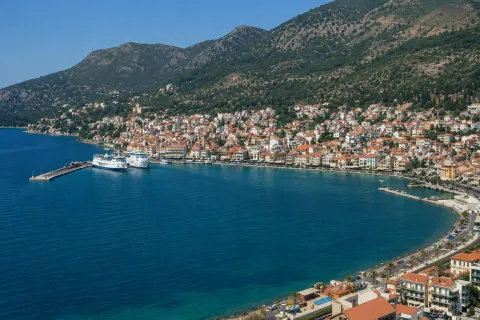
Pythagoreio is a historic seaside town on the southeastern coast of Samos, built on the site of the ancient city of Samos. The modern settlement extends around the ancient harbour, in a place where archaeological monuments, more recent historic buildings, traditional neighbourhoods and a lively waterfront coexist.
Together with Heraion, located approximately 6 kilometres to the west, Pythagoreio has been included on the UNESCO World Heritage List since 1992. The protected area includes the fortified ancient city, the harbour, the Tunnel of Eupalinos and important remains from the Greek and Roman periods.
Administratively, Pythagoreio is the historic seat of the Municipality of Eastern Samos and the administrative seat of the Municipal Community of Pythagoreio. It belongs to the Municipal Unit of Pythagoreio, the Regional Unit of Samos and the North Aegean Region. According to the 2021 census, the settlement has 1,277 permanent residents, while the total population of the Municipal Community is 1,538.
📍 Location and Character
Pythagoreio lies on the southeastern side of Samos, approximately 14.5 kilometres from Samos Town and about 3 kilometres from Samos International Airport “Aristarchos of Samos”. Its proximity to Chora, Potokaki, Heraion and the airport makes it one of the most easily accessible destinations on the island.
The settlement extends around the harbour and continues towards the low hills where the Tower of Lykourgos Logothetis, Panagia Spiliani, the ancient theatre and the Tunnel of Eupalinos are located.
The waterfront is the busiest part of Pythagoreio, while the inner streets preserve low traditional houses, courtyards, older shops and small neighbourhoods with a quieter, more residential character.
🏺 The Ancient City of Samos
The modern settlement stands on the ancient city of Samos. Archaeological discoveries show that the area was inhabited from very early periods, while its most significant development began after the arrival of Ionian settlers during the 10th century BC.
The ancient city was organised around its sheltered harbour and developed into an important commercial, naval and cultural centre of the eastern Aegean. Its location opposite the coast of Asia Minor facilitated communication, trade and relations with other parts of the Greek and Mediterranean worlds.
Remains of the ancient city can still be found within and around the modern settlement, creating the distinctive character of an inhabited town built upon successive layers of history.
👑 The Era of Polycrates
Ancient Samos reached its greatest prosperity during the 6th century BC, particularly under the rule of the tyrant Polycrates, approximately between 535 and 522 BC.
At that time, Samos became one of the most important naval and commercial powers in the Mediterranean, with trading posts and connections extending from Asia Minor and Thrace to the western Mediterranean. The island also achieved major advances in architecture, sculpture, engineering and the organisation of public works.
The most important projects of this period included the Tunnel of Eupalinos, the powerful walls of Polycrates, the great harbour and the monumental works at Heraion.
📐 Pythagoras and the Intellectual Heritage
Ancient Samos was the birthplace of Pythagoras, one of the most important mathematicians and philosophers of antiquity.
Pythagoras was born during the 6th century BC and connected mathematical research with philosophy, music, astronomy and the search for a harmonious order within the universe. Pythagorean thought had a decisive influence on the development of Greek philosophy and scientific thinking.
Samos is also associated with important figures such as the astronomer Aristarchos, who proposed an early heliocentric model, the philosopher Epicurus, and the architects and sculptors Rhoikos and Theodoros.
🏛️ Hellenistic, Roman and Byzantine Periods
The city remained an important commercial and naval centre during the Hellenistic and Roman periods. Its harbour was used as a naval base, while houses, villas, public buildings, baths and places of worship were constructed throughout the city.
Settlement continued during the Byzantine period, although raids and increasing insecurity along the coast gradually led much of the population towards safer locations in the island’s interior.
A Byzantine fortification was established on Castle Hill, incorporating earlier ancient remains. Parts of this fortified site were later integrated into the structures built by Lykourgos Logothetis.
⚓ From Tigani to Modern Pythagoreio
The modern coastal settlement developed mainly during the 19th century, when the harbour was reconstructed and organised over the remains of the ancient port facilities.
The settlement was formerly known as “Tigani”. The origin of the name has traditionally been associated with the curved, frying-pan-like outline of the harbour, although other interpretations have also been proposed.
In 1955, Tigani was officially renamed Pythagoreio in honour of Pythagoras. The administrative renaming of both the settlement and the community was published in Government Gazette 157A on 21 June 1955.
🏛️ Administrative Development
The Community of Tigani was officially established in 1918, with the settlement as its administrative seat. Following the renaming in 1955, it became the Community of Pythagoreio.
In 1981, the settlements of Karpovoulos and Nea Poli were incorporated into the community, while in 1989 the community was elevated to the Municipality of Pythagoreio. The settlement of Pountes was officially recognised and incorporated in 1991.
Under the administrative reform of 1997, the expanded Municipality of Pythagoreio was created and included many villages from southeastern and central Samos. In 2010, it became part of the unified Municipality of Samos, and since 2019 Pythagoreio has belonged to the Municipality of Eastern Samos, of which it is the historic seat.
👥 The Municipal Community of Pythagoreio
The Municipal Community of Pythagoreio includes four officially recognised settlements:
✅ Pythagoreio: 1,277 residents
✅ Karpovoulos: 38 residents
✅ Nea Poli: 88 residents
✅ Pountes: 135 residents
According to the 2021 census, the total permanent population of the community is 1,538 residents.
🌍 UNESCO World Heritage Site
“Pythagoreion and Heraion of Samos” was inscribed on the UNESCO World Heritage List in 1992.
The designation was based on the exceptional technological, architectural and cultural development of ancient Samos, as well as its importance as a leading naval and commercial power during the 6th century BC.
The protected zone at Pythagoreio includes the ancient city within its fortification walls and a surrounding buffer zone, while Heraion forms a separate but closely connected part of the same World Heritage property.
⛏️ The Tunnel of Eupalinos
The Tunnel of Eupalinos is one of the most important engineering achievements of antiquity. It was constructed during the 6th century BC by Eupalinos of Megara to carry water from the Agiades spring to the ancient city.
The underground tunnel is 1,036 metres long and was excavated simultaneously from both sides of the mountain. The two teams met inside with remarkably little deviation, demonstrating the advanced geometric and surveying knowledge of the period.
Herodotus described it as a “two-mouthed tunnel”, and today it is an accessible archaeological site. Entry into the tunnel is permitted only through the organised visitor routes and in accordance with the site’s safety instructions.
🧱 The Walls of Polycrates
The ancient city was surrounded by a powerful fortification wall with a total length of approximately 6.4 kilometres. The wall protected the harbour, the inhabited areas and the hills surrounding the city.
Sections of the ancient fortifications survive at different points around Pythagoreio. Some are visible near roads and modern houses, while others are located on the slopes surrounding the archaeological site.
⚓ The Ancient Harbour and the Great Mole
The harbour of ancient Samos was one of the most important engineering works of the era of Polycrates. The natural bay was organised with breakwaters, quays and separate areas for commercial and military activities.
Its most significant structure was the “embankment in the sea”, a large ancient mole approximately 360 metres long. Modern harbour structures were developed over and around the ancient remains during the 19th century.
The present harbour remains the centre of Pythagoreio’s social and economic life, accommodating fishing boats, sailing vessels, excursion boats and seasonal passenger connections.
🏺 The Archaeological Museum of Pythagoreio
The Archaeological Museum of Pythagoreio is located in the centre of the settlement, next to visible remains of the ancient city.
Its collections display approximately 3,000 objects from the ancient city and the countryside of Samos. These include sculptures, pottery, coins, inscriptions, architectural elements and objects from everyday life.
The exhibition covers an extensive period, from prehistory and the Archaic era to the Hellenistic and Roman periods, offering a comprehensive overview of the development of the ancient city.
🏟️ The Ancient Theatre
The ancient theatre is located on the slopes above Pythagoreio, near Panagia Spiliani and the Tunnel of Eupalinos.
Although the monument has not survived in its original form, the site has been restored for cultural use and hosts selected musical performances and events.
Every August, it hosts the Samos Young Artists Festival, an international cultural institution established in 2010, presenting young and established musicians from Greece and abroad.
🏰 The Tower of Lykourgos Logothetis
The Tower of Lykourgos Logothetis stands on the low hill west of the harbour. It was built approximately between 1824 and 1827 by Georgios Paplomatas, known as Lykourgos Logothetis, the leader of the Samian Revolution.
The tower was constructed over sections of an earlier Byzantine castle and served as a fortress, headquarters and residence during the Greek Revolution.
Today, it houses an exhibition dedicated to the life and activities of Lykourgos Logothetis, together with finds from the Byzantine castle, the old settlement of Tigani and other Byzantine sites on Samos.
⛪ The Church of the Transfiguration of the Saviour
The historic Church of the Transfiguration of the Saviour stands next to the Tower of Lykourgos Logothetis.
The church was built in 1831 or shortly afterwards on the initiative of Lykourgos Logothetis, in memory of the victory of the Greek naval forces over the Ottoman fleet in the Mykale Strait in August 1824.
The anniversary became associated with the feast of the Transfiguration of the Saviour on 6 August and gained particular importance throughout Samos. The building is not a monastery, but a historic church closely connected with the island’s modern revolutionary history.
🕯️ Panagia Spiliani
Panagia Spiliani is located above Pythagoreio, on a hill offering panoramic views over the town, the airport and the sea.
The small church is built within a natural cave that was used as a place of worship and religious retreat during the Byzantine period. The area is also associated with older local traditions and earlier religious use.
Access is possible by road or by a walking route from Pythagoreio. The cave interior is humid and the floor can be slippery, so suitable footwear and caution are required.
🗿 The Statue of Pythagoras
The statue of Pythagoras stands on the eastern side of the harbour, along the breakwater.
The sculpture presents the philosopher standing beside a large right-angled triangle representing the Pythagorean theorem. Its position at the end of the harbour creates one of the town’s most recognisable landmarks, with views towards the sea and waterfront.
The statue is situated at the harbour and not at the entrance to the Castle of Lykourgos Logothetis.
🏘️ The Modern Town
Modern Pythagoreio is one of the most important tourist and cultural destinations on Samos.
Restaurants, cafés, shops, tourist services and accommodation operate along the waterfront. Behind the promenade, a network of narrow streets contains homes, small squares and neighbourhoods that preserve more of the town’s everyday residential character.
Despite the intense tourist activity of the summer months, Pythagoreio remains a permanently inhabited town with schools, public services, commercial activity and an active local community.
🎨 Cultural Life
The cultural activity of Pythagoreio is closely connected with its archaeological and historical identity.
The ancient theatre hosts the international Samos Young Artists Festival, while Art Space Pythagorion presents temporary exhibitions and contemporary art projects. The programme changes every year and includes music, visual arts, lectures and cultural meetings.
During the summer, concerts and local events also take place at the harbour, in the squares and at various locations around the settlement.
🎉 The 6 August Celebration
The most important historical and religious commemoration in Pythagoreio takes place on 6 August, the feast of the Transfiguration of the Saviour.
The celebration is connected with the victory of the Greek fleet at the Battle of Samos in August 1824 and the defence of the island against the Ottoman attack.
Religious services at the historic church, official ceremonies and cultural events attract residents and visitors, preserving one of the most important memories of modern Samian history.
🏖️ Beaches and Sea Activities
At the eastern edge of the settlement lies the small Remataki Beach, offering direct access to the sea without the need for a vehicle.
West of Pythagoreio extends Potokaki Beach, one of the largest organised beaches in southern Samos. The area is easily accessible and located close to the airport.
During the summer season, boat trips depart from the harbour towards Samiopoula and the southern coastline of the island, together with other routes that depend on the seasonal schedules of local operators.
🌿 What to See
During your visit to Pythagoreio, take time to discover:
✅ The Tunnel of Eupalinos
✅ The Archaeological Museum of Pythagoreio
✅ The remains of the ancient city of Samos
✅ The surviving sections of the Walls of Polycrates
✅ The ancient harbour and the great mole
✅ The Tower of Lykourgos Logothetis
✅ The Church of the Transfiguration of the Saviour
✅ Panagia Spiliani
✅ The ancient theatre
✅ The statue of Pythagoras at the harbour
✅ The waterfront promenade and inner streets
✅ Remataki Beach
✅ Nearby Heraion and the ancient Sacred Way
🚶 The Visitor Experience
Pythagoreio can largely be explored on foot. A visit can begin at the harbour and the statue of Pythagoras, continue to the Archaeological Museum and the remains of the ancient city, and conclude on Castle Hill.
The Tunnel of Eupalinos, Panagia Spiliani and the ancient theatre require a separate journey towards the slopes above the settlement.
Approximately two hours are needed for a basic walk around the harbour and historic centre. For a more complete visit including the museum, the Tower of Lykourgos Logothetis and the Tunnel of Eupalinos, it is preferable to allow half a day or a full day.
📆 When to Visit
Spring: Temperatures are suitable for exploring archaeological sites and visitor numbers remain relatively low.
Summer: Pythagoreio is at its liveliest, with sea activities, cultural events and intense activity around the harbour.
6 August: Events take place for the Transfiguration of the Saviour and the Battle of Samos.
August: The ancient theatre hosts the Samos Young Artists Festival and other cultural events.
Autumn: The sea often remains suitable for swimming, while the archaeological sites are quieter.
Winter: The town remains permanently inhabited, although many tourism-related businesses operate on reduced hours or remain closed.
🧭 How to Get There
Pythagoreio is connected by paved road with Samos Town, Chora, Heraion and the other villages of the Municipal Unit of Pythagoreio.
The road distance from Samos Town is approximately 14.5 kilometres, while the airport is about 3 kilometres away. Access is possible by car, taxi and local bus services.
Traffic within the settlement increases during the summer months. Parking areas are available near the entrances to the town, and continuing the visit on foot is the most practical option.
ℹ️ Useful Information
✅ Administrative community: Municipal Community of Pythagoreio
✅ Municipal unit: Pythagoreio
✅ Municipality: Eastern Samos
✅ Administrative role: Historic seat of the Municipality of Eastern Samos
✅ Settlement population in 2021: 1,277 residents
✅ Municipal Community population in 2021: 1,538 residents
✅ Community settlements: Pythagoreio, Karpovoulos, Nea Poli and Pountes
✅ Distance from Samos Town: Approximately 14.5 kilometres
✅ Distance from the airport: Approximately 3 kilometres
✅ Distance from Heraion: Approximately 6 kilometres
✅ Postal code: 83103
✅ GPS coordinates: 37.6908, 26.9433
✅ Former name: Tigani
✅ Official renaming: 1955
✅ UNESCO: Since 1992, together with Heraion
✅ Main religious celebration: Transfiguration of the Saviour, 6 August
✅ Suggested visiting time: From 2 hours to a full day
✅ Ideal for: Archaeology, history, museums, culture, photography, waterfront walks and swimming


Add new comment