
Spatharaioi of Samos

🏞️ Spatharaioi, Samos – The Balcony of the Aegean
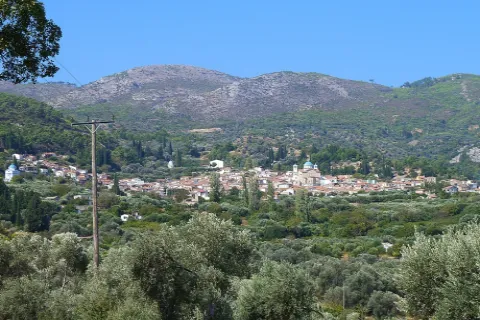
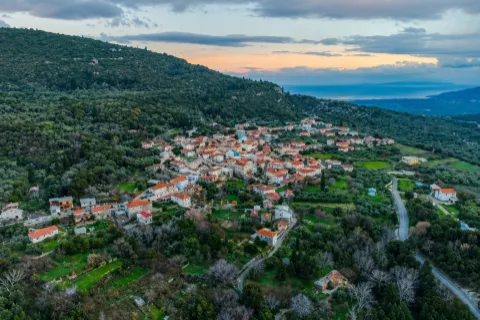
Spatharaioi is a mountain village in the southern part of Samos, built on the western slopes of Mount Bournias at an altitude of approximately 580 metres. It is one of the highest permanently inhabited villages on the island and is known for its panoramic views across southwestern Samos and the open Aegean Sea.
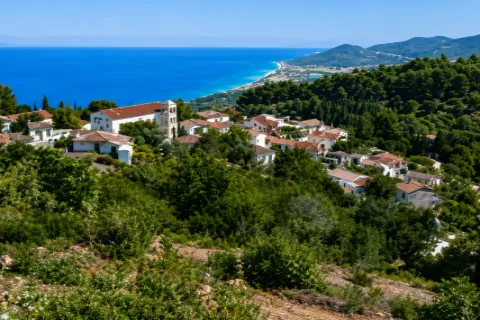
When visibility is clear, the southwestern coastline of Samos, Mount Kerkis, the Fournoi island group, Ikaria and islands of the northern Dodecanese can be seen from the village. This wide and impressive panorama has earned Spatharaioi the nickname “the Balcony of the Aegean”.
Administratively, Spatharaioi is the seat of the Municipal Community of Spatharaioi, which belongs to the Municipal Unit of Pythagoreio, the Municipality of Eastern Samos, the Regional Unit of Samos and the North Aegean Region. According to the 2021 census, the village has 156 permanent residents, while the entire Municipal Community has a total population of 228.
📍 Location and Character
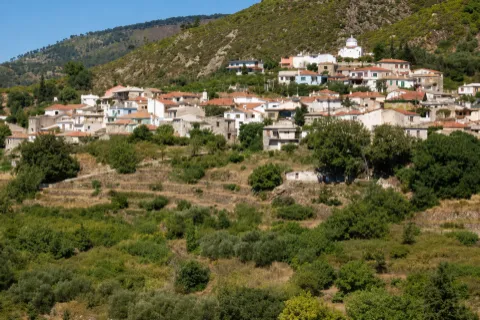
The village occupies a privileged position above the southern and southwestern coasts of Samos. Its homes follow the steep slope of the mountain, forming neighbourhoods at different levels, with views appearing between tiled roofs, narrow lanes and traditional courtyards.
Its mountainous location provides cooler conditions than the coastal areas, particularly during summer afternoons. Olive groves, cultivated plots, vineyards, fruit trees and areas of Mediterranean vegetation extend around the settlement.
📜 History and the Origin of the Village Name
Several different traditions have been recorded concerning the origin of the name “Spatharaioi”. According to one account, the first settler was a priest named Spathas, who established himself in the area together with his large family.
A second version connects the foundation of the village with a man bearing the Byzantine title of Spatharios, who arrived from Constantinople during the early 18th century. A third theory suggests that the first residents came from the village of Spathari in northern Evia and transferred the name of their place of origin to Samos.
The location of the village, the presence of old churches and the remains of earlier habitation in the wider area connect Spatharaioi with the long historical development of southern Samos.
🏛️ Administrative Development
The Community of Spatharaioi was officially established in 1918, with the mountain village as its administrative seat and the islet of Samiopoula included within its territory.
Limnonaki was officially recognised and incorporated into the community in 1971, Kyrgianni in 1981 and the settlements of Kalogeriko, Vergi, Zefyros, Metochi, Apostolos Pavlos and Sykia in 1991. The settlement of Zefyros was officially renamed Avanti in 2001.
In 1997, the community became part of the Municipality of Pythagoreio. In 2010, it was incorporated into the unified Municipality of Samos and, since 2019, it has belonged to the Municipality of Eastern Samos.
👥 The Municipal Community of Spatharaioi
The Municipal Community of Spatharaioi includes the mountain village and the smaller settlements that developed along the slopes and southern coastline of the area:
✅ Spatharaioi
✅ Avanti
✅ Apostolos Pavlos
✅ Vergi
✅ Kalogeriko
✅ Kyrgianni
✅ Limnonaki
✅ Metochi
✅ Sykia
✅ The islet of Samiopoula
These settlements connect the mountainous centre of the community with the sea, small beaches, olive groves and agricultural land of southern Samos. The 2021 census recorded a total of 228 permanent residents throughout the Municipal Community.
⛪ The Church of the Taxiarches
Beside the central square stands the stone-built Church of the Taxiarches, the principal religious and architectural landmark of the village.
The church is dedicated to the Archangels Michael and Gabriel and forms the centre of ecclesiastical life in Spatharaioi. The Synaxis of the Archangels and the other Bodiless Powers is celebrated on 8 November with religious services and local events.
Smaller chapels dedicated to the Ascension, Profitis Ilias, Agios Panteleimon, Agia Paraskevi, the Three Hierarchs, the Holy Apostles and Agios Fanourios are also found throughout the wider area. On Samiopoula stand the churches of Agia Pelagia and the Ascension of the Saviour.
🌳 The Square with the Plane Tree and Jasmine
The central square is the heart of the village and one of the most distinctive places in Spatharaioi. The large plane tree provides shade during the summer months, while the old jasmine plant is a recognisable feature of the square.
The Church of the Taxiarches, traditional buildings and local gathering places surround the square. It hosts festivals, cultural events and the Carnival custom known as the Kadis.
🚰 The Fountains and Old Washhouses
Traditional fountains and old public washhouses survive near the historic centre of the village. Before the development of an organised water supply network, these facilities served the daily needs of the residents, providing water and places for washing clothes.
The fountains and washhouses also functioned as important social meeting points, where news was exchanged and communication between neighbourhoods was maintained. Together with the stone-paved lanes and traditional houses, they form an essential part of the village’s historic character.
🏡 Traditional Architecture and Neighbourhoods
The historic centre of Spatharaioi includes stone-built and plastered houses, tiled roofs, wooden window frames, external staircases, small balconies and courtyards filled with flowers and grapevines.
The narrow lanes follow the steep gradient of the terrain, creating small passages between the homes. Older and newer houses coexist, while several traditional buildings have been restored with respect for the main characteristics of Samian architecture.
🫒 The Village of Olive Groves
Olive cultivation is the most important traditional agricultural activity of the area. Extensive olive groves and cultivated fields stretch from the slopes surrounding the village towards the coastline and the boundary with Skoureika.
Olive oil has long played a decisive role in the local economy and remains one of the community’s principal products. Vineyards, fruit trees, vegetables and small family gardens are also cultivated.
The stone terraces supporting the soil on the slopes reflect the long-standing efforts of the residents to cultivate the mountainous terrain and protect their crops.
🎭 The Carnival Custom of the Kadis
The custom of the Kadis is one of the most important cultural traditions of Spatharaioi and is revived on the final Sunday of Carnival.
The Kadis appears as a satirical representation of the Ottoman judge and tax collector. Accompanied by costumed participants, he arrives in the village and establishes an improvised court in the square, where incidents from everyday life, local events and current affairs are “tried” with humour.
Sentences, symbolic fines, satirical sketches and improvisation create a popular theatrical performance with strong participation from the residents. The event is supported by the Cultural Association of Spatharaioi and attracts visitors from across Samos.
🎉 Festivals and Cultural Life
On 15 August, the village hosts its major summer festival dedicated to the Dormition of the Virgin Mary, with music, dancing, food and the participation of residents and visitors.
On 8 November, the Taxiarches, the patron saints of the village, are celebrated with a religious service and local events. These two celebrations are important gathering occasions for residents, people who have moved away and families who maintain strong connections with Spatharaioi.
🏝️ The Southern Coast and Samiopoula
Rural roads descend from the mountain village towards the small coastal settlements of the community. The coastline includes small coves, rocky sections and beaches with clear water, away from large-scale tourist development.
Limnonaki is traditionally regarded as the village’s coastal outlet. Opposite the southern shore lies the small islet of Samiopoula, which belongs administratively to the Municipal Community of Spatharaioi.
Samiopoula covers an area of approximately one square kilometre and is characterised by low vegetation, small beaches and historic chapels.
🌿 What to See
During your visit to Spatharaioi, take time to discover:
✅ The central square with its plane tree and jasmine
✅ The stone-built Church of the Taxiarches
✅ The traditional houses and narrow stone-paved lanes
✅ The old fountains and public washhouses
✅ The courtyards with grapevines and flowers
✅ The olive groves and stone terraces
✅ The views towards Mount Kerkis and the southwestern coastline
✅ The horizon towards Fournoi, Ikaria and the Dodecanese
✅ The routes towards Pyrgos, Pagondas and the southern coast
🚶 The Visitor Experience
A visit to Spatharaioi combines traditional architecture, local history and some of the most impressive views in southern Samos.
Exploration can begin at the central square and continue through the stone-paved lanes, fountains and historic neighbourhoods. The steep roads require comfortable footwear, but even short walks reward visitors with changing views of the village and the Aegean Sea.
Approximately 60 to 90 minutes are recommended for a relaxed visit to the main points of interest.
📆 When to Visit
Spring: The landscape is lush and green, temperatures are mild and visibility is often excellent.
Summer: The altitude provides cooler conditions than the coast. Morning and late afternoon visits are recommended.
15 August: The major summer festival dedicated to the Virgin Mary takes place.
Autumn: The harvest season highlights the agricultural character and extensive olive groves of the area.
8 November: The Taxiarches, the patron saints of the village, are celebrated.
Carnival: The satirical custom of the Kadis is revived on the final Sunday of Carnival.
🧭 How to Get There
The main access route begins in Pyrgos, following the paved mountain road towards Spatharaioi and Pagondas. The road passes through olive groves and slopes with open views and includes several bends.
Spatharaioi lies approximately 21 kilometres from Pythagoreio, 35 kilometres from Samos Town, 25 kilometres from Karlovasi and 20 kilometres from Marathokampos.
An unpaved rural route leads towards Skoureika and requires a suitable vehicle and careful driving. The internal village streets are narrow and steep, so parking near the entrance and continuing on foot is often the most practical option.
ℹ️ Useful Information
✅ Administrative community: Municipal Community of Spatharaioi
✅ Municipal unit: Pythagoreio
✅ Municipality: Eastern Samos
✅ Village population in 2021: 156 residents
✅ Municipal Community population in 2021: 228 residents
✅ Altitude: Approximately 580 metres
✅ Distance from Pythagoreio: Approximately 21 kilometres
✅ Distance from Samos Town: Approximately 35 kilometres
✅ Postal code: 83104
✅ GPS coordinates: 37.67839, 26.80032
✅ Road access: Paved mountain road
✅ Suggested visiting time: Approximately 60–90 minutes
✅ Ideal for: Views, history, traditional architecture, photography and local customs


Add new comment