
Castle of Lykourgos Logothetis – Fortress of Freedom and History
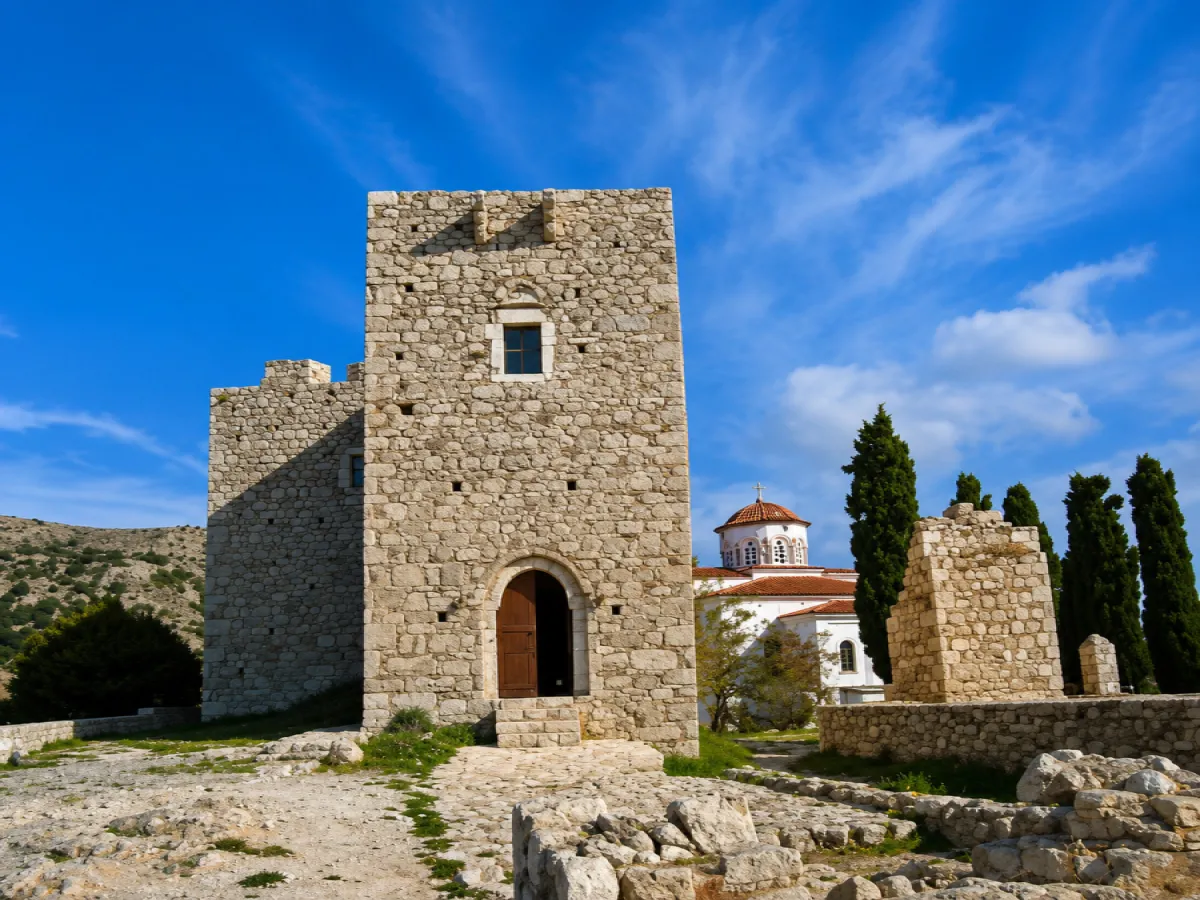
🏰 Tower of Lykourgos Logothetis – Castle of Pythagoreio, Samos
On the southwestern side of the harbour of Pythagoreio, on the low hill known as Castle Hill, stands one of the most important historical complexes of Samos: the Byzantine Castle of Pythagoreio and, within it, the Tower of Lykourgos Logothetis.
The site preserves successive traces of human activity from the Late Neolithic period, ancient Samos, the Hellenistic and Roman eras, the Byzantine and Genoese periods, and finally the Samian Revolution of 1821.
The imposing stone tower visible today became closely associated with Lykourgos Logothetis, the political and military leader of revolutionary Samos, who transformed one of the towers of the older fortification into his residence and administrative headquarters.
📍 Location
The monumental complex is located in Pythagoreio, within easy walking distance of the harbour and the historic centre of the settlement.
Its position on a hill beside the sea provided control over the harbour and the maritime approaches, explaining its strategic importance from antiquity through the 19th century.
The entire area forms part of the wider archaeological landscape of ancient Pythagoreio, which together with the Heraion of Samos has been included on the UNESCO World Heritage List since 1992.
🏺 A Hill with Thousands of Years of History
The history of the hill did not begin with the Byzantine castle.
Archaeological excavations have revealed activity at the site as early as the Late Neolithic period, at the end of the 4th millennium BC.
During the Archaic period, the hill lay within the powerful defensive system of ancient Samos and helped protect the harbour. Archaeological sources also record the tradition or hypothesis that the palace of Polycrates, the famous 6th-century BC tyrant of Samos, may once have stood in this area.
Architectural remains also show that the hill continued to be used during the Hellenistic and Roman periods.
🛡️ The Creation of the Byzantine Castle
A major change occurred during the 7th century AD, when increasing Arab activity and raids in the Aegean created new defensive needs.
The local population became increasingly concentrated around the hill, and the site was fortified with the construction of the Byzantine Castle, probably in the late 7th century AD.
The castle should therefore not be confused with the present-day Tower of Lykourgos Logothetis. The original fortification predates the revolutionary phase of the 19th century by more than a thousand years.
🏰 The Form of the Byzantine Castle
The Byzantine Castle had an approximately square ground plan and was reinforced with circular and square towers.
Its main entrance was located on the eastern side.
Repairs and alterations were carried out over the following centuries without fundamentally changing the overall layout of the fortification.
Work continued during the Byzantine period until around the 11th century, while the castle appears to have remained active into the 13th century.
⚔️ The Genoese Giustiniani
In the middle of the 14th century, when Samos came under the control of the Genoese Giustiniani, the castle was strengthened again.
The Genoese reused the earlier Byzantine fortification and carried out modifications to adapt it to the military requirements of their time.
The history of the castle is therefore not the story of a single building phase, but of successive alterations to the same strategically important location.
🏚️ Abandonment of the Castle
In 1475, following the submission of Samos to the Ottomans and the large-scale movement of much of the island’s population towards Chios and Asia Minor, the castle was abandoned.
For several centuries, the fortified hill lost much of its former function until the events of the Greek Revolution restored its strategic importance.
🇬🇷 The Samian Revolution of 1821
With the outbreak of the Greek Revolution, Samos rose against the Ottoman Empire.
Georgios Paplomatas, better known as Lykourgos Logothetis, emerged as the political and military leader of revolutionary Samos. He was a member of the Filiki Eteria and became one of the central figures of the Samian uprising.
Under his leadership, the island developed its own revolutionary political and military administration, while Samos effectively remained outside direct Ottoman control until 1834.
🧱 The New Fortification of the Hill, 1824–1827
In 1824, during the War of Independence, Lykourgos Logothetis decided to fortify the old Castle Hill once again.
The people of Samos participated in the works, and the defensive programme was largely completed by around 1827.
Sections of the older Byzantine fortifications and their towers were repaired.
One of these towers was extensively remodelled and eventually took the form now known as the Tower of Lykourgos Logothetis.
🏛️ The Tower of Lykourgos Logothetis
The Tower is the best-preserved and most recognisable building within the complex.
Its architectural features include:
✅ Raised ground floor
✅ Two upper storeys
✅ Battlements along the roofline
✅ Limited openings for defensive purposes
✅ Strong stone masonry
✅ Main entrance
✅ Machicolation above the entrance
Its architecture combines the functions of a residence and administrative headquarters with clear defensive characteristics.
🏠 Residence & Administrative Headquarters
Lykourgos Logothetis did not use the Tower only as a military stronghold.
The building served simultaneously as his residence and as an administrative centre of revolutionary Samos.
Important aspects of the island’s political and military administration were conducted from here.
Logothetis remained in the Tower as leader of the island until 1834, when he was forced to leave Samos along with other revolutionaries after the final decision not to include the island within the borders of the newly established Greek state.
⚓ The Battle of Samos
In the summer of 1824, revolutionary Samos faced a serious Ottoman naval threat.
The decisive confrontation in the Straits of Mycale on 5 August 1824, on the eve of the Feast of the Transfiguration of the Saviour, prevented an Ottoman landing and acquired enormous symbolic importance for the Samians.
The salvation of the island became closely associated with 6 August, the Feast of the Transfiguration, which continues to be commemorated in Pythagoreio through religious and anniversary events.
✝️ Church of the Transfiguration of the Saviour
Beside the Tower stands the historic Church of the Transfiguration of the Saviour.
It was built on the initiative of Lykourgos Logothetis as a monument of gratitude for the salvation of Samos from the Ottoman fleet.
Its construction is dated to the period 1831–1833.
The church’s association with the events of 1824 is also reflected in the historic phrase:
“Christ saved Samos on 6 August 1824.”
This became one of the strongest symbols of the modern history of Pythagoreio and Samos.
🏛️ After 1834
After the departure of Lykourgos Logothetis, the castle was occupied by an Ottoman garrison.
During this period, antiquities that had been kept within the castle were reportedly looted.
In 1863, Alexandros Logothetis, the son of Lykourgos, sold the Tower and the associated property to the Samian State.
🏺 The Tower as a Museum
The Tower has been restored and today functions as a visitable monument with an organised exhibition.
Inside, visitors can see an exhibition dedicated to the life and activity of Lykourgos Logothetis, together with archaeological finds from:
✅ The Byzantine Castle of Samos
✅ The area of Tigani, today’s Pythagoreio
✅ Other Byzantine sites on the island
The visit therefore does not focus solely on the Revolution of 1821, but also presents the much longer Byzantine history of the area.
🌍 Pythagoreio & UNESCO
The castle lies within the historical and archaeological landscape of Pythagoreio, the site of the ancient city of Samos.
Pythagoreion and the Heraion of Samos were jointly inscribed on the UNESCO World Heritage List in 1992 because of the exceptional importance of ancient Samos in architecture, technology, trade and culture.
Castle Hill is a particularly interesting part of this continuous historical landscape because traces from several different periods survive in the same location.
🌊 Views over Pythagoreio & the Aegean
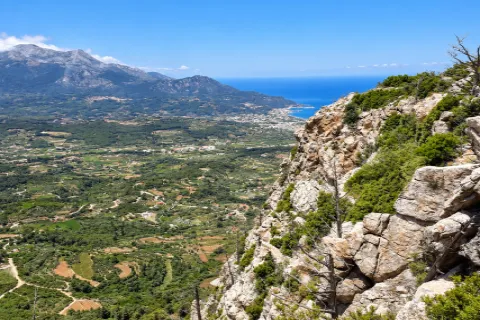
The position of the Tower offers open views towards the sea, the harbour and the settlement of Pythagoreio.
Today this is one of the most attractive features of the monument, but historically the view had a far more practical purpose.
For centuries, the ability to monitor the harbour and the maritime straits opposite Asia Minor was one of the main reasons for the strategic importance of the hill.
🔧 The 2020 Earthquake
The powerful earthquake of 30 October 2020 caused damage to parts of the towers and walls of the castle, as well as to the neighbouring Church of the Transfiguration.
Emergency stabilisation and safety works were subsequently carried out on the affected monuments.
The Tower is once again open to visitors.
🕒 Opening Hours, Admission & Contact
According to the latest official visitor information:
Summer period: 1 April–31 October
08:30–15:30: Monday, Wednesday, Thursday, Saturday & Sunday
Closed: Tuesday & Friday
Winter period: 1 November–31 March: Closed
Admission: Free
Last entry: Up to 20 minutes before closing
Address: Pythagoreio, Samos 83103
Telephone: +30 22730 62813
Email: efasam@culture.gr
Opening hours may change, so it is advisable to confirm current information before visiting.
👀 What to Look For During Your Visit
Particularly interesting features include:
✅ The strong stone masonry of the Tower
✅ The machicolation above the main entrance
✅ The battlements at the upper level
✅ Surviving sections of the older Byzantine Castle
✅ Traces of the different construction phases
✅ The Church of the Transfiguration of the Saviour
✅ Archaeological remains around the hill
✅ Views towards the harbour and the Straits of Mycale
The special character of the site lies precisely in the coexistence of ancient, Byzantine and modern history in the same place.
🧭 Places to Combine with Your Visit
Within a short distance are:
✅ Church of the Transfiguration of the Saviour
✅ Archaeological Museum of Pythagoreio
✅ Statue of Pythagoras
✅ Archaeological remains of the ancient city
✅ Roman Baths of Pythagoreio
✅ Panagia Spiliani
✅ Tunnel of Eupalinos
Together, these sites create an exceptional route through the history of Samos, from antiquity and the Byzantine era to the revolutionary period of the 19th century.
⭐ A Monument Where Different Periods of Samos Meet
The importance of the Tower and the Castle does not lie only in their association with Lykourgos Logothetis.
The same hill was used from the Late Neolithic period, became part of the fortifications of ancient Samos, remained occupied in Hellenistic and Roman times, was fortified again in the late 7th century, strengthened by the Genoese and transformed between 1824 and 1827 into one of the most important administrative and defensive centres of revolutionary Samos.
For this reason, the Tower of Lykourgos Logothetis – Castle of Pythagoreio is one of the few places on the island where visitors can follow so clearly the continuity of Samian history from antiquity to the modern era.


Add new comment