
Archaeological Site of the Ancient City of Samos – Pythagoreio

🏛️ In the footsteps of one of the most important cities of the ancient Aegean
Beneath and around modern-day Pythagoreio lie the remains of the ancient city of Samos, a city that flourished in antiquity and developed into an important naval, commercial and cultural centre of the eastern Aegean.
The archaeological site is not a single, isolated monument. The modern town of Pythagoreio was essentially built over ancient Samos, which means that traces of the ancient city can be found at various locations within the present-day settlement and throughout the surrounding area.
Its fortification system, ancient harbour, public works, baths, water-supply infrastructure and other surviving remains formed part of a much larger urban complex.
📍 Location & Archaeological Landscape
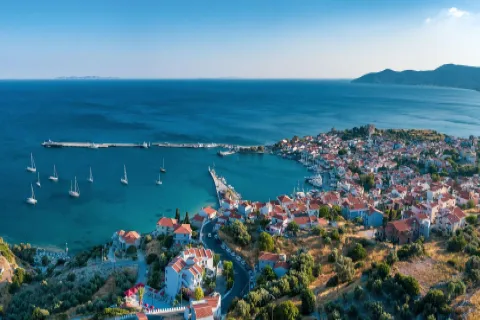
The ancient city occupied the area where Pythagoreio stands today, on the southeastern coast of Samos. Its location beside a natural harbour and opposite the coast of Asia Minor played a decisive role in the development of Samos as a major maritime and trading power.
Unlike an archaeological site confined within a single fenced area, ancient and modern landscapes coexist here. Archaeological remains have been discovered within and around the present-day urban fabric, while continuing research has gradually added to our understanding of the ancient city.
🏺 From Prehistoric Times to Ionian Samos
Human presence in the area has very deep roots. The earliest finds date back to the 5th–4th millennium BC, during the Neolithic period, while the settlement began to develop significantly from around the 10th century BC, when Ionians from mainland Greece settled in the region.
During the centuries that followed, Samos gradually became one of the most important centres of the Ionian world.
The island’s geographical position encouraged contact with both Asia Minor and the wider Greek world, creating favourable conditions for extensive trade, maritime activity and cultural exchange.
⚓ The Great Prosperity of the 6th Century BC
The ancient city of Samos reached its greatest prosperity during the 6th century BC.
During this period, the island developed into one of the leading naval powers of the eastern Mediterranean, with extensive trade networks and connections that reached far beyond the Aegean.
The city’s economic and political strength was reflected in ambitious public works and major engineering projects.
Among the most remarkable achievements associated with this period were the Eupalinos Tunnel, the fortification system surrounding the ancient city and its harbour installations. A short distance away stood the great Sanctuary of Hera at the Heraion.
This period is closely associated with the rule of the tyrant Polycrates, under whom Samos became renowned for its naval strength, wealth and impressive engineering works.
🧱 An Organised and Fortified City
Ancient Samos was a carefully organised and fortified city.
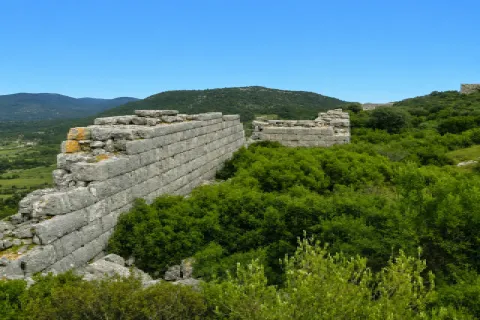
Its defensive walls enclosed the urban area and protected both the inhabited districts and essential infrastructure.
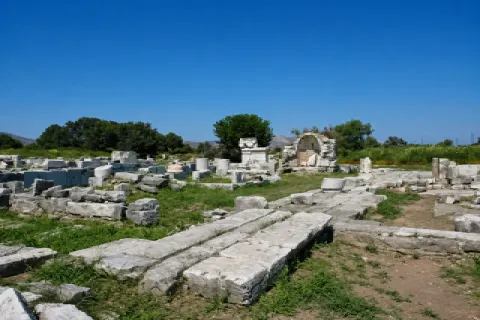
Archaeological excavations within and around the ancient city have revealed remains belonging to different historical periods. Together, they present the picture of an urban centre with a long and complex history that continuously changed and developed over the centuries.
Some of the most important parts of this ancient urban complex are today presented as separate monuments, including the Polycratean Walls, the Thermae of Ancient Samos and the Eupalinos Tunnel.
Although these can be visited as individual attractions, they were all components of the same ancient city.
🏛️ From the Hellenistic to the Roman Period
The importance of Samos did not end with the decline of its Archaic-period prosperity.
The city continued to function as an important commercial centre during the Hellenistic and Roman periods, leaving behind monuments and archaeological remains representing several different phases of its long history.
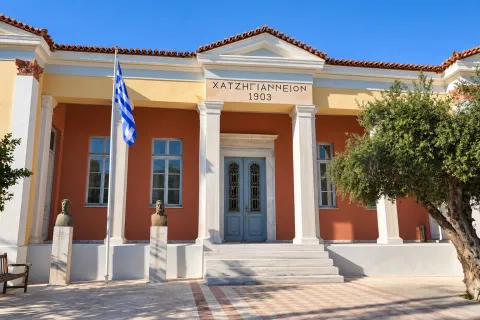
The remarkable duration of settlement in the area is also reflected in the collections of the Archaeological Museum of Pythagoreio, which present the historical development of the ancient city and the surrounding region from the 4th millennium BC until the 7th century AD.
🌍 UNESCO World Heritage Site
Since 1992, Pythagoreio together with the Heraion of Samos has been included on the UNESCO World Heritage List.
UNESCO recognises the exceptional importance of ancient Samos in the development of Ionian civilisation, as well as the technological and artistic achievements of the island during the 6th century BC and its role as a major maritime and commercial power.
The protected area of Pythagoreio includes the ancient city of Samos within its fortification walls, demonstrating that the UNESCO designation concerns an entire historic urban landscape rather than a single isolated monument.
👀 What This Means for Visitors
Exploring the ancient city of Samos is quite different from visiting a conventional archaeological site concentrated within one clearly defined area.
Modern Pythagoreio stands directly over the remains of the ancient city, and many of its most important monuments are scattered throughout the town and the surrounding landscape.
For a fuller understanding of ancient Samos, a visit can be combined with the Archaeological Museum of Pythagoreio, the Eupalinos Tunnel, the Thermae, the Polycratean Walls and the other surviving remains of the ancient city.
Together, these sites make it easier to understand that modern Pythagoreio is not simply located near an ancient settlement: it occupies the very place where one of the most important cities of the ancient eastern Aegean once flourished.


Add new comment