
Folklore Museum “Nikolaos Dimitriou” – Pythagoreio, Samos
🧿 Traditional life on Samos
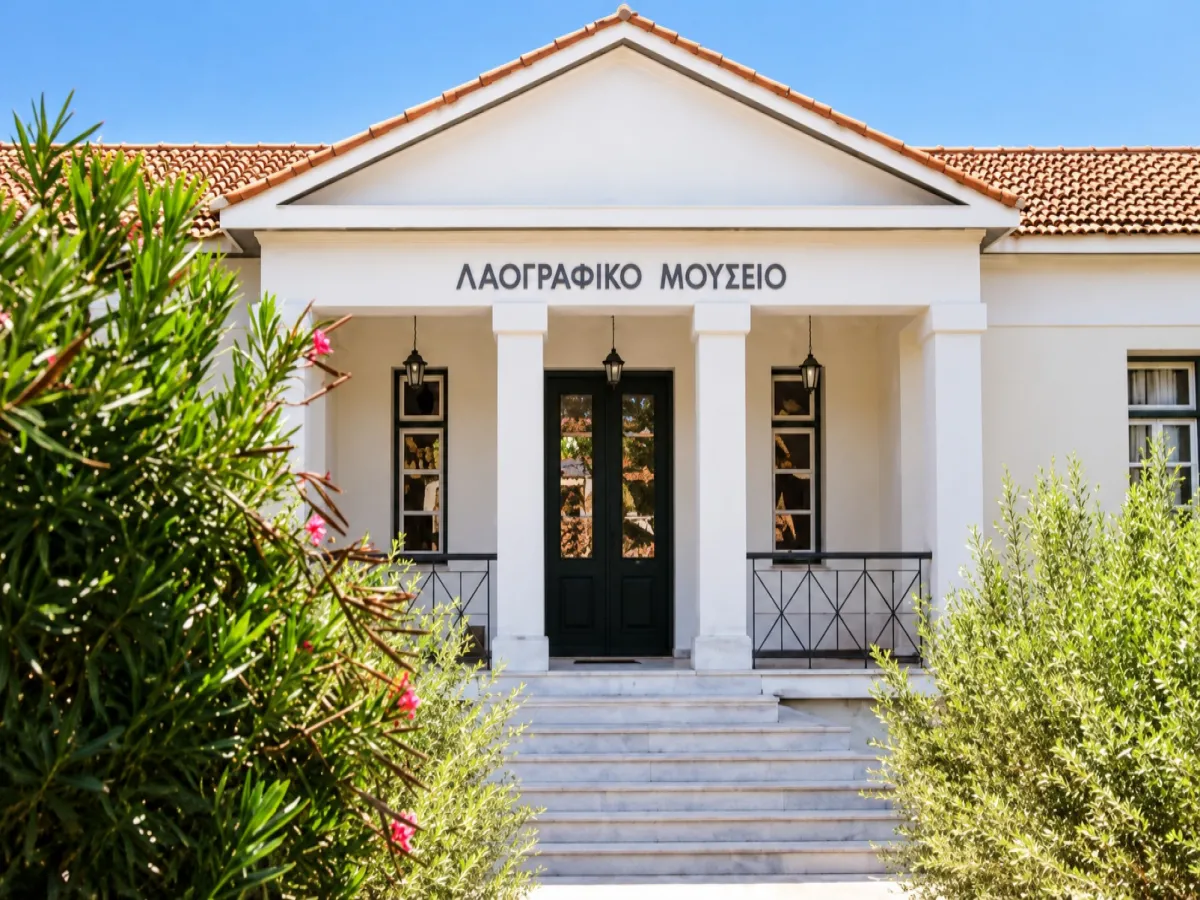
Just outside Pythagoreio, Samos, within the traditionally designed village of Doryssa, stands the Folklore Museum of the Cultural Foundation of Samos “Nikolaos Dimitriou”.
The museum presents the way of life of the people of Samos mainly before the Second World War, through reconstructions of homes, workshops, agricultural activities and traditional professions.
The exhibition combines authentic objects with carefully arranged settings, allowing visitors to discover not only the tools and household items of another era, but also the environment in which they were used.
🏛️ The creation of the museum
The museum has been operating since May 1997 and belongs to the Cultural Foundation of Samos “Nikolaos Dimitriou”.
It is named after the Samian teacher, writer and folklorist Nikolaos A. Dimitriou (1897–1996), who devoted much of his life to systematically recording the customs, language, professions and everyday life of Samos.
His multi-volume work “Folklore of Samos” is an important record of the island’s traditional society and is closely connected with the philosophy of the museum.
🏡 The traditional Samian house
The museum includes a reconstruction of the traditional single-room Samian house, where much of family life was organised within one main living space.
Furniture, cooking utensils, woven textiles and everyday objects show how the same room could serve for eating, resting, working and family activities.
The exhibition also presents the katoi, the lower part of the house used for storing food, agricultural produce, tools and other essential household supplies.
🌾 Rural life & cultivation
Agriculture played a central role in the lives of Samian families, and this is strongly reflected in the collection.
Traditional farming tools such as ploughs, sickles, shovels and sieves are displayed alongside objects connected with different stages of cultivation and harvesting.
The exhibits demonstrate how demanding agricultural work was before machinery became widely available, when most tasks depended on human or animal power.
🍇 Viticulture & Samian wine
Viticulture, one of the most important traditional activities of Samos, has a prominent place in the museum.
Objects and tools connected with vine cultivation, grape harvesting and wine handling link the present-day reputation of Muscat of Samos with the everyday work of earlier generations of winegrowers.
🍞 Food production
Preparing basic foods was an essential part of traditional household organisation.
The museum displays tools used for making bread and cheese, as well as objects related to the preparation and preservation of agricultural products.
Traditional ovens in the outdoor area further illustrate the importance of household food production in everyday life.
🍯 Beekeeping
Traditional beekeeping is represented through tools used for tending beehives, collecting honey and processing beeswax.
This activity formed part of a varied rural economy in which families combined different forms of production to meet their needs and support their livelihood.
🧶 Weaving & Samian embroidery
Weaving is one of the museum’s most important themes.
Visitors can see a loom, handmade textiles, embroidery and examples of traditional white Samian embroidery.
Much of a household’s textile production was carried out at home and included bed linen, clothing, curtains and dowry items.
The exhibits highlight both the practical importance of weaving and the craftsmanship of the women who preserved and passed on these techniques.
👗 Traditional costumes & family life
The collection includes traditional men’s and women’s costumes, together with objects connected with family life.
Through clothing and personal belongings, visitors can learn about elements of social organisation, customs and the different stages of life within a traditional Samian family.
🔨 Traditional professions
The reconstructions of old professions are among the museum’s most interesting sections.
Using authentic tools, the exhibition presents the work of the farmer, shepherd, fisherman, shoemaker, beekeeper, blacksmith and carpenter.
These sections show how the small communities of Samos depended on local craftsmen and specialist knowledge passed down from generation to generation.
🏘️ The traditional village
The museum experience continues beyond the indoor exhibition areas.
The surrounding setting has been designed with features inspired by old Samian settlements, including stone-paved lanes, courtyards, traditional ovens, wash areas and stone enclosures.
This environment helps connect the collection with the type of village setting in which many of these objects and activities originally belonged.
🎟️ Visiting the museum
The museum is located approximately 1.3 km west of Pythagoreio and is easily accessible by road.
Its operation is mainly seasonal, while outside the summer period visits may be available by prior arrangement.
As opening hours can change, it is advisable to confirm them before visiting.
👀 Why it is worth visiting
The Folklore Museum “Nikolaos Dimitriou” offers a broad picture of the traditional society of Samos.
The house, agricultural tools, loom, costumes, craftsmen’s workshops and traditionally designed surroundings help visitors understand how island residents lived and worked before the major social and technological changes of the 20th century.


Add new comment