
Ancient Theatre of Samos – Pythagoreio
🎭 A theatre of the ancient city that still hosts culture today
On the slope below the Monastery of Panagia Spiliani, just above Pythagoreio, lies the Ancient Theatre of Samos, one of the monuments that formed part of the ancient city of Samos.
Unlike other ancient theatres in Greece, where impressive stone seating and large parts of the original architecture survive, only very limited ancient remains have been preserved here. Archaeological research, however, has made it possible to identify the location and the basic layout of the original theatre.
The monument uncovered at the site dates to the Roman period and appears to have included the main architectural elements of a theatre: the cavea, orchestra and stage building.
📍 Location & landscape
The theatre is situated on the slope of Panagia Spiliani, northwest of modern Pythagoreio, within the wider archaeological landscape of the ancient city of Samos.
The natural shape of the terrain played an important role in identifying the site. The slope and its terraced formation still help visitors understand where the cavea, the seating area for spectators, once stood.
The site is directly connected with the wider archaeological complex of Pythagoreio, which also includes the Eupalinos Tunnel, the Polycratean Walls, the Thermae and other remains of the ancient city.
🏛️ The theatre during the Roman period
According to the archaeological evidence available today, the theatre identified at this location was built during the Roman period.
Its original form cannot be fully reconstructed because very few of its stone architectural elements remain in place. Excavations and the morphology of the site, however, indicate that it included a cavea, an orchestra and a stage, following the basic arrangement of an ancient theatre.
The presence of a theatre provides further evidence of the organised urban life of ancient Samos and of the continuing importance of the city during Roman times.
⛏️ The 1996 excavation
A rescue excavation was carried out at the site in 1996 by the then 21st Ephorate of Prehistoric and Classical Antiquities.
The excavation revealed a row of rectangular stone slabs in front of the area of the stage building. Their surfaces contained features believed to indicate the position of a colonnade.
At the northern edge of the paved area, archaeologists also uncovered a floor foundation and traces of marble paving. A rectangular area at a lower level has been interpreted as a possible hypogeum or underground stage space, while farther south the foundations of the side-stage structures were identified.
Only one stone seat from the cavea has been found at the site.
🧱 Why so little survives
One of the most striking characteristics of the Ancient Theatre of Samos is precisely how little of the original structure has survived.
According to archaeological documentation, it is very likely that a large part of the theatre’s stone material was removed in later periods and reused as building material in other structures in the town.
This was a common practice at many ancient sites. Once a monument was no longer in use, its already cut and worked stone could be reused in later construction.
As a result, the site visitors see today is very different from the theatre as it would have appeared during its period of use.
🪵 The modern wooden installation
After the 1996 excavation, the archaeological trenches were backfilled by decision of the Ministry of Culture in order to protect the remains.
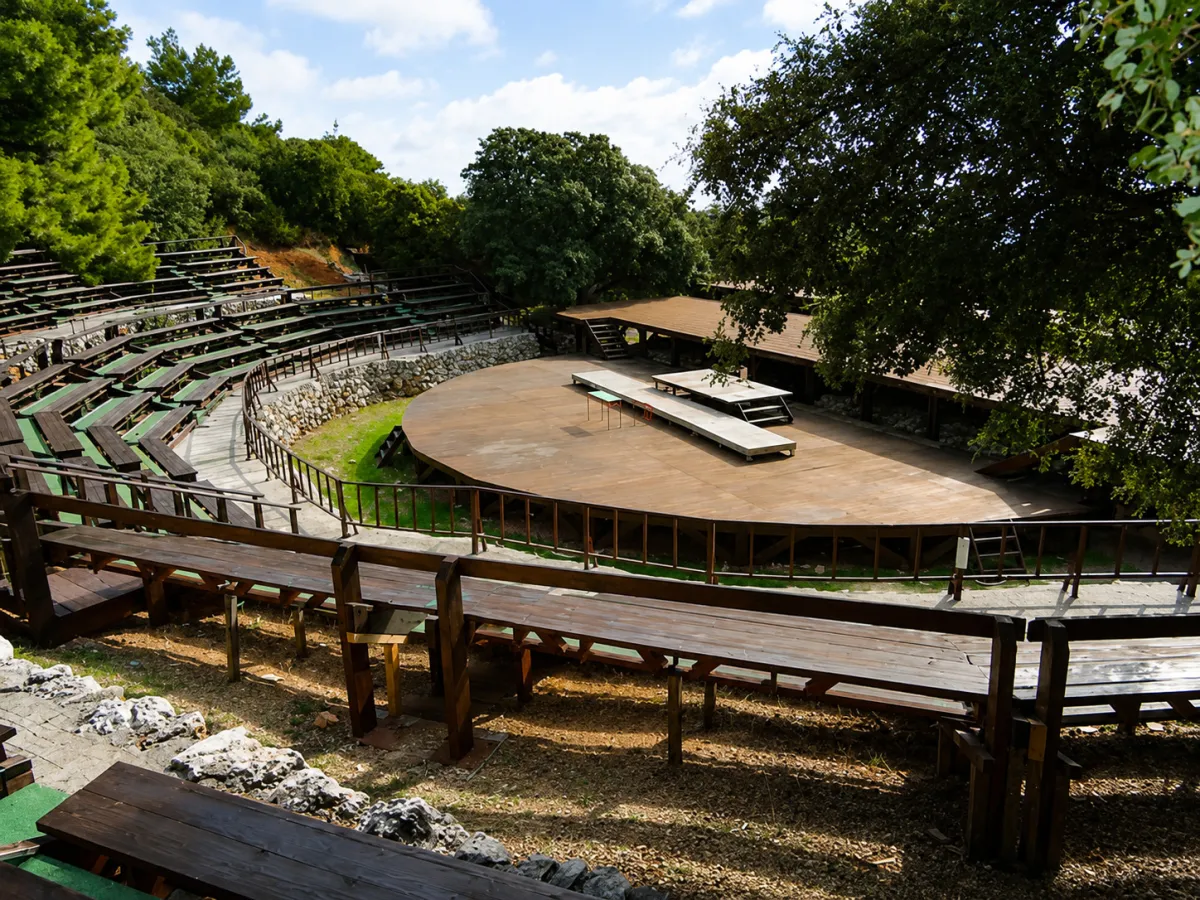
A wooden theatrical installation was later created on the site, following the basic arrangement of the ancient theatre. Seating was installed in the position of the cavea, a wooden floor in the area of the orchestra and auxiliary spaces in the position of the side-stage structures.
The installation can accommodate approximately 750 spectators.
For this reason, visitors should be aware that the wooden seating visible today is not an archaeological reconstruction of the ancient theatre, but a modern structure designed to allow the site to be used for cultural events.
🎶 A venue that remains in use
One of the most distinctive aspects of the site is that it has not remained solely an archaeological monument.
Cultural performances were already taking place there from the 1980s, before the current wooden installation was built. After 1996, the site was organised so that it could host theatrical performances, concerts and other cultural events.
This use continues today, linking contemporary artistic activity with a place that had a theatrical function in antiquity.
🌍 Part of the UNESCO-listed Pythagoreio
The theatre lies within the declared archaeological area of Pythagoreio and within the protected zone of the ancient city of Samos.
Since 1992, Pythagoreio and the Heraion of Samos have been jointly inscribed on the UNESCO World Heritage List.
This designation applies to the wider archaeological complex rather than to the theatre as an individual monument. The Ancient Theatre is one of the surviving elements that help visitors understand the scale and historical continuity of the ancient city of Samos.
👀 What visitors will see
The Ancient Theatre of Samos should not be approached with the expectation of seeing a monument like Epidaurus or other ancient theatres where large sections of the original stone seating remain intact.
Its importance lies elsewhere: in its location within the ancient city, in the archaeological evidence that revealed its layout and in the continuing use of the site as a place of culture.
The natural slope, the modern theatrical installation and the limited surviving archaeological remains allow visitors to understand the location and approximate arrangement of the ancient theatre, while also showing how differently ancient monuments can survive over time.
A visit can easily be combined with the other monuments of ancient Pythagoreio and the Eupalinos Tunnel, offering a fuller picture of the history of ancient Samos.



Add new comment