
Ancient Harbour of Samos – Polycratean Mole in Pythagoreio
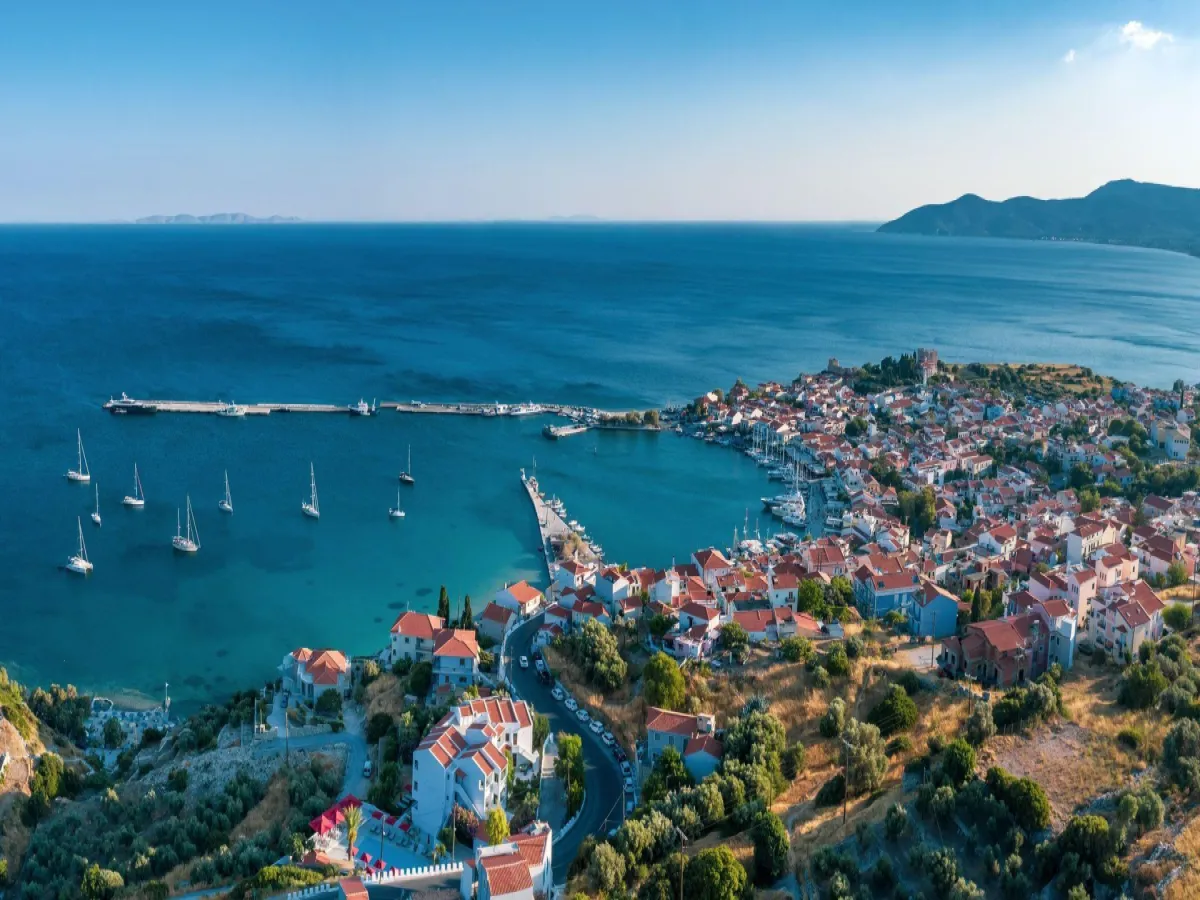
⚓ The harbour that supported the maritime power of ancient Samos
On the site of the present-day harbour of Pythagoreio once stood the ancient harbour of Samos, one of the most important engineering and naval works of the ancient city.
During the 6th century BC, when Samos developed into one of the strongest naval and commercial powers of the eastern Aegean, the harbour was a fundamental part of its military, economic and trading strength.
Ancient Pythagoreio was a fortified port city, and maritime activity played a central role in its development and prosperity.
The best-known structure associated with the harbour is the so-called Polycratean Mole, the great breakwater linked with the period of Samos’ greatest prosperity and with the tyrant Polycrates.
📍 Location & connection with modern Pythagoreio
The ancient harbour occupied essentially the same location as the modern harbour of Pythagoreio.
This is important for visitors to understand, because there is no separate archaeological site beside the present-day harbour where the entire ancient port can be seen standing above ground.
Instead, the modern harbour landscape developed directly over and around the ancient harbour installations. Later harbour works were constructed over sections of the ancient mole, meaning that the modern and ancient structures are closely intertwined.
Visitors standing along the waterfront of Pythagoreio are therefore in the same maritime area where merchant ships and warships of ancient Samos once arrived, departed and were sheltered.
👑 Samos under Polycrates
The great prosperity of the harbour is associated above all with the 6th century BC, particularly with the rule of the tyrant Polycrates, who governed Samos approximately between 535 and 522 BC.
During this period, Samos emerged as a major naval and commercial power in the eastern Mediterranean. Its trading connections extended across Asia Minor, mainland Greece and far beyond the Aegean.
Such naval strength required an organised harbour system capable of protecting a powerful fleet while also serving intense commercial traffic.
The Polycratean Mole belonged to the same era of ambitious public works that produced some of the most remarkable engineering achievements of ancient Samos, including the Eupalinos aqueduct system, the city fortifications and the monumental construction activity at the Heraion.
📜 Herodotus and the great harbour work
The harbour works of Samos were considered so impressive that Herodotus, writing in the 5th century BC, included the great mole among three extraordinary engineering achievements of the Samians that drew his particular admiration.
In Book III of his Histories, he refers to a major artificial construction extending into the sea and protecting the harbour, alongside the Eupalinos aqueduct and the great Temple of Hera.
This reference is especially important because it represents one of the earliest written descriptions of a major harbour engineering project in the ancient Greek world.
🧱 The Polycratean Mole
The Polycratean Mole is described as a breakwater approximately 360 metres long and around 3 metres wide, constructed to protect the harbour from strong southerly winds.
The harbour system appears to have created two distinct zones.
The protected inner closed harbour could serve the naval fleet, while the outer harbour area was primarily associated with commercial shipping.
This arrangement shows that the structure was not simply a pier extending into the sea, but part of a sophisticated harbour system designed to meet the different needs of a powerful maritime city.
🛡️ The closed military harbour
Archaeological research has identified a closed military harbour at the eastern side of the ancient city.
This naval area was connected with the defensive system of Samos. Sections of the fortifications extended toward the coastal zone, strengthening the protection of the harbour and the fleet anchored within it.
The existence of a protected military harbour becomes especially significant when considered alongside the naval power achieved by Samos during the 6th century BC.
It demonstrates that the city’s maritime strength was supported not only by ships and sailors, but also by carefully planned infrastructure and defensive engineering.
🚢 Naval and commercial fleets
Ancient Samos did not rely solely on military power.
Its strategic position opposite the coast of Asia Minor made the island an important hub within the maritime trading networks of the eastern Mediterranean.
By the 6th century BC, Samos had developed into a major naval power with strong commercial connections to Asia Minor and mainland Greece, while Samian merchants and ships also operated much farther west in the Mediterranean.
The harbour was therefore more than a military installation. It was one of the principal gateways through which goods, people, technologies and cultural influences moved between Samos and the wider Mediterranean world.
🌊 What underwater research has revealed
Research into the ancient harbour has not been limited to structures visible on land.
Underwater archaeological investigations have examined architectural remains beneath the sea around Pythagoreio, revealing that the harbour landscape is considerably more complex than it appears from the shore today.
Structures belonging to different periods exist within the area, while later repairs, reconstructions and modern harbour works have covered, incorporated or altered earlier remains.
For this reason, an important distinction must be made between the Polycratean harbour work described by ancient sources and every submerged stone structure visible today.
It would not be archaeologically accurate to identify every underwater accumulation of stone or every surviving harbour structure as part of the original 6th-century BC construction.
🕰️ A harbour with centuries of history
The importance of the harbour did not disappear after the age of Polycrates.
Samos remained an important commercial centre during the Hellenistic and Roman periods, while the harbour area continued to be used, altered and rebuilt over the centuries.
Much later, during the 19th century, the settlement of Tigani developed over the area of the ancient city.
The harbour of this newer settlement occupied the same general location as the ancient harbour and experienced significant growth during the late 19th century.
Tigani was eventually renamed Pythagoreio.
This created a remarkable continuity in the use of the same natural harbour area, extending from antiquity to the modern period.
🌍 Part of the UNESCO World Heritage Site
The ancient harbour forms part of the wider archaeological landscape of Pythagoreio, which together with the Heraion of Samos was inscribed on the UNESCO World Heritage List in 1992.
Pythagoreio is recognised as an ancient fortified port city with important Greek and Roman monuments, while Samos is acknowledged for its role as a major maritime and commercial power of the ancient Greek world during the 6th century BC.
The harbour should therefore not be viewed as an isolated engineering structure, but as part of the larger urban, military and technological system of the ancient city.
👀 What visitors can see today
Visiting the Ancient Harbour of Samos is different from visiting a conventional archaeological site.
There are no large ancient harbour structures standing fully preserved above the surface of the sea. Much of the ancient infrastructure lies underwater, beneath later harbour works or incorporated into subsequent constructions.
What makes the site particularly interesting is the opportunity to stand in the modern harbour of Pythagoreio and realise that this is the same maritime space where one of the most important ports of the ancient Aegean operated around two and a half thousand years ago.
The modern breakwater, the natural shape of the harbour and the position of the ancient city help visitors understand why this location was so important to ancient Samos.
A visit can be combined with the Ancient City of Samos, the Polycratean Walls, the Archaeological Museum of Pythagoreio and the Eupalinos Tunnel, offering a more complete understanding of the scale and organisation of ancient Samos.



Add new comment