
Eupalinos Tunnel – The Miracle of Ancient Engineering on Samos
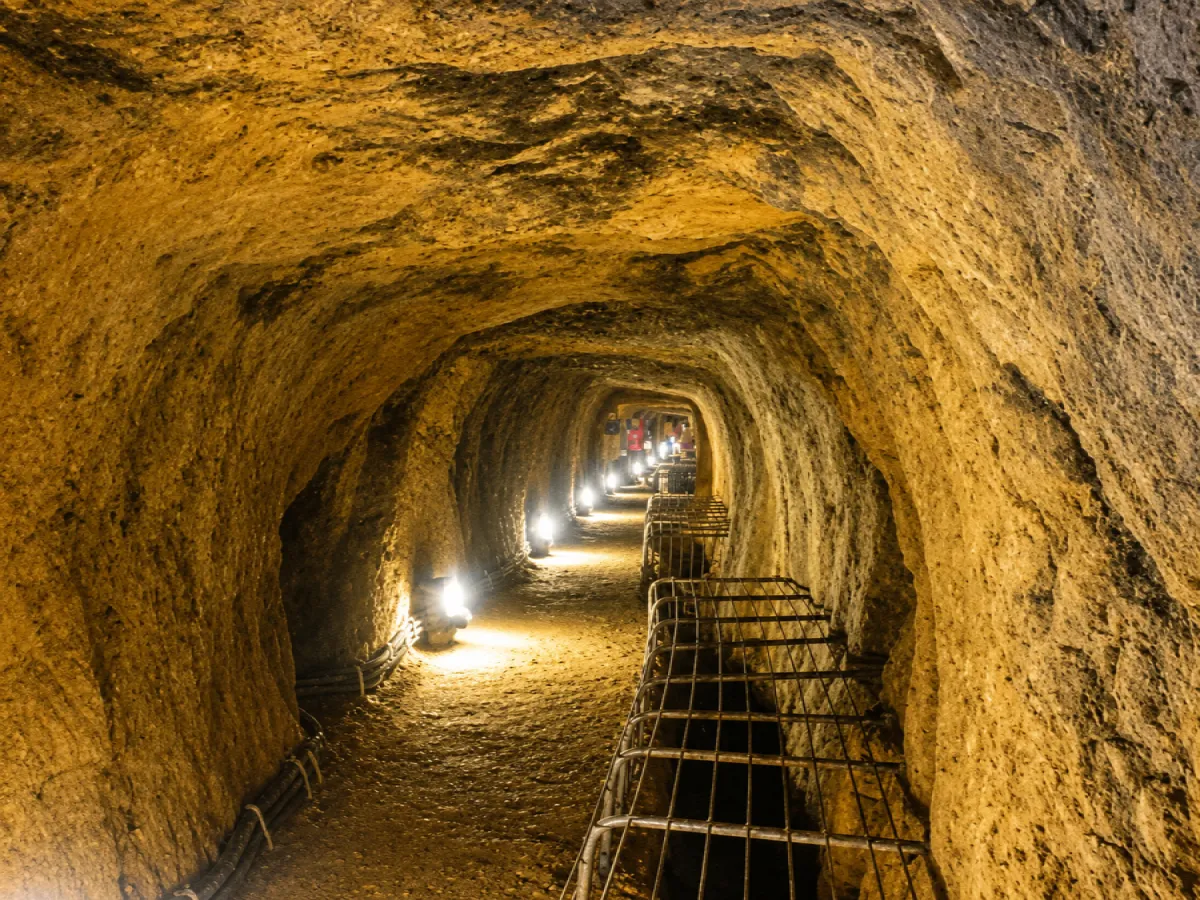
🛠️ Tunnel of Eupalinos in Pythagoreio, Samos
Inside Mount Kastro, above Pythagoreio, lies one of the most important engineering achievements of antiquity: the Tunnel of Eupalinos, the central underground section of the ancient aqueduct of the city of Samos.
The tunnel is 1,036 metres long and was constructed during the 6th century BC under the direction of the engineer Eupalinos of Megara, son of Naustrophos. What made the project exceptional even by ancient standards was that excavation began simultaneously from opposite sides of the mountain, with the two teams eventually meeting underground.
The tunnel formed part of a complete water-supply system that carried water from the spring at Agiades to the ancient city. The Eupalinos Aqueduct remained in use for approximately 1,100 years, demonstrating not only the originality of its design but also its remarkable long-term effectiveness.
📍 Location
The Tunnel of Eupalinos is situated north of Pythagoreio and runs through the interior of Mount Kastro.
The southern entrance, normally used for visits, lies approximately 2 kilometres from Pythagoreio and can be reached by road or on foot. The northern entrance faces the area of Agiades and is connected with the side from which water entered the tunnel system.
The location presented a major engineering challenge, as a mountain stood between the spring and the ancient city. Instead of taking the water around the mountain along a much longer surface route, the builders chose the far more demanding solution of excavating directly through the limestone mass.
📜 Eupalinos of Megara
Most of what we know about the engineer responsible for the project comes from Herodotus.
In Book III of his Histories, the ancient historian names Eupalinos, son of Naustrophos, from Megara as the engineer responsible for the underground work.
It is particularly significant that the name of the engineer behind such an early technical project has survived, since those responsible for many major Archaic-period constructions remain unknown.
🕰️ When Was It Built?
The Tunnel of Eupalinos dates to around the middle of the 6th century BC.
For many years, it was commonly associated directly with the tyranny of Polycrates, since Herodotus mentions the project within the broader historical context of powerful 6th-century BC Samos.
More recent archaeological and technical research, however, has encouraged a more cautious interpretation. Hermann J. Kienast, one of the most important modern scholars of the aqueduct, argued that construction probably began before the period of Polycrates, around the middle of the 6th century BC.
It is therefore more accurate to associate the project with the great technological and economic development of 6th-century BC Samos without stating with certainty that Polycrates himself commissioned its construction.
⛏️ The Double-Ended Tunnel
The most important feature of the project was its excavation from two opposite directions.
One team began working from the northern side of the mountain and another from the south, with the intention of meeting underground.
For this reason, Herodotus described the tunnel as “amphistomon”, meaning “with two openings”.
Working from both ends allowed construction to progress simultaneously, but created an extremely difficult engineering problem: the direction and elevation of both excavation fronts had to be determined with considerable accuracy despite there being no direct line of sight through the mountain.
📐 The Geometry Behind the Project
Successful excavation required measurements across the surface of the mountain and the transfer of calculated directions underground.
The two sections do not follow a perfectly straight line throughout their entire length. In several places there are deliberate or necessary deviations related both to the quality of the rock and to the need to ensure that the two teams would not pass each other without meeting.
Modern studies of the tunnel indicate that Eupalinos used systematic geometric and surveying methods to control the alignment.
The successful meeting of the two excavation fronts inside the mountain is one of the main reasons why the project is considered a landmark in the history of engineering.
🧱 Dimensions of the Main Tunnel
The main tunnel is 1,036 metres long, with an average cross-section of approximately 1.80 × 1.80 metres.
Its dimensions are not identical throughout. In some sections the passage becomes considerably narrower, while in others the ancient builders had to reinforce the walls and ceiling because of unstable or poor-quality rock.
Tool marks left on the carved stone are still visible and provide direct evidence of the labour of the workers who excavated the tunnel more than two and a half thousand years ago.
💧 A Complete Aqueduct – Not Just a Tunnel
The Tunnel of Eupalinos was only the central and most impressive part of a much larger water-supply system.
The water originated from a spring in the Agiades area, north of the mountain.
From there it travelled towards the northern entrance through an underground conduit approximately 890 metres long. It then passed through the mountain and, after emerging from the southern side, continued towards reservoirs and the water-distribution system of the ancient city.
The monument should therefore not be understood simply as “a tunnel”, but as part of a complete system for collecting, transporting and distributing water.
⬇️ The Deeper Water Channel
Inside the main tunnel was a second and deeper technical structure.
The principal tunnel was used for access and construction, while a deeper trench was excavated along its length to carry the water.
Because the main tunnel needed to remain almost level so that the two excavation teams could meet successfully, the water channel required a different gradient in order to maintain natural flow towards the city.
As a result, the trench gradually becomes deeper towards the southern section.
🏺 The Terracotta Water Pipes
At the bottom of the hydraulic channel, the ancient engineers installed a line of terracotta pipes to carry the water.
The pipeline consisted of thousands of individual sections joined together to create a continuous conduit.
Their design also allowed cleaning and maintenance, which was essential for a water-supply system expected to remain operational for many generations.
The fact that the Eupalinos Aqueduct remained in use for approximately 1,100 years demonstrates both the quality of its engineering and its enduring importance to the city.
📜 What Herodotus Actually Wrote
Herodotus explained that he discussed the Samians at greater length because they had completed three works greater than those of other Greeks.
The first was the double-ended tunnel through the mountain. He described it as seven stadia long and eight feet in both height and width, and also mentioned the deeper channel through which water was carried to the city in pipes.
The other two great works he listed were the harbour construction of ancient Samos and the enormous temple of Hera.
His account is particularly valuable because it not only describes the project but also preserves the name of its engineer.
🛡️ Water Supply & Protection of the City
The primary purpose of the aqueduct was to provide the ancient city with a reliable supply of water.
Its underground route protected a substantial part of the system inside the mountain and reduced its exposure above ground.
At a time when Samos was a major naval and commercial power and the city possessed strong fortifications, securing a dependable water supply clearly had strategic importance.
Its main engineering purpose, however, was straightforward but extremely demanding: to transport water from the spring at Agiades to the city despite the natural obstacle presented by the mountain.
🌍 Tunnel of Eupalinos & UNESCO
The Tunnel of Eupalinos forms part of the archaeological property “Pythagoreion and Heraion of Samos”, which was inscribed on the UNESCO World Heritage List in 1992.
UNESCO particularly recognises the technological sophistication of the Eupalinos project and its importance in the development of engineering and major public works.
The World Heritage designation does not apply to the tunnel as an isolated monument, but to the wider archaeological ensemble of ancient Pythagoreio and the Heraion.
🏅 International Historic Civil Engineering Landmark
International recognition of the project extends beyond UNESCO.
In 2017, the American Society of Civil Engineers designated the Tunnel of Eupalinos an International Historic Civil Engineering Landmark.
A commemorative plaque marking this distinction was installed at the southern entrance of the monument on 29 October 2017.
The designation recognises the importance of the tunnel not only in Greek archaeology but also in the global history of civil engineering.
🔧 Restoration & Modern Presentation
The monument has been the subject of systematic archaeological research, structural consolidation, conservation and restoration.
Particularly important was the long-term research undertaken by the German Archaeological Institute and Hermann J. Kienast, which contributed greatly to understanding the route, construction phases and engineering methods used in the project.
Modern conservation and stabilisation works have made it possible for visitors to enter sections of the monument more safely while preserving the ancient structure.
🚶 The Three Designed Visitor Routes
Three different visitor routes were created for the presentation of the monument:
✅ Route 1 – 185 metres
The shortest route, with a total duration of approximately 20 minutes including the return. It includes a narrow staircase and a passage about 17 metres long, approximately 1.55 metres high and 0.50 metres wide.
✅ Route 2 – 424 metres
This route reaches the Byzantine reservoir and the area near the meeting point of the two ancient excavation fronts. It includes rougher, uneven and occasionally slippery ground.
✅ Route 3 – 1,036 metres
The complete crossing of the tunnel from one entrance to the other. It includes particularly narrow sections and is considerably more demanding.
⚠️ Which Routes Are Currently Available
The existence of three designed routes does not mean that all three are currently open to visitors.
According to the current official information:
✅ Route 1: currently operating
⛔ Route 2: temporarily unavailable for safety reasons because of slippery sections
⛔ Route 3: currently unavailable following recommendations from the responsible conservation authorities for the protection of the monument
Because access conditions may change, visitors should always check the latest official information before travelling to the site.
🦺 What Visitors Should Know
Visiting the interior of the Tunnel of Eupalinos is very different from walking through a typical open-air archaeological site.
The environment is underground, narrow and low in several places.
Visitors are required to:
✅ Wear a protective helmet, provided at the entrance
✅ Wear flat, stable, non-slip and preferably closed shoes
✅ Avoid carrying large bags or backpacks
✅ Arrive approximately 10 minutes before the scheduled entrance time
Under the current rules, children under the age of 14 are not permitted inside, while visitors aged 14–18 must be accompanied by a responsible adult.
🕒 Opening Hours, Tickets & Contact
According to the current official information:
Opening hours: 08:30–15:30
Tuesday: Closed
For the route currently in operation:
Route 1: €10
Reduced admission: €5
The established ticket prices for Routes 2 and 3 are €15 and €8 reduced admission, but these routes are not currently operating.
Address: Pythagoreio, Samos 83103
Telephone: +30 22730 62813
Opening hours, available routes and access conditions may change because of conservation or safety requirements, so checking the latest official information before visiting is recommended.
👀 What Visitors Can Observe
During the visit, visitors can see:
✅ The rock-cut main tunnel
✅ Marks left by ancient tools on the rock
✅ Sections of ancient stone reinforcement
✅ The deeper aqueduct trench
✅ Vertical openings connecting the main gallery with the water channel
✅ Changes in the direction of the ancient excavation
✅ The solutions used to deal with difficult geological conditions
The monument can therefore be read almost like an engineering drawing carved directly into the mountain.
🧭 Places to Visit Nearby
A visit to the Tunnel of Eupalinos can be combined with several important monuments in Pythagoreio and the surrounding area:
✅ Monastery of Panagia Spiliani
✅ Archaeological Museum of Pythagoreio
✅ Remains of the ancient city of Samos
✅ Roman Baths of Pythagoreio
✅ Castle and Tower of Lykourgos Logothetis
✅ Statue of Pythagoras
✅ Heraion of Samos
⭐ An Engineering Achievement Ahead of Its Time
The importance of the Tunnel of Eupalinos lies not simply in the fact that a tunnel more than one kilometre long was excavated through solid rock.
The true achievement lies in the design of a complex water-supply system, the simultaneous excavation from opposite sides of the mountain, the control of alignment and elevation, and the ability of the ancient engineers to adapt their plans to the actual geological conditions they encountered.
The Tunnel of Eupalinos is therefore a rare monument where visitors can observe not only an ancient structure, but the process of ancient engineering itself preserved in the rock.
More than two and a half thousand years after its construction, it remains one of the strongest surviving examples of the remarkable level of technical knowledge achieved on Samos during the 6th century BC.
More Information
Its distinctive feature was that it was excavated simultaneously from both sides of the mountain. The tunnel was amphistomon, meaning “open at both ends”, as Herodotus described it, through whose account it became widely known. The two tunnel sections met approximately in the middle with remarkable accuracy, an impressive achievement considering the technological capabilities of the time.
Historical Information
 |
| Cross-section showing the two tunnels (1) the main tunnel, (2) the smaller tunnel for the water conduit and (3) a vertical access shaft. |
The construction of the tunnel was carried out by order of the tyrant Polycrates and is estimated to have taken approximately ten years. The designer and engineer of the project was Eupalinos, son of Naustrophos from Megara. The tunnel measures approximately 1.80 × 1.80 m in cross-section and is 1,036 metres long.
A few metres below the main tunnel, a smaller tunnel was excavated through which the water flowed.
It is believed that the purpose of the tunnel was not only to carry water from the spring behind the mountain to the capital of Samos, present-day Pythagorio, but also to do so in a way that could not easily be detected by attackers. If an above-ground water conduit had been visible, invaders could easily have destroyed it and deprived the city of its most essential resource. From the tunnel, the water was carried through the city walls.
The reason there are two parallel tunnels is that, at the time the project was designed and constructed, the spring was located at a certain elevation above the level of the main tunnel. However, after the main tunnel had been completed, the spring began to emerge at a lower level, meaning that the water could no longer flow naturally into the original tunnel.
For this reason, it became necessary to excavate an auxiliary, smaller tunnel at a lower level. This smaller tunnel was dug from within the main tunnel with the assistance of vertical shafts.
Herodotus, the only ancient source we have regarding the Tunnel of Eupalinos, describes both the main tunnel and the auxiliary water channel.
The Text of Herodotus
The only ancient reference to the Tunnel of Eupalinos comes from Herodotus:
Ἐμήκυνα δὲ περὶ Σαμίων μᾶλλον, ὅτι σφι τρία ἐστὶ μέγιστα ἁπάντων Ἑλλήνων ἐξεργασμένα, ὄρεός τε ὑψηλοῦ ἐς
πεντήκοντα καὶ ἑκατὸν ὀργυιάς, τούτου ὄρυγμα κάτωθεν ἀρξάμενον, ἀμφίστομον.
2 τὸ μὲν μῆκος τοῦ ὀρύγματος ἑπτὰ στάδιοι εἰσί, τὸ δὲ ὕψος καὶ εὖρος ὀκτὼ ἑκάτερον πόδες. διὰ παντὸς δὲ αὐτοῦ ἄλλο ὄρυγμα εἰκοσίπηχυ βάθος ὀρώρυκται, τρίπουν δὲ τὸ εὖρος, δι᾽ οὗ τὸ ὕδωρ ὀχετευόμενον διὰ τῶν σωλήνων παραγίνεται ἐς τὴν πόλιν ἀγόμενον ἀπὸ μεγάλης πηγῆς.
3 ἀρχιτέκτων δὲ τοῦ ὀρύγματος τούτου ἐγένετο Μεγαρεὺς Εὐπαλῖνος Ναυστρόφου. τοῦτο μὲν δὴ ἓν τῶν τριῶν ἐστι, δεύτερον δὲ περὶ λιμένα χῶμα ἐν θαλάσσῃ, βάθος καὶ εἴκοσι ὀργυιέων• μῆκος δὲ τοῦ χώματος μέζον δύο σταδίων.
4 τρίτον δέ σφι ἐξέργασται νηὸς μέγιστος πάντων νηῶν τῶν ἡμεῖς ἴδμεν• τοῦ ἀρχιτέκτων πρῶτος ἐγένετο Ῥοῖκος Φιλέω ἐπιχώριος. τούτων εἵνεκεν μᾶλλόν τι περὶ Σαμίων ἐμήκυνα..
Translation:
[3.60.1] I have written at greater length about the Samians because they accomplished three of the greatest works to be found among all the Greeks. The first of these is a tunnel with two entrances, beginning beneath a mountain that rises to a height of one hundred and fifty fathoms.
[3.60.2] The length of the tunnel is seven stadia, while its height and width are each eight feet. Along its entire length another channel has been excavated, twenty cubits deep and three feet wide, through which water is carried in pipes from a large spring into the city.
[3.60.3] The architect of this tunnel was Eupalinos of Megara, son of Naustrophos. This, then, is one of the three works. The second is a breakwater around the harbour, built out into the sea, reaching a depth of twenty fathoms and extending for more than two stadia.
[3.60.4] The third work they completed is a temple, the largest of all the temples known to us. Its first architect was Rhoikos, son of Phileos, a native of Samos. For these reasons I have written somewhat more extensively about the Samians.
Comparison of the measurements mentioned by Herodotus:
- A mountain 150 fathoms high. This mountain is approximately 225 metres high.
- The estimated length of one fathom is 1.50 metres.
- Length of the tunnel: 7 stadia. Its actual length is 1,036 metres.
- Each stadion consisted of 100 fathoms. The measurement given by Herodotus, 7 stadia, therefore corresponds to 700 fathoms. Based on an estimated fathom length of 1.5 metres, the calculated length of the tunnel is approximately 1,050 metres.
- Height and width: 8 feet. The average height and width of the tunnel are approximately 1.8 metres.
- One fathom consisted of 6 feet. Based on an estimated fathom length of 1.5 metres, each foot would have measured approximately 0.25 metres, giving an estimated tunnel height and width of around 2 metres.
The Techniques Used by Eupalinos
Eupalinos used ingenious techniques to ensure that the two tunnel sections would meet even if errors occurred in his measurements.
Schematic representation:
On the horizontal plane:

On the vertical plane:



Add new comment