
The Polycrates Walls – The Grand Fortification of Ancient Samos
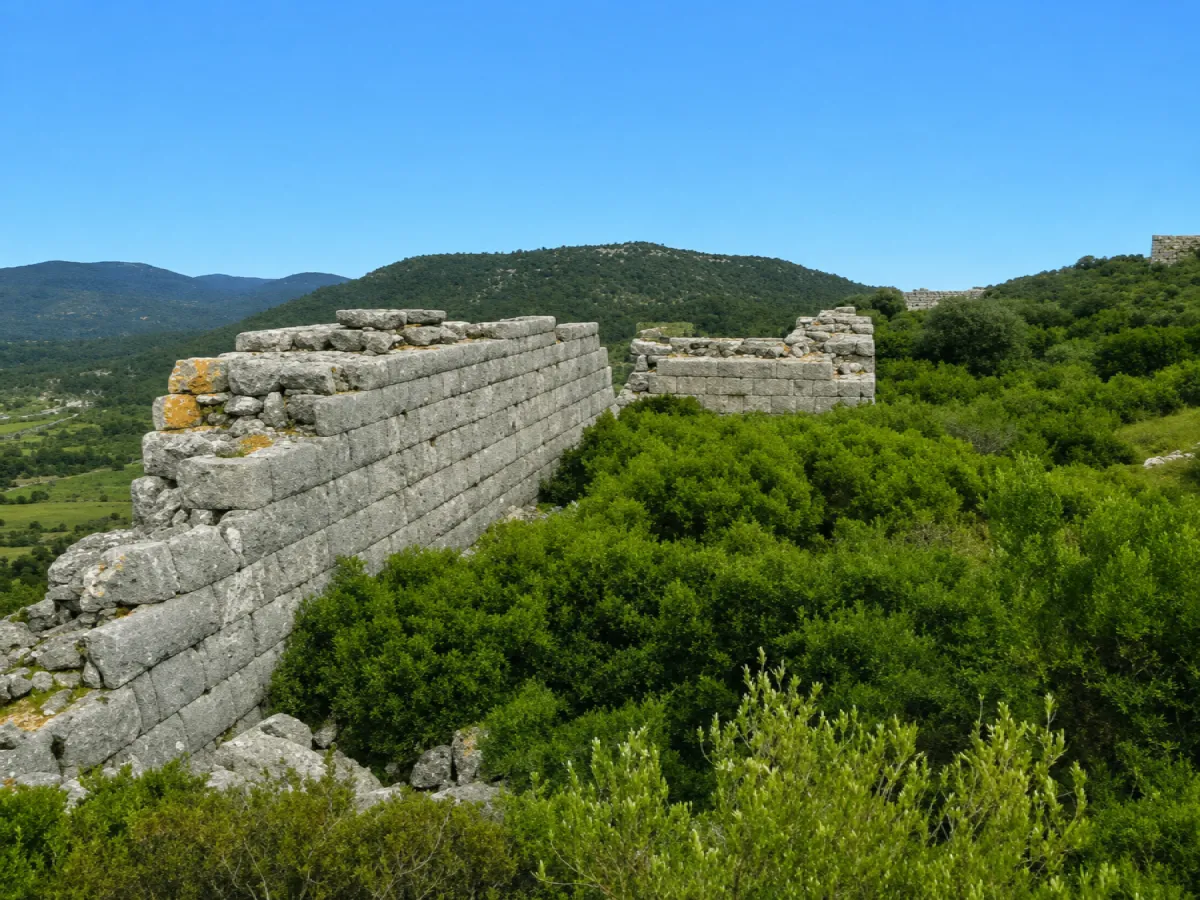
🛡️ Walls of Ancient Samos – “Polycrates’ Walls” of Pythagoreio
Around present-day Pythagoreio, sections survive of the great fortification that once protected the ancient city of Samos, one of the most powerful cities of the eastern Aegean in antiquity.
The fortification is widely known as the “Polycrates’ Walls”, because its first monumental phase is associated with the 6th century BC and the period when Samos reached the height of its power under the tyrant Polycrates.
However, the walls visible today do not all belong to the same period. The fortification was constructed, destroyed, rebuilt and repaired during different historical phases.
📍 Location
The ancient city of Samos occupied the site of modern Pythagoreio, in southeastern Samos.
The ancient fortification formed a large circuit around the city. Its course began near the ancient harbour, climbed towards Kastelli Hill, followed the ridge of Kastri Hill, passed above the area of the Tunnel of Eupalinos, descended towards Glyfada and eventually reached the coast again west of the ancient city.
Today, there is no continuous wall surrounding Pythagoreio. The surviving remains are scattered along different sections of the ancient defensive circuit.
📏 A Fortification Approximately 6.5 Kilometres Long
The complete circuit of the ancient fortification measured approximately 6.5 kilometres, an impressive size for an ancient Greek city.
Even the earliest phase of the fortification extended over this considerable distance and was constructed using polygonal masonry.
The circuit did not surround only the densely inhabited parts of the city. It also incorporated higher ground that could serve defensive purposes and accommodate workshops or other activities.
🏺 The First Archaic Fortification
The first major phase of the wall dates to the 6th century BC.
The exact beginning of its construction cannot be attributed with complete certainty personally to Polycrates. Archaeological dating places the earliest fortification within the period of Samos’s great Archaic prosperity, possibly shortly before or during his rule.
For this reason, the term “Polycrates’ Walls” is useful and well established for visitors, but historically it is more accurate to refer to the Walls of Ancient Samos, with their first monumental phase dating to the 6th century BC.
👑 Samos in the Age of Polycrates
During the 6th century BC, and particularly under Polycrates, Samos developed into one of the leading naval and commercial powers of the eastern Mediterranean.
At that time, the island reached a particularly high level of technical, architectural and artistic achievement.
The same historical context produced major projects such as the Tunnel of Eupalinos, the development of the ancient harbour and other large-scale building programmes.
🧱 Polygonal Masonry
The Archaic phase of the fortification was constructed using polygonal masonry.
The stones were shaped with irregular polygonal sides so that they fitted together with remarkable precision.
The main building material was limestone, quarried locally, including from areas above present-day Panagia Spiliani.
🧱 Stone Below – Mudbrick Above
The ancient wall was not built entirely from massive stone blocks all the way to its full height.
The surviving stonework formed the strong lower section, while parts of the upper structure were constructed using sun-dried mudbricks.
This helps explain why today mainly the stone foundations and lower sections of the fortification have survived.
⚔️ The Destruction of 439 BC
The first great fortification did not remain intact.
During the Samian War of 440–439 BC, Samos came into conflict with Athens under Pericles and was ultimately defeated.
Following the Athenian victory, the city walls were demolished as part of the terms imposed on Samos.
This event created a clear break between the Archaic fortification and the later defensive phases.
🔨 The Major Reconstruction Around 300 BC
The walls were rebuilt much later.
After the return of the exiled Samians towards the end of the 4th century BC, a major new phase of fortification began, and around 300 BC the walls were reconstructed using a different building technique.
This phase made greater use of regular rectangular ashlar masonry, reflecting the more advanced requirements of Hellenistic defensive architecture.
🏰 The Most Impressive Surviving Sections Are Not All from the Age of Polycrates
This is perhaps the most important point for visitors to understand.
Some of the largest and most impressive sections visible today, particularly along the ridge of Kastri and towards Glyfada, belong to later reconstruction phases and not necessarily to the original wall of Polycrates’ era.
Therefore, when viewing a surviving section of the fortification, it should not automatically be assumed that those specific stones were laid in the 6th century BC.
🔧 A Third Phase Around 200 BC
Another, more limited phase of repairs dates to approximately 200 BC.
At this time Samos once again held considerable strategic importance and was used as a naval base within the struggles between Hellenistic powers.
The final limited repairs to the fortification are associated with this period.
The walls collectively known today as the “Polycrates’ Walls” therefore preserve several centuries of military history.
🗺️ The Course of the Fortification Around the City
The wall was designed to make full use of the natural topography.
From the ancient harbour, it climbed towards the higher ground north of the city, followed the ridgelines and then descended again towards the western coastline.
In this way, the fortification protected not only the city and harbour but also strategic heights surrounding them.
Its overall course shows that ancient engineers did not impose a rigid geometric layout, but adapted the defences to the natural terrain.
💧 The Connection with the Tunnel of Eupalinos
The Tunnel of Eupalinos lay within the wider fortified system of the ancient city.
This was of crucial importance because the city’s water supply had to remain secure even during a siege, with the main water route protected inside the fortified area.
The Tunnel also dates to the 6th century BC and represents one of the greatest engineering achievements of ancient Samos.
🌊 The Connection with the Ancient Harbour
The fortifications were also directly connected with the harbour.
Ancient Samos was above all a naval and commercial city, and protecting the harbour was essential to both its security and economic power.
The city, harbour and fortification therefore formed a single defensive and economic system.
🏔️ What Survives Today
Only part of the approximately 6.5-kilometre ancient circuit survives today.
Visible remains can be found in several areas, including:
✅ On the northern and northwestern slopes above Pythagoreio
✅ Along the ridge of Kastri Hill
✅ In the wider area above the Tunnel of Eupalinos
✅ Near Glyfada, where a section of wall with a tower also survives
The level of preservation varies considerably from one location to another. In some places only low foundations remain, while elsewhere impressive rows of large dressed stones are still visible.
🚶 Access & Exploration
The walls do not form a single enclosed archaeological site with one entrance.
The surviving sections are spread across a broad area around Pythagoreio, and some can be reached via trails or dirt tracks.
Access conditions vary depending on location and season, especially because of vegetation and uneven natural terrain.
For the more remote sections, closed walking shoes, drinking water and avoiding the hottest midday hours are recommended.
👀 What to Look For
At the best-preserved sections, it is worth paying attention to:
✅ The large size of the stones
✅ The precision with which they fit together
✅ The difference between polygonal and more regular masonry
✅ The way the wall follows the natural terrain
✅ Remains of towers and reinforced sections
✅ Strategic views towards Pythagoreio and the surrounding area
The different building techniques are among the clearest clues revealing the various historical phases of the fortification.
📷 Photography
The walls offer particularly interesting photographic opportunities at the higher surviving sections.
Especially striking are:
✅ Long rows of ancient stones along the ridgelines
✅ Details of the polygonal masonry
✅ The contrast between ancient stonework and vegetation
✅ Views towards Pythagoreio and the surrounding landscape
During the summer months, early morning and late afternoon usually provide better light and more comfortable temperatures.
🌍 Pythagoreio & UNESCO
The ancient fortified city of Samos forms a fundamental part of Pythagoreio, which together with the Heraion of Samos was inscribed on the UNESCO World Heritage List in 1992.
The protected archaeological landscape of Pythagoreio includes the ancient city within its walls, highlighting the importance of the fortification for understanding the overall layout and history of the ancient settlement.
⭐ A Wall That Tells the Story of More Than One Era
The so-called Polycrates’ Walls are not simply a defensive structure built once during the 6th century BC.
The first fortification belongs to the great Archaic period of Samos, was destroyed following the defeat by Athens in 439 BC, rebuilt around 300 BC and repaired again during the Hellenistic period.
It is precisely this succession of phases that makes the Walls of Ancient Samos so important: within the same defensive circuit, visitors can trace the rise of Archaic Samos, the military upheavals of the Classical period and the renewed strategic importance of the city during Hellenistic times.


Add new comment