
Marathokampos of Samos

🏞️ Marathokampos, Samos – History, Tradition and Life at the Foot of Mount Kerkis
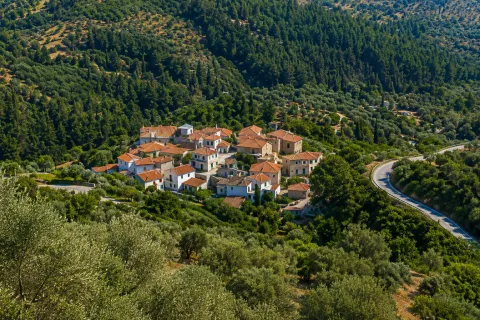
Marathokampos is one of the most historic large villages of western Samos. Built on the southeastern slopes of Mount Kerkis and along the foothills of Fterias, it combines the character of an old mountain settlement—with narrow lanes, arches, churches and stone public buildings—with a broad hinterland extending all the way to the island’s southern coast.
Its history is linked to the resettlement of Samos in the 16th century, seafaring, trade, agriculture, the Greek Revolution of 1821, the period of the Principality of Samos and the social struggles of more recent times. The wider area also includes Ormos Marathokampou, Kampos, Limnionas, Agia Kyriaki, Velanidia and smaller settlements, while the massif of Mount Kerkis is one of the most important natural landmarks on the entire island of Samos.
📍 Location & Geomorphology
Marathokampos lies in southwestern Samos, on the southeastern slopes of Mount Kerkis and along the foothills of Fterias. The settlement rises amphitheatrically, reaching an elevation of about 400 metres in its highest sections, and offers open views over the southern Aegean, Samiopoula, Fournoi Korseon and, in clear weather, islands of the Dodecanese.
The wider area is marked by striking changes in landscape. The rocky slopes and mountainous zones of Kerkis give way to olive groves, cultivated land and small valleys before the terrain descends towards the southern coastline.
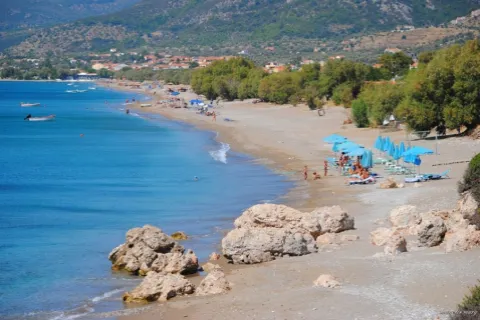
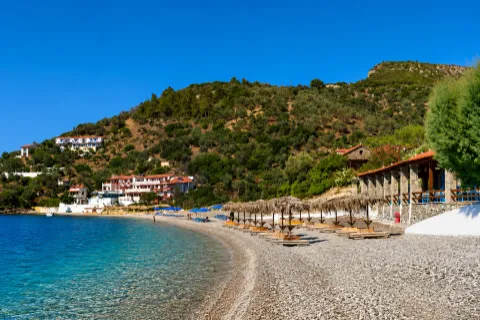
About 4 kilometres south of the village lies Ormos Marathokampou, the historic seaport of Marathokampos. Farther south and west are the coastal areas of Kampos, Velanidia, Limnionas and Agia Kyriaki.
📌 Approximate coordinates of the village centre: 37.7272, 26.6895
🏘️ Architecture & Traditional Character
The old urban fabric of Marathokampos preserves characteristic features of traditional Samian architecture. Houses stand very close to one another, often sharing party walls, while narrow paved lanes, passageways and distinctive arches wind between them.
Older buildings feature flat roofs, arcades, open galleries, terraces with projecting eaves, stone elements and tiled roofs. The same historic fabric includes old churches, public fountains, traditional washhouses, stone school and administrative buildings, as well as structures showing Neoclassical influences.
The narrow, maze-like streets also served a practical defensive purpose in earlier times, as the dense construction, arches and restricted passageways made movement difficult for anyone unfamiliar with the layout of the village.
The variety of architectural forms also reflects the work of craftsmen from different parts of Greece. Several buildings show features associated with Epirote and Peloponnesian building techniques alongside local Samian forms and later Neoclassical lines.
👥 Administration & Population
Marathokampos belongs to the Municipality of West Samos and is the seat of the Municipal Community of Marathokampos. The Municipal Unit of Marathokampos comprises five Municipal Communities:
Marathokampos
Kallithea
Koumeika
Neochori
Skoureika
According to the 2021 Population and Housing Census, the Municipal Unit of Marathokampos has a total permanent population of 2,401.
According to the final census results, the Municipal Community of Marathokampos has 1,681 permanent residents.
Marathokampos retains an important administrative, educational and social role in southwestern Samos, with schools, public services and infrastructure that also serve residents of neighbouring areas.
🏡 Settlements of the Municipal Community of Marathokampos
The Municipal Community of Marathokampos includes the mountain village of Marathokampos and the following officially recorded settlements:
Agia Kyriaki
Velanidia
Isomata
Kampos
Limnionas
Ormos Marathokampou
Palaiochori
Sevasteika
Kampos Marathokampou is also widely known in tourism as Votsalakia, a name frequently used for the coastal zone of the area.
🚗 Distances
Marathokampos is approximately:
📍 14 km from Karlovasi
📍 16 km from the port of Karlovasi
📍 42 km from the port of Samos
📍 32 km from Samos Airport
📍 4 km from Ormos Marathokampou
Access is via the road network of western Samos, with numerous bends along the more mountainous sections of the route.
📜 History & Formation of the Settlement
The formation of present-day Marathokampos dates to the second half of the 16th century, during the resettlement of Samos. After a long period of population decline and abandonment on the island, privileges granted to new settlers attracted families from different parts of the Greek world.
Among the early inhabitants were the so-called Chiosamians, descendants of Samians who had settled on Chios. On returning to Samos, they brought with them the veneration and icon of Agia Matrona of Chios, which became closely associated with the religious life of the village and is kept in the metropolitan church of Profitis Ilias.
An early settlement nucleus existed lower down at Loukaika, towards the present-day Kampos area. Over time the population concentrated at the current site of Marathokampos, where the old neighbourhoods developed around Louga, Profitis Ilias, Agia Triada and Agia Paraskevi.
The presence of Marathokampos is documented from the early 17th century. Agia Paraskevi is mentioned in a document of 1607, while in 1624 Theodosios, abbot of the Monastery of Hozoviotissa on Amorgos, stated that he had been born in Marathokampos. In 1632 the settlement appears in a tax register with 73 households, showing that an organised community had already been established.
Over time, settlers from the Peloponnese, Crete, Ikaria, the Dodecanese and other families from the Aegean and Asia Minor joined the local population. Their different origins left traces in surnames, place names, neighbourhoods and the architecture of the village.
🌿 Origin of the Name
The most widely accepted interpretation links the name ‘Marathokampos’ to the fennel that once grew abundantly across the lower-lying parts of the area. The name combines the Greek words marathos, meaning fennel, and kampos, meaning plain, directly reflecting the natural landscape around the earliest settlement nuclei.
The presence of wild fennel also appears in local tradition associated with the first settlement at Loukaika, before the village shifted to its present location.
🛶 Maritime Tradition & Commercial Development
Although Marathokampos is a mountain village, the sea played a decisive role in its economic and social development. The growth of Ormos Marathokampou as its seaport created a permanent link between the village and the maritime trade routes of the Aegean.
In the period before the Greek Revolution, Marathokampos developed into an important seafaring community. Shipwrights, captains, sailors and merchants from the area travelled to the coast of Asia Minor, the Aegean islands, Cyprus, the northern coasts of Africa and the Black Sea.
Timber from Mount Kerkis was a valuable raw material for shipbuilding, while boatyards and workshops for building and repairing wooden vessels developed along the coast. Maritime skills passed from generation to generation and became one of the defining elements of local identity.
Alongside shipping, fishing, olive-oil production, soapmaking, logging, charcoal production and the quarrying of the local stone known as ‘santournisa’ also played important roles in the economy.
🇬🇷 The Greek Revolution of 1821 in Marathokampos
Marathokampos took an active part in the Samian Revolution of 1821 and produced several notable fighters. On 17 April 1821, a service of thanksgiving was held in the village, during which the fighters raised the icon of the Archangels and swore to fight for freedom.
The historic icon thereafter became closely associated with the village’s participation in the Revolution, and in 1825 captains from Marathokampos covered it with silver. The bell that rang on 17 April 1821, calling the inhabitants to rise up, is preserved with the icon in the church of Agios Antonios.
A central figure in the revolutionary history of the village was Captain Stamatis Georgiadis, who joined the military-political organisation of Lykourgos Logothetis and served as the first chiliarch of Samos. In early July 1821 he distinguished himself in the clash at Cape Tzortzi, later known as Kavo Fonias, where Kaplan Agha, commander of the Ottoman force, was killed.
Captain Stamatis was born in Marathokampos in 1791 and died in Chalkida in 1861. Lykourgos Logothetis was his brother-in-law, having married his sister Loulouda Georgiadi, while the poet and fighter Georgios Anagnostis Kleanthis was also related to him by marriage.
⚔️ Fighters & Historical Figures of 1821
Other inhabitants of Marathokampos also took part in the struggle in military, naval or political roles.
Among the most notable were:
Antonios Georgiadis, brother of Captain Stamatis, who later played an important role in the Samian assemblies.
Sevastos Giagas, a chiliarch during the Revolution.
Konstantinos Palaios, who placed his privately owned ship Charikleia, armed with six cannons, at the service of the struggle.
Konstantinos Kontrafouris, a fireship sailor.
Stamatis Alexi, a close associate of Captain Stamatis.
Georgios Anagnostis Kleanthis, poet and fighter, known as the ‘Tyrtaeus of Samos’.
Their activity formed part of the wider mobilisation of Samos, which repeatedly repelled Ottoman attempts to seize the island during the Revolution.
🎩 The Principality, Union with Greece & Modern History
During the period of the Principality of Samos, Marathokampos retained an important administrative and educational role. Public services and educational institutions operated in the village, while buildings and public works were constructed that remain local landmarks today.
The old building of today’s Gymnasium was erected around 1881, during the administration of Prince Konstantinos Adosidis, to house the second Court of First Instance of Samos. After the union of Samos with Greece in 1912 it was used as a secondary school and, from 1930, housed the Gymnasium.
In the early 20th century, the brothers Giorgos, Kostas, Giannis and Kimon Giagas became prominent figures. They participated in the movement led by Themistoklis Sofoulis against the Principality and in favour of the union of Samos with Greece. In the years that followed, they were associated with the so-called Giagades movement, a complex and particularly turbulent chapter in Samian history during the first decades of the 20th century.
🪖 Occupation & National Resistance
During the Italian and German occupation of Samos, from 1941 to 1944, Marathokampos saw intense resistance activity.
The historic Gymnasium building was used as an administrative headquarters by the occupying forces, while testimonies from the period link the school and village residents with organised resistance activities.
The war memorial near the Kentourios School preserves the memory of residents who lost their lives in the wars of the 20th century, during the Occupation and in the National Resistance.
👤 Ecclesiastical, Intellectual & Cultural Personalities
Marathokampos has produced important figures in church life, education, literature and the sciences.
Patriarch Damianos of Jerusalem, born Dimitrios Kassiotis (1848–1931), came from the village and also contributed to the educational development of the area.
Alexandros Dilanas also distinguished himself in the ecclesiastical hierarchy, serving as metropolitan bishop in important dioceses.
In literature and education, Giorgis Karatzas, Manolis Sarris and Giannis Chatzinis stood out, while the archaeologist Manolis Andronikos—one of the most important figures in 20th-century Greek archaeology—is also connected with Marathokampos.
🏫 Education & Historic Public Buildings
Marathokampos’s educational tradition is reflected in buildings that still possess considerable historical and architectural value.
The Kentourios Urban School, today the Primary School, was built in 1920 at the expense of Patriarch Damianos of Jerusalem. The site had been donated by the Kentouris family in memory of their parents, and the imposing building is one of the village’s most distinctive public structures.
The old Gymnasium of Marathokampos has an even earlier history. The building was erected around 1881 as a Court of First Instance, later served as a secondary school and, from 1930, as the Gymnasium. During the Occupation it was used by the occupying forces, before returning to educational use after Liberation.
The old community office, built in 1906, is another part of Marathokampos’s public architectural heritage.
🌿 Natural Environment & Cultivation
The natural landscape of Marathokampos is shaped to a great extent by Mount Kerkis. Its steep rocky slopes, ravines, springs, caves and smaller wooded zones create one of the most imposing landscapes on Samos.
At lower elevations, extensive olive groves, vineyards and cultivated land spread across the terrain. Velanidia and the flatter areas of the community were traditionally used for vegetables, potatoes, onions, pulses, vines and olives.
Olive cultivation has been a cornerstone of the local economy for centuries. High olive-oil production led to the operation of numerous olive presses throughout the wider area, while olive groves remain a defining feature of the agricultural landscape today.
⛰️ Mount Kerkis – The Mountain Identity of the Area
Mount Kerkis, also known as Kerketeas, rises above Marathokampos and is the highest mountain on Samos. Its Vigla summit reaches about 1,434 metres, making Kerkis one of the highest island mountains in the Aegean.
The mountain contains caves, springs, chapels and old places of ascetic retreat. Its steep slopes and rocky terrain create demanding hiking routes with large elevation changes and impressive views across the southern and western Aegean.
On its slopes lie the Cave of Pythagoras, Panagia Sarantaskaliotissa, Evangelistria and the mountain chapel of Profitis Ilias—sites where the natural landscape meets the religious and folk traditions of the area.
🏘️ Neighbourhoods & Local Names
Traditional Marathokampos is divided into neighbourhoods and smaller districts whose names remain part of the collective memory of local residents.
Among the best known are:
Alonaki
Ambarakia
Ano Rouga and Kato Rouga
Vatikiotika
Gyrisma
Kotroni
Louga
Loviarika
Moraitochori or Moraitia
Parliaria
Pirnari
Skoutari
These names are associated with old families, occupations, geomorphological features, churches and events from local history.
🧭 Place Names of the Wider Area
The extensive territory of the Municipal Community has preserved numerous place names that reflect the inhabitants’ relationship with the land, vegetation and religious life.
Characteristic names include Velanidia, Isomata, Limnionas, Palaiochori, Psili Ammos, Sarantaskaliotissa, Fterias and the Cave of Pythagoras. Many smaller place names derive from saints and chapels, plants, rocks, streams or distinctive features of the terrain.
Local pronunciation has preserved several of these names in forms that differ from modern standard Greek, forming part of the linguistic and folkloric heritage of Marathokampos.
⛲ Fountains & Traditional Washhouses
Public fountains and washhouses are among the most characteristic features of old communal life. Before household water supply became universal, they were everyday places of work, meeting and social contact.
In Lakka Square stands the ornate fountain built on 23 February 1891, during the rule of Prince Alexandros Karatheodoris. Its water also supplied the stone washhouses behind Agios Athanasios, which were built in 1900.
In Louga, the square also known as Union Square, there is a public fountain dating from 1881, built during the period of Prince Konstantinos Adosidis. Beside it stands the old plane tree, associated with the memory of the Union of Samos with Greece.
The Aplyti fountain, near Agia Triada, is connected with the washhouses of Ano Rouga and bears the renovation date 1847.
Another important group is formed by the large stone washhouses at Vryses, dating from the late 19th century, as well as the surviving Tsangarakis Washhouses in the Skoutari area.
🛍️ Traditional Economy & Local Production
For a long period, the economy of Marathokampos was based on a combination of agriculture and maritime activity. Olive-oil production held a central place, and numerous olive presses operated throughout the wider area.
Fishing, logging, charcoal production, soapmaking, woodworking and the quarrying of the local ‘santournisa’ stone also developed. Timber from Mount Kerkis supplied the traditional shipbuilding industry of the coastal zone.
Olives, vines and vegetables are cultivated in Velanidia and the lowland areas, and agricultural production remains clearly visible in the landscape today.
In the coastal areas, particularly Kampos and Ormos, tourism has acquired an important role, with accommodation, restaurants and services operating mainly during the summer season.
🍽️ Local Gastronomy
The cuisine of the area follows the agricultural and island traditions of Samos, making use of olive oil, vegetables, pulses, herbs, meat, fish and seasonal produce.
Home cooking includes trahanas, dolmades, pies, dishes made with courgettes and wild greens, stuffed courgette flowers, pulses and seasonal recipes prepared for major feast days. Fish and seafood meze hold an important place in the coastal areas.
Traditional sweets include baklava, spoon sweets made from seasonal fruit and nuts, as well as older local confections preserved through family recipes.
⛪ Churches & Religious Heritage
Marathokampos has a significant number of historic churches, chapels and monastic sites. Religious architecture is an essential part of the village’s character and is connected with events in local history from the 17th century to the present day.
🕯️ Profitis Ilias
Profitis Ilias is the four-aisled metropolitan church of Marathokampos and stands above Louga Square. The church houses the icon of Agia Matrona of Chios, brought to the area by the Chiosamian settlers during the resettlement period.
A sundial survives on the southern side of the church, an unusual feature that stands out within the ecclesiastical architecture of the village.
🕯️ Agia Paraskevi
Agia Paraskevi is one of the earliest documented churches of Marathokampos, as it is mentioned in a document dating to 1607.
It is a spacious three-aisled basilica. A dome that once formed part of the church collapsed after the strong earthquake of 1904 and no longer survives.
🕯️ Agia Triada
Agia Triada dominates Ano Rouga, in the northern and highest part of the settlement. An inscription above the doorway gives 1798 as the year of construction.
The church has two aisles and includes a small chapel dedicated to Hosios Christodoulos. The iconostasis dates to 1892, while the principal icon of the Holy Trinity bears the date 1810.
🕯️ Agios Athanasios & Agia Varvara
Agios Athanasios stands in the lower part of the village and is a two-aisled basilica without a dome. An old olive press was once associated with the church, reflecting the close relationship between the parishes and the economic and social life of the settlement.
Agia Varvara also stands in a small square of the old neighbourhood and is locally known as the small Ai-Thanassakis. An inscription at the southern entrance bears the date 1798. It is a simple two-aisled church with vaulted aisles and a small arched bell tower.
🕯️ Agios Antonios
The church of Agios Antonios stands near the central square and was founded in 1904. It is dedicated to Saint Anthony the Great and the Archangels.
Inside are preserved two of the most important historic relics of Marathokampos: the icon of the Archangels associated with the thanksgiving service of 17 April 1821 and the bell that called the inhabitants to the uprising.
🕯️ Panagia Myrtidiotissa
Panagia Myrtidiotissa served as the village cemetery church. According to the inscription above the doorway, its foundations were laid in 1840 and it was completed in 1898.
The church stands near the historic school complex and forms another stop on the walking route through Marathokampos.
🕯️ Monastery of the Dormition of the Theotokos
The Monastery of the Dormition of the Theotokos lies within the settlement. Its church was built in 1768, while an inscription above the door records a renovation in 1819.
It was organised as a women’s monastery in 1887, when Athonite fathers associated with the Kollyvades tradition settled in the area. After a period of abandonment, new construction and restoration work began in 2010.
Old ecclesiastical books and other evidence of the monastery’s long religious presence are preserved on the site.
🕯️ Agios Georgios of Marathokampos
Agios Georgios stands on a foothill of Mount Kerkis, about 7–8 kilometres southwest of the village. It was the church of a small old monastery associated with the Monastery of Saint John the Theologian on Patmos and is mentioned as early as the 17th century.
The present church is dated to the 18th century and belongs to the triconch type, with a low dome. Elements of the former monastic complex survive on the site, including sections of the enclosure and cells, within an isolated mountain landscape of Kerkis.
🕯️ Evangelistria of Mount Kerkis
Evangelistria lies on the southern slopes of Mount Kerkis, in a mountain location associated with the old ascetic routes of the massif.
The site is a characteristic stop for hikers and pilgrims heading towards the higher zones of Kerkis and the mountain chapel of Profitis Ilias. The secluded landscape, rocky slopes and views towards the sea create one of the area’s most distinctive religious landmarks.
🕯️ Panagia Sarantaskaliotissa & the Cave of Pythagoras
Panagia Sarantaskaliotissa is a small chapel built in a cave-like setting on Mount Kerkis. Its name is associated with the steps leading to the site, and its location is a characteristic example of the ascetic tradition that developed in the caves and steep slopes of the mountain.
In the same mountain zone lies the Cave of Pythagoras, where, according to local tradition, Pythagoras took refuge while being persecuted by the tyrant Polycrates. The area combines historical legend, mountain scenery and religious tradition and is one of the best-known hiking destinations in western Samos.
🎭 Customs & Folk Tradition
The social life of Marathokampos preserves customs linked to the annual cycle of feast days, the parishes and agricultural life. Many have been passed from generation to generation and form an essential part of the village’s cultural identity.
🤡 Frantzolia – Carnival in Marathokampos
A distinctive Carnival custom is the Frantzolia: masqueraders wearing improvised, mismatched and often exaggerated costumes. Their appearance is based on satire, the overturning of everyday appearances and social commentary.
The masqueraders move through the neighbourhoods, teasing acquaintances and passers-by and carrying the humour of Carnival from house to house and from group to group. The custom remains one of the most characteristic expressions of Marathokampos folklore.
🧨 The Easter ‘Ovydes’
One of the best-known customs of Marathokampos is the Easter ‘Ovydes’, held on Easter Sunday on the slopes surrounding the village.
The tradition is linked to the historical memory of the Ottoman period and to the symbolism of the Resurrection and freedom. The village parishes maintain separate sites on the surrounding slopes, known as tabania, and take part in organised volleys during the Easter celebrations.
The powerful sound, the smoke over the hillsides and the participation of the parishes have made the custom one of the most recognisable cultural events in Marathokampos. It is watched from safe viewing areas and in accordance with instructions from local authorities and organisers.
🔥 Klidonas & Summer Festivals
In Ormos Marathokampou, the custom of Klidonas is revived on 23 June, the eve of the feast of Agios Ioannis, with bonfires, traditional activities, music and dancing.
Festive events are held in Agia Kyriaki around the feast day of Agia Kyriaki on 7 July, while Profitis Ilias is celebrated in Louga Square on 20 July.
Agia Triada celebrates with festivities on the feast of the Holy Spirit. During the summer months, cultural and gastronomic events are also organised in Ormos and the coastal areas, depending on the annual programme of local organisations.
🏖️ Coastal Zone & Tourism
The Municipal Community of Marathokampos has an extensive coastal zone with a character quite different from that of the mountain village.
Ormos Marathokampou is the historic coastal settlement and harbour of the area, with a long fishing and maritime tradition. Kampos Marathokampou – Votsalakia is the largest tourism zone, with a long beach and well-developed accommodation and dining services.
Farther west lie Limnionas and Agia Kyriaki, while Psili Ammos Marathokampou is one of the well-known beaches of southwestern Samos. Velanidia retains a more agricultural and tranquil character, linking cultivated land with the sea.
The growth of tourism along the coast created a second economic centre for the area without erasing the distinct character of the mountain village of Marathokampos.
🚶 Walking Route through Marathokampos
A tour of the village can be organised as a circular walk through the settlement’s most important historical and architectural points of interest.
1. Central junction – starting point
2. Tourist information kiosk
3. Kentourios School – Primary School
4. War memorial
5. Square and Church of Agios Antonios
6. Historic Gymnasium – Lyceum building
7. Panagia Myrtidiotissa
8. Lakka Square
9. Traditional washhouses of Lakka
10. House of Patriarch Damianos of Jerusalem
11. Rina Arch
12. Soulou Arch
13. Alexios Kiassos Arch
14. Agia Varvara
15. Psoma Arch
16. Agia Paraskevi
17. Site of the house of Captain Stamatis Georgiadis
18. Traditional Sgouros fountain
19. Traditional washhouses
20. Old carpentry workshop
21. Old Marathokampos community office
22. Louga Square – Union Square
23. Old cinema building
24. Bust of Captain Stamatis Georgiadis, fighter of the Greek Revolution of 1821
The route passes through the old neighbourhoods, arches, churches and public works that reflect different phases of the village’s history.
🤝 Associations & Community Life
Organised community activity has a strong and continuing presence in the Marathokampos area. Sports, cultural, professional and volunteer organisations contribute to preserving customs, civil protection, promoting the area and organising events.
Organisations associated with the social life of the area include A.S. Kerkis Marathokampou, the Marathokampos Volunteer Firefighters, the Marathokampos Association of Tourism Professionals, the Friends of Marathokampos Cultural and Improvement Association and the ‘Agios Nikolaos’ Cultural Association of Ormos Marathokampou.
The work of these associations complements the role of the parishes and local communities and forms an important part of contemporary social life.
🌅 Marathokampos Today
Marathokampos remains a village with a strong historical memory and a distinctive local identity. Old architecture, arches, squares, fountains and churches coexist with schools, services and contemporary everyday life.
Its relationship with Mount Kerkis, agriculture and the sea continues to shape its character. The mountain village, Ormos and the coastal settlements together form an area with a remarkable variety of landscapes, historical memories and activities.
For visitors, Marathokampos is not simply a stop on the road to the beaches of southwestern Samos. It is a place worth discovering on foot—walking through its lanes, observing its old buildings, arches and fountains, and experiencing the close relationship between the mountain, the village and the sea.



Add new comment