
Kambos of Skoureika
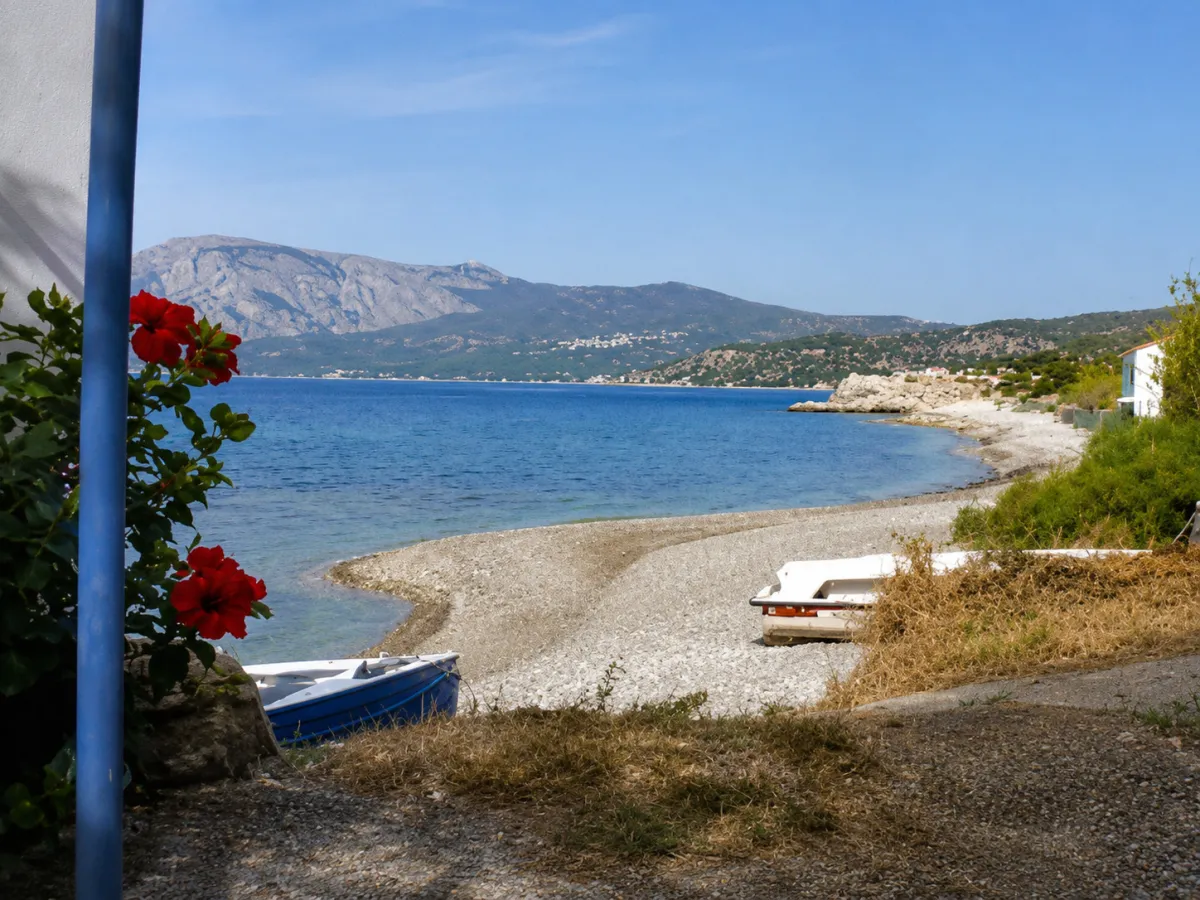
🌾 Kampos Skouraiikon, Samos – The Peaceful Coastal Settlement Among the Olive Groves
Kampos Skouraiikon is a small and sparsely populated coastal settlement in southwestern Samos. It lies between the village of Skouraiika and the island’s southern coastline, within a low agricultural area characterised by olive groves, cultivated land, scattered houses and small local roads.
Unlike the higher village of Skouraiika, Kampos extends almost at sea level. It does not have a compact historic centre, central square or densely built traditional neighbourhood. Its character is defined by houses scattered among cultivated fields and by its close relationship with the nearby coast.
The area is suitable for visitors seeking tranquillity, agricultural scenery and access to less crowded beaches. It is not an organised tourism resort, but a small place of permanent and seasonal residence with an authentic rural character.
📍 Location and natural environment
Kampos is located in southwestern Samos, approximately 4–4.5 kilometres southwest of Skouraiika. It extends across a low plain that reaches the southern coastline, between the coastal settlements of Perri and Pefkos.
The landscape includes extensive olive groves, small gardens, cultivated plots, reeds, low Mediterranean vegetation and scattered houses. The surrounding hills create a sheltered rural environment, while the horizon opens towards the Aegean Sea to the south.
Its very small elevation above sea level makes the area considerably flatter than most villages in western Samos. The officially recorded altitude of the settlement is approximately one metre.
🏛️ Administrative identity of the settlement
Kampos belongs to the Municipal Community of Skouraiika, within the Municipal Unit of Marathokampos and the Municipality of Western Samos. The municipality is part of the Regional Unit of Samos in the North Aegean Region.
The Municipal Community of Skouraiika includes four officially recognised settlements:
✅ Skouraiika
✅ Kampos
✅ Perri
✅ Pefkos
According to the 2021 Population Census, the Municipal Community of Skouraiika has a total of 193 permanent residents.
📜 Official recognition and administrative changes
Kampos was officially recognised as a separate settlement on 14 March 1971 and was incorporated into the former Community of Skouraiika.
In 1997, following the implementation of the Kapodistrias administrative reform, the settlement became part of the Municipality of Marathokampos. In 2010, it was incorporated into the unified Municipality of Samos, and since 2019 it has belonged to the Municipality of Western Samos.
Its official recognition in 1971 does not necessarily mean that the area was previously uninhabited. It reflects the administrative registration of a small agricultural and coastal residential area that had gradually acquired a more permanent population.
📝 The name Kampos
The name “Kampos” derives from the geographical character of the area. Unlike the higher village of Skouraiika, this zone consists of low and relatively flat land suitable for olive cultivation, small gardens and residential use near the sea.
To distinguish it from other settlements on Samos with the same name, it is commonly referred to as Kampos Skouraiikon.
Other settlements on the island with similar names include:
✅ Kampos Marathokampou in western Samos
✅ Kampos Vourlioton in northern Samos
👥 Population and present-day life
According to the results of the 2021 Population Census, Kampos Skouraiikon has 39 permanent residents. In the 2011 Census, seven permanent residents were recorded.
This increase has not transformed Kampos into a densely built settlement. Houses remain scattered across a broad agricultural and coastal area, without a clearly defined central neighbourhood.
During the summer months, the number of people increases because of seasonal residences, visitors and residents using the area to reach the nearby beaches.
🏘️ The form of the settlement
Kampos does not have the typical form of a Samian village with a square, parish church and houses grouped around a central road.
The settlement is characterised by:
✅ Scattered detached houses
✅ Small holiday homes
✅ Agricultural buildings and storage facilities
✅ Gardens and olive groves between the houses
✅ Low-rise development without large buildings
✅ Local roads leading towards the coast
The sparse development allows the agricultural landscape to remain the dominant feature. Most houses are relatively modern and functional, without a consistent traditional architectural style.
🫒 Olive cultivation and the agricultural landscape
Olive cultivation is the most important feature of the landscape in the wider Skouraiika area. Olive groves cover much of the flat zone and the lower hillsides surrounding Kampos.
Small gardens, fruit trees and plots used for household production can be found among the olive trees. Old agricultural roads and tracks continue to connect the cultivated land with the houses and the coastline.
Agricultural activity is less intensive than in previous decades, but it continues to shape the character and use of the land.
🌿 Vegetation and seasonal scenery
The appearance of the area changes noticeably with the seasons.
In spring, the low fields and roadsides are covered with wildflowers and grass. The olive groves take on a rich green colour, while temperatures are suitable for walking and photography.
During summer, the landscape becomes drier and activity shifts towards the coast. In autumn and winter, agricultural activity associated with the care of the olive groves and the olive harvest becomes more noticeable.
🌊 The coastline of Kampos
The low-lying area of Kampos reaches the southern coastline of Samos. The coast includes small quiet beaches, rocky sections and stretches with sand or pebbles.
These beaches do not have the character of large organised tourism destinations. Facilities are limited, and the coastline retains a more natural appearance.
The sea along the southern coast of Samos is generally less exposed to strong northerly winds than the beaches of the northern coast. Sea conditions should nevertheless always be checked before swimming.
🏖️ Nearby beaches and coastal settlements
Kampos lies among small coastal settlements and quiet beaches in the Skouraiika area.
Along the wider coastline, visitors can find:
✅ Kampos Beach
✅ Perri and its beach
✅ Psili Ammos Perri
✅ Pefkos and its small coastal areas
✅ Small natural bays without organised facilities
Psili Ammos Perri retains a natural and relatively secluded character, with sand and fine pebbles and no permanent organised facilities.
The names of smaller beaches are not always used consistently on maps and in local references. Visitors are therefore advised to keep accurate GPS locations available.
🛣️ The local road network
Kampos can be reached from Skouraiika by a local paved road descending towards the southern coastline.
The road network in the area includes:
✅ Paved roads connecting the officially recognised settlements
✅ Narrower local roads leading to houses
✅ Agricultural branches leading to the olive groves
✅ Short unpaved sections leading to isolated fields or beaches
The main routes are suitable for a conventional car. Some smaller branches require caution because of their narrow width, limited signs or uneven road surface.
🥾 Walking and gentle routes
Kampos is not an organised hiking destination with marked trails. It is, however, suitable for short and peaceful walks through the agricultural landscape.
Local roads pass through olive groves, gardens and low vegetation, while several branches lead towards the sea.
For longer walks, visitors should bring:
✅ Suitable footwear
✅ Drinking water, especially during summer
✅ Sun protection
✅ A map or navigation application
✅ Respect for private farmland and fenced properties
🛏️ Facilities and everyday needs
Kampos has limited local facilities. There is no organised shopping centre, large market or concentrated service area.
For essential shopping, pharmacies, banking services and a wider selection of restaurants, visitors need to travel to Skouraiika, Marathokampos, Kampos Marathokampou or Karlovasi.
Small accommodation facilities and restaurants may operate seasonally in the wider coastal area, particularly during summer. Their availability and opening hours should not be assumed outside the main tourism season.
🌿 What to see
During your visit to Kampos Skouraiikon, it is worth discovering:
✅ The low agricultural landscape near the sea
✅ The olive groves and small gardens
✅ The quiet local beaches
✅ Kampos Beach
✅ Psili Ammos Perri
✅ The coastal settlement of Perri
✅ Pefkos and its surrounding beaches
✅ The small roads passing through cultivated land
✅ The open viewpoints towards the southern Aegean Sea
🚶 Visitor experience
A visit to Kampos does not follow the pattern of a conventional village tour. There is no specific square or central historic neighbourhood from which visitors need to begin.
The best experience is a slow drive or walk through the olive groves, with stops at places offering open views towards the sea.
A visit can be combined with:
✅ A walk through Skouraiika
✅ A stop at Perri
✅ Swimming at Psili Ammos Perri
✅ A visit to Pefkos
✅ Continuing towards Neochori, Koumaika or Balos
A short introduction to the settlement takes approximately 30–45 minutes. With a walk and a stop at a nearby beach, the visit can last two hours or longer.
📆 When to visit
Spring: The best season for green agricultural landscapes, wildflowers, mild temperatures and walking.
Summer: Suitable for combining the area with swimming at the nearby beaches. Morning or late-afternoon visits are preferable.
Autumn: A peaceful season for photography, exploration and scenes of agricultural work.
Winter: The area is extremely quiet, but available services and restaurants are limited.
🧭 How to get there
The main access route begins at Skouraiika, following the local road descending towards the coastal zone.
Kampos is located approximately:
✅ 4–4.5 kilometres from Skouraiika
✅ 19 kilometres from New Karlovasi
✅ Approximately 41–45 kilometres from Samos Town, depending on the route
Distances may vary according to the exact part of the settlement or coastline selected as the destination.
Travelling by car or motorcycle is the most practical option. A regular public bus connection to this small settlement should not be assumed.
ℹ️ Useful information
✅ Official settlement name: Kampos
✅ Commonly used name: Kampos Skouraiikon
✅ Municipal community: Skouraiika
✅ Official settlements of the community: Skouraiika, Kampos, Perri and Pefkos
✅ Character: Small coastal and agricultural settlement
✅ Location: Southwestern Samos
✅ Municipal unit: Marathokampos
✅ Municipality: Western Samos
✅ Regional unit: Samos
✅ Region: North Aegean
✅ Official recognition of the settlement: 14 March 1971
✅ Population in 2011: 7 permanent residents
✅ Population in 2021: 39 permanent residents
✅ Population of the community in 2021: 193 permanent residents
✅ Altitude: Approximately 1 metre
✅ Distance from Skouraiika: Approximately 4–4.5 kilometres
✅ Distance from New Karlovasi: Approximately 19 kilometres
✅ GPS coordinates: 37.68740, 26.75880
✅ Road access: Paved local road
✅ Facilities: Limited and mainly seasonal
✅ Recommended visiting time: From 30 minutes to 2 hours
✅ Suitable for: Agricultural landscapes, peaceful stays, photography, short walks and access to secluded beaches




Add new comment