
Ormos Agios Isidoros, Samos

⚓ Ormos Agios Isidoros, Samos – The Historic Boatyard at the Northwestern Edge of the Island
Ormos Agios Isidoros, known locally as Ai Sideris, is a small coastal settlement at the northwestern edge of Samos. It lies on a remote shoreline below the western slopes of Mount Kerkis and historically served as the natural seaport of the villages of Drakaioi and Kallithea.
The identity of the area is closely connected with the sea and traditional wooden shipbuilding. One of the most important historic boatyards on Samos survives in the small bay, where wooden vessels continue to be constructed, repaired and maintained. The chapel of Agios Isidoros, the old workshops, wooden hulls and small pier create a rare landscape of maritime and technical heritage.
According to the 2021 census, no permanent residents were recorded in Ormos Agios Isidoros. The area is not abandoned, however, as shipbuilding activity continues and the bay is used seasonally by craftsmen, fishermen, boat owners and visitors. Administratively, it belongs to the Municipal Community of Drakaioi, the Municipal Unit of Karlovasi and the Municipality of Western Samos. The municipality forms part of the Regional Unit of Samos in the North Aegean Region.
📍 Location and Character
Ormos Agios Isidoros lies on the northwestern, rather than southwestern, coast of Samos, in an area far from the island’s main road network. It is an officially recognised settlement of the Municipal Community of Drakaioi, although it is historically and functionally connected with both Drakaioi and Kallithea.
The small bay is formed between rocky shores and low slopes descending towards the sea. The landscape is rugged and isolated, with pine trees, olive groves, shrubs and low Mediterranean vegetation. From the wider area, there are open views across the Aegean towards Ikaria and Fournoi.
The settlement lies close to sea level, at an altitude of approximately 20 metres. The geographical coordinates of its central point are approximately 37.7542, 26.5921.
📝 The Official Name and the Name Ai Sideris
The official administrative name is Ormos Agios Isidoros. In local speech, the name Ai Sideris is widely used as a traditional shortened form of Agios Isidoros.
The place name comes from the chapel located inside the bay, one of the oldest surviving landmarks in the area.
📜 The Seaport of Drakaioi and Kallithea
For a long period, Ormos Agios Isidoros served as the principal maritime outlet of Drakaioi and Kallithea. Until the construction of a road suitable for vehicles in 1965, communication between these two isolated villages and the rest of the island took place largely by sea.
Karlovasi, approximately six nautical miles northeast of the bay, was the main connecting port. People, tools, timber, agricultural products and supplies were transported through Agios Isidoros to and from the two mountain villages.
Maritime communication was particularly important because of the geography of western Samos. The steep slopes of Mount Kerkis and the difficult terrain made the construction of a short road connection with Karlovasi extremely challenging.
🏛️ Administrative Development
An earlier settlement named Agios Isidoros was officially recognised in 1928 and incorporated into the Community of Drakaioi. This original administrative entry was abolished in 1940.
On 5 April 1981, the present settlement was officially recognised under the name Ormos Agios Isidoros and incorporated into the Community of Drakaioi. In 1997, it became part of the Municipality of Karlovasi, in 2010 of the unified Municipality of Samos and, since 2019, of the Municipality of Western Samos.
👥 Population and Present-Day Use
The population of Ormos Agios Isidoros was always small and was mainly connected with the operation of the boatyards. In 1991, 19 residents were recorded, followed by 11 in 2001 and 18 permanent residents in the 2011 census.
In the 2021 census, the permanent population was recorded as zero. The Municipal Community of Drakaioi had a total population of 75, all recorded in the mountain settlement of Drakaioi.
The absence of a registered permanent population does not mean that the area is no longer used. Work continues at the traditional boatyard, while storage buildings, workshops and other small facilities support the seasonal presence of people connected with boats and the sea.
⚓ The Natural Bay and Small Pier
Agios Isidoros is a small natural bay providing access and temporary shelter for small vessels. A pier along the shore serves fishing boats, private craft and the operational needs of the boatyard.
It is not an organised marina or a modern fishing harbour. There are no refuelling facilities, formally arranged moorings, port services or tourism infrastructure for larger vessels.
Approaching by sea requires careful assessment of the weather, as the small bay should not be considered safe in every wind direction or during strong waves.
🛶 The Tradition of Wooden Shipbuilding
The boatyard of Agios Isidoros is one of the most important locations in the modern shipbuilding history of Samos. The isolated shoreline, the ability to launch vessels directly into the sea and access to suitable timber contributed to the development of traditional wooden boat construction.
During the 20th century, six small and independent shipbuilding or repair units operated in the bay. Their workforce included residents of Drakaioi, Kallithea and other villages of Samos.
The activity employed traditional shipwrights, woodcutters, timber hewers, transport workers, assistants and craftsmen from several specialised trades. Timber was brought from the forested areas of western Samos and processed close to the shoreline.
⛵ The Wooden Vessels of Agios Isidoros
Different types of traditional vessels were constructed at Agios Isidoros, including trechantiri boats, trawlers, perama cargo boats, varkalades, karavoskara, smaller boats and wooden barges. The barges were used to transfer passengers and goods between the shore and larger ships that could not approach the coast easily.
The largest vessel reported to have been built at Agios Isidoros was constructed during the middle of the 20th century by the shipwright Psilopatis. It measured approximately 25 metres in length and 8 metres in width, with a reported displacement of around 500 tonnes.
The gradual replacement of wooden merchant and passenger vessels by metal ships, together with the spread of fibreglass boats, greatly reduced demand and led to the decline of traditional boatyards.
🪚 An Active Traditional Boatyard
Shipbuilding activity at Agios Isidoros has not ceased. A traditional boatyard remains in operation, continuing the construction, repair and maintenance of wooden vessels through techniques passed down from one generation to the next.
The Manoliadis family has been closely associated with the survival of the craft in the bay. A report published in 2024 documented the construction of an eight-metre trechantiri, confirming that the boatyard remains a productive workplace rather than an abandoned industrial remnant.
Visitors may see timber, unfinished hulls, tools, old machinery, auxiliary shelters and active work areas. It is, however, a functioning professional site and should be approached respectfully without disrupting the craftsmen.
🏛️ A Protected Historic Site
In 2007, the boatyard of Agios Isidoros was officially designated by the Greek Ministry of Culture as a protected historic site. The designation was issued under decision YPPO/DNSAK/28789/837/16-5-2007 and published in Government Gazette 240/AAP/12-06-2007.
The protection recognises the importance of the site to the history and development of traditional wooden shipbuilding. The boatyard is not merely a collection of old buildings, but a historic working landscape in which the natural bay, installations, tools, technical knowledge and practising craftsmen are closely connected.
Greek wooden shipbuilding has also been included in the National Inventory of Intangible Cultural Heritage, as its knowledge and techniques are transmitted mainly through practical apprenticeship alongside experienced craftsmen.
⛪ The Chapel of Agios Isidoros
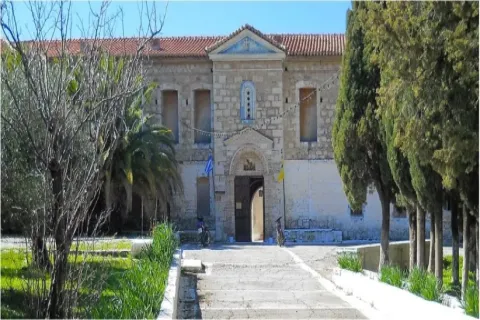
The small chapel that gave the bay its name is dedicated to Agios Isidoros of Chios. According to local historical accounts, it was built in 1530 and is one of the oldest monuments in the area.
Agios Isidoros was a sailor and martyr of the Christian Church and became closely associated with people who worked at sea. His feast is celebrated on 14 May.
The chapel connects the religious tradition of the area with its maritime life. For shipwrights, fishermen and sailors, the saint represented protection and spiritual guidance before the launching or departure of a vessel.
🏘️ The Settlement Today
Ormos Agios Isidoros does not have a compact residential centre, central square or organised commercial district. Its appearance is defined mainly by the buildings of the boatyard, warehouses, auxiliary workshops, the chapel and a small number of houses or installations close to the sea.
Old stone or plastered buildings, wooden shelters, machinery and vessels in different stages of construction or repair reflect the area’s long working history.
The absence of dense development and tourism facilities preserves the authentic character of the bay, but it also means that visitors should not expect the services of an organised coastal resort.
🏖️ The Natural Shoreline
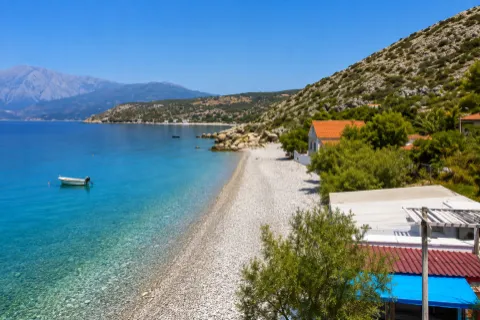
The shoreline of Agios Isidoros is small, natural and unorganised, with pebbles, gravel and rocky sections. It is not an organised beach with sunbeds, umbrellas, showers or lifeguard services.
The water is usually clear, although conditions vary depending on wind and waves along the western coast. Entering the sea requires care because of stones, rocks and the possible movement of small vessels around the pier and boatyard.
Anyone choosing to swim should remain well away from active working areas, launching ramps and boat moorings.
🌿 The Natural Environment
The area is surrounded by the rugged landscape of western Samos, with rocky slopes, pine trees, olive groves, low shrubs and aromatic Mediterranean plants.
The nearby forests were essential to the development of shipbuilding because suitable timber was the principal raw material used in constructing traditional vessels.
During spring, the hillsides are greener and particularly suitable for photography and gentle walks. In summer, the area becomes extremely dry and strict care is required to prevent fire.
🏝️ Varsamo Beach and the Surrounding Coastline
The isolated beach of Varsamo lies approximately two kilometres from Agios Isidoros. Access is by an unpaved road whose condition may change after rainfall or maintenance work.
The wider western coastline of Samos includes small bays, rocky shores and isolated beaches that have largely preserved their natural character.
🌿 What to See
During your visit to Ormos Agios Isidoros, take time to discover:
✅ The active traditional boatyard
✅ Wooden vessels at different stages of construction
✅ The old workshops and auxiliary shelters
✅ Traditional tools and machinery
✅ The chapel of Agios Isidoros
✅ The small natural bay
✅ The pier with fishing boats and small vessels
✅ The historic buildings connected with shipbuilding
✅ The views across the Aegean towards Ikaria and Fournoi
✅ The rugged landscape of the western slopes of Mount Kerkis
✅ The unpaved road and old routes towards Drakaioi and Kallithea
✅ Nearby Varsamo Beach
🚶 The Visitor Experience
A visit can begin at the small pier and continue towards the chapel and the boatyard buildings. From the open areas along the coast, visitors can see the vessels, working spaces and natural outline of the bay.
The boatyard is an active professional workplace. Visitors should not enter workshops or warehouses without permission, climb aboard vessels, move tools or approach lifting and launching operations.
Approximately 60–90 minutes are sufficient for a basic visit to the bay, chapel and exterior areas of the boatyard. More time is needed when the visit includes photography, swimming or a route towards Varsamo.
📆 When to Visit
Spring: The best period for green landscapes, exploring and photography without intense heat.
14 May: The feast day of Agios Isidoros.
Summer: Visit during the morning or late afternoon and carry water, a hat and sun protection.
Autumn: Suitable for a peaceful visit, provided the unpaved road remains in good condition.
Winter: Access may become difficult after heavy rainfall, so the condition of the road should be checked in advance.
🧭 How to Get There
Road access is through Kallithea and Drakaioi. The final section of the route, approximately 4.5 kilometres long, is an unpaved road. A vehicle with increased ground clearance or four-wheel drive is preferable, particularly when the road has suffered damage.
Agios Isidoros lies approximately 40 kilometres by road from Karlovasi, 20 kilometres from Kampos Marathokampos, 56 kilometres from Pythagoreio and 70 kilometres from Samos Town. The considerable road distances are caused by the necessary route around the mountainous mass of Kerkis.
Parking is informal, in available spaces close to the bay and boatyard. Vehicles must not obstruct access, boatyard operations or the route towards the pier.
ℹ️ Useful Information
✅ Official name: Ormos Agios Isidoros
✅ Local name: Ai Sideris
✅ Character: Historic coastal and shipbuilding settlement
✅ Location: Northwestern Samos
✅ Historic role: Seaport of Drakaioi and Kallithea
✅ Administrative community: Municipal Community of Drakaioi
✅ Municipal unit: Karlovasi
✅ Municipality: Western Samos
✅ Regional unit: Samos
✅ Region: North Aegean
✅ Recognition of the present settlement: 5 April 1981
✅ Population in 2021: 0 permanent residents
✅ Population in 2011: 18 permanent residents
✅ Altitude: Approximately 20 metres
✅ Principal heritage site: Traditional boatyard of Agios Isidoros
✅ Present condition of the boatyard: Active
✅ Shipbuilding units during the 20th century: Six
✅ Boatyard designation: Protected historic site
✅ Year of designation: 2007
✅ Religious monument: Chapel of Agios Isidoros
✅ Date of the chapel: 1530
✅ Feast day: 14 May
✅ Harbour facility: Small pier
✅ Beach: Small, natural and unorganised shoreline
✅ Nearby beach: Varsamo, approximately 2 kilometres away
✅ Final access section: Approximately 4.5 kilometres of unpaved road
✅ Recommended vehicle: High-clearance vehicle or four-wheel drive
✅ Postal code: 83102
✅ GPS coordinates: 37.7542, 26.5921
✅ Organised tourism facilities: None
✅ Suggested visiting time: Approximately 60 minutes–3 hours
✅ Ideal for: Maritime history, wooden shipbuilding, photography, natural landscapes and peaceful exploration


Add new comment