
Kambos of Marathokampos
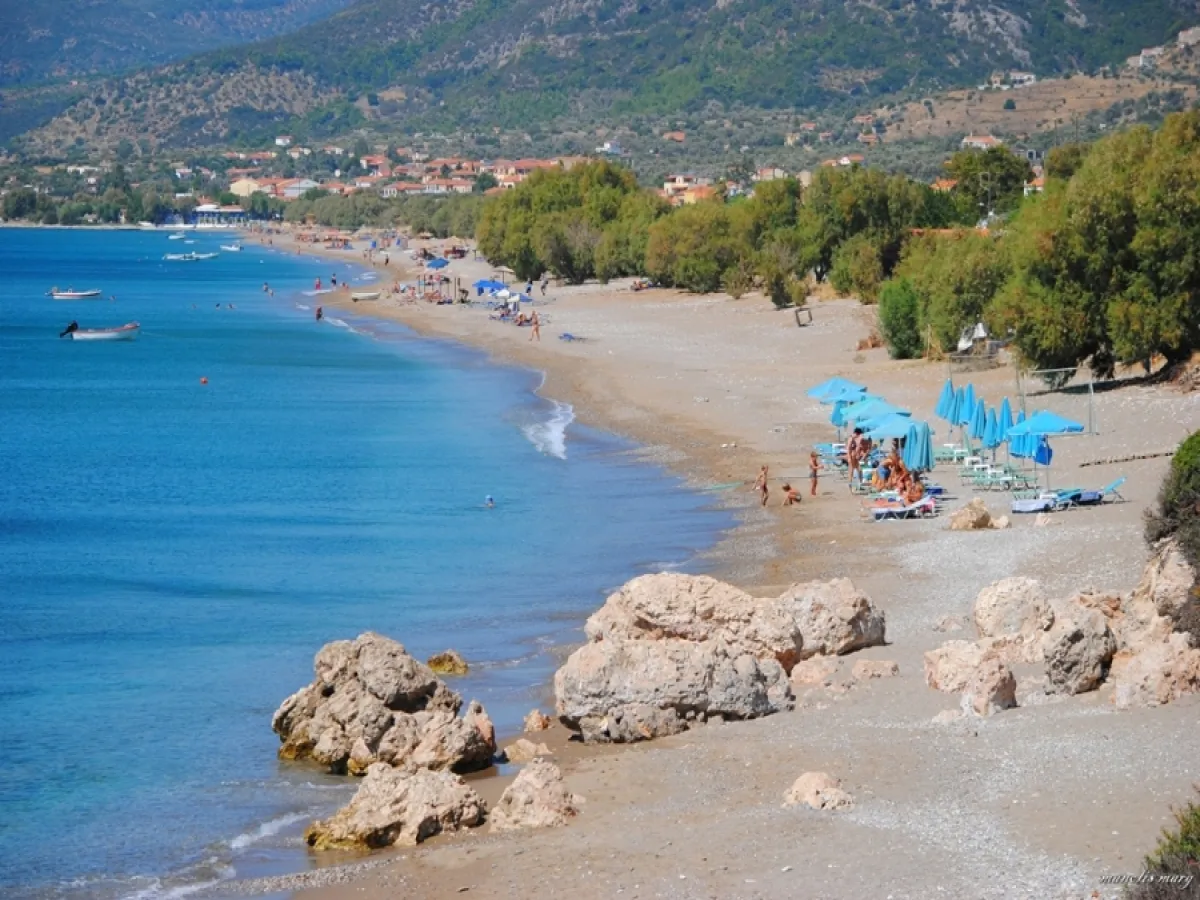
🏖️ Kampos Marathokampou, Samos – The Seaside Resort Beneath Mount Kerkis
Kampos Marathokampou, widely known as Votsalakia, is one of the most important coastal settlements and holiday destinations in southwestern Samos. It extends in a long, narrow line along the coast at the southeastern foothills of Mount Kerkis, combining a large beach, developed visitor facilities, low-rise buildings and an impressive mountainous backdrop.
The area is a separate settlement from neighbouring Ormos Marathokampou. Kampos is characterised by its long beach, accommodation, restaurants and holiday activity, while the historic harbour, fishing shelter and boatbuilding tradition are associated with Ormos, which lies further east.
📍 Location and natural environment
Kampos is located on the southwestern coast of Samos, west of Ormos Marathokampou and approximately seven kilometres by road from the mountain village of Marathokampos. The settlement extends across a narrow, low-lying coastal strip between the sea and the steep slopes of Mount Kerkis.
The centre of the settlement lies at an altitude of approximately 5–8 metres. The sea dominates the landscape to the south, while the mountainous mass of Kerkis rises immediately to the north, creating one of the most characteristic contrasts between mountain and coast on Samos.
🏛️ Administrative identity
The official name of the settlement is Kampos. It belongs to the Municipal Community of Marathokampos, within the Municipal Unit of Marathokampos and the Municipality of Western Samos, in the Regional Unit of Samos and the North Aegean Region.
The Municipal Community of Marathokampos officially includes the following settlements:
✅ Marathokampos
✅ Agia Kyriaki
✅ Velanidia
✅ Isomata
✅ Kampos
✅ Limnionas
✅ Ormos Marathokampou
✅ Palaiochori
✅ Sevastaika
According to the 2021 Population Census, the Municipal Community of Marathokampos has a total of 1,681 permanent residents.
📝 The names Kampos and Votsalakia
The official administrative name of the settlement is “Kampos”, referring to the low and relatively flat cultivated area that developed beneath the mountain village of Marathokampos.
The name “Votsalakia” became widely established mainly from the 1970s onwards and is now commonly used in tourism for both the settlement and its beach. In older local references, the wider area also appears under the name “Pountes”.
In practice, the names “Kampos Marathokampou” and “Votsalakia” are often used for the same coastal zone, although some maps place the name Votsalakia mainly towards the western part of the area.
📜 From agricultural plain to coastal settlement
For a long period, the area formed one of the main cultivated zones used by the residents of Marathokampos. The land was used for vegetables, pulses, cereals, olives and animal feed, while small single-room farmhouses, locally known as kalyvia, stood among the fields.
Residents travelled down from the mountain village for agricultural work and returned after completing their tasks. Permanent settlement near the sea remained limited, initially because of the exposure of the coast to pirate raids and later because of the area’s predominantly agricultural character.
From the late 19th and early 20th centuries, the agricultural buildings began to be used increasingly as summer residences. The most significant transformation began in the late 1970s, when tourism development became more systematic, accommodation and restaurants were established and Kampos gained a larger permanent population.
📅 Official recognition and administrative changes
Kampos was officially recognised as a separate settlement on 14 March 1971 and was incorporated into the former Community of Marathokampos.
In 1997, it became part of the Municipality of Marathokampos. In 2010, it was incorporated into the unified Municipality of Samos, and since 2019 it has belonged to the Municipality of Western Samos.
Its official recognition in 1971 does not mean that the area was created at that time. It reflects the administrative registration of an already developing coastal and agricultural area as an independent settlement.
👥 Population and contemporary life
The 2001 Census recorded 237 residents, while by 2011 the permanent population had increased to 471. The 2021 Census recorded 454 permanent residents.
The slight decline during the most recent decade does not change the fact that Kampos is one of the largest coastal settlements in western Samos. During summer, the actual number of people staying in the area increases considerably because of visitors, seasonal workers and holiday homes.
Activity becomes quieter during winter, and many tourism businesses close for the season. Kampos nevertheless retains a permanent population and basic services throughout the year.
🏘️ Settlement form and residential development
Kampos does not have a compact traditional centre, central square or maze of stone-paved lanes like the mountain village of Marathokampos. Development extends mainly in a linear form along the coastal road and along smaller roads running towards the sea.
The built environment includes:
✅ Low-rise houses and holiday homes
✅ Small hotels and family-run accommodation
✅ Restaurants, cafés and leisure venues
✅ Mini markets and everyday shops
✅ Older farmhouses converted into residences
✅ Olive groves and undeveloped plots between the buildings
The architecture is mostly modern and functional, with a limited number of traditional structures. The low-rise development allows the mountain and the sea to remain the dominant features of the settlement’s landscape.
🏖️ Kampos–Votsalakia Beach
Kampos Beach, also known as Votsalakia, is one of the largest and best-known beaches in southwestern Samos. The officially recorded section is approximately 1.86 kilometres long and has an average width of around 25 metres, while the broader continuous coastal zone appears even longer.
The eastern section consists mainly of sand and small pebbles, while larger concentrations of pebbles are found towards the west. The seabed varies between different sections, but the water generally deepens gradually and is usually calm.
Organised and unorganised sections are found along the beach. Visitors can therefore choose between areas with umbrellas and sunbeds or quieter sections offering more open space.
⭐ Beach characteristics
✅ Long beach with several access points
✅ Combination of sand and pebbles
✅ Usually clean and calm sea
✅ Gradual increase in depth
✅ Organised and unorganised sections
✅ Umbrellas and sunbeds in selected areas
✅ Restaurants and leisure venues near the shore
✅ Seasonal water activities
✅ Areas with natural shade from tamarisk trees and coastal vegetation
✅ Easy access from the coastal road
The availability of organised services and water activities varies according to the season and the particular section of the beach.
👨👩👧👦 Suitability for families
The length of the beach, the generally gradual increase in depth and the choice between organised and quieter sections make Kampos suitable for families.
In areas with more pebbles, water shoes can make entering the sea more comfortable. Parents should always supervise children, as the depth and wave conditions may vary along the extensive shoreline.
🏨 Tourism and visitor facilities
Kampos has one of the most developed tourism infrastructures in western Samos. The area offers hotels, small family-run properties, studios, apartments and rooms for rent.
Along the main road and close to the beach, visitors can find:
✅ Restaurants and tavernas
✅ Cafés and places for drinks
✅ A bakery and small food shops
✅ Mini markets
✅ Vehicle-rental businesses
✅ Tourism shops
✅ Seasonal water-recreation services
Despite its tourism development, the area does not have the character of a large urban resort. Most accommodation and businesses are small or medium-sized, while the nightlife remains relatively relaxed.
🌄 Mount Kerkis and the mountain landscape
Mount Kerkis dominates the landscape behind Kampos. Its bare limestone peaks, lower slopes covered with olive groves and immediate proximity to the sea create one of the most recognisable views in southwestern Samos.
The area is a suitable base for exploring the southern and southwestern parts of the mountain. Not all mountain routes begin directly from the beachfront, however, and some require transport, reliable navigation and appropriate equipment.
Hiking to higher parts of Kerkis should not be treated as a simple walk from the beach, particularly during the hottest months.
🚶 Walking, cycling and water activities
The coastal road and the smaller roads leading towards the sea are suitable for gentle walks, especially early in the morning or late in the afternoon.
The main activities include:
✅ Swimming and relaxing on the beach
✅ Walking along the coast
✅ Photographing Mount Kerkis and the seascape
✅ Cycling along the coastal road with attention to traffic
✅ Canoeing and other seasonal water activities
✅ Fishing from accessible rocky points
✅ Excursions towards hiking routes on Mount Kerkis
The availability of equipment and organised activities should be checked locally, as it may vary throughout the summer season.
🌿 What to see
During your stay in Kampos, it is worth discovering:
✅ The long Kampos–Votsalakia Beach
✅ The different sections with sand and pebbles
✅ The views towards the slopes and peaks of Mount Kerkis
✅ Areas with tamarisk trees and natural shade
✅ Neighbouring Ormos Marathokampou and its harbour
✅ The traditional village of Marathokampos
✅ Psili Ammos Marathokampou
✅ Asprochorti and the smaller beaches west of the settlement
✅ Limnionas
✅ The mountain routes and religious monuments of Kerkis
Ormos, Marathokampos and Limnionas are separate settlements and are best presented as independent destinations rather than neighbourhoods of Kampos.
🚶 Visitor experience
The best way to become familiar with Kampos is to travel slowly along the coastal road and stop at different parts of the beach.
The eastern and western sections of the coastline have different characteristics, so it is worth exploring beyond the first access point. A swimming stop can be combined with a walk, a meal and late-afternoon photography of Mount Kerkis.
A short visit to the settlement and beach requires approximately two hours. For a more complete experience including swimming, dining and a visit to a nearby destination, an entire day can easily be spent in the area.
📆 When to visit
May and June: Mild temperatures, greener scenery and fewer visitors.
July and August: Most accommodation, restaurants and organised beach sections are fully operational.
September: Warm sea, a calmer atmosphere and usually fewer visitors.
Spring and autumn: Suitable periods for photography, road trips and exploration without the intense summer heat.
Winter: A very quiet season with considerably fewer tourism services available.
🧭 How to get there
Kampos is reached by paved road from Marathokampos, Ormos Marathokampou, Karlovasi and the wider road network of western Samos.
Kampos is located approximately:
✅ 7 kilometres from Marathokampos
✅ 2.5–3 kilometres from Ormos Marathokampou
✅ 35 kilometres from Karlovasi, depending on the route
✅ 30–40 kilometres from Pythagoreio, depending on the route
✅ 45–50 kilometres from Samos Town
Distances shown by navigation applications may vary because the settlement extends over a considerable length and does not have a single central destination point.
Travelling by car or motorcycle is the most practical option. Seasonal bus services may operate, but schedules should be checked before travelling.
ℹ️ Useful information
✅ Official settlement name: Kampos
✅ Commonly used name: Kampos Marathokampou
✅ Alternative name: Votsalakia
✅ Character: Coastal tourism settlement
✅ Location: Southwestern Samos
✅ Municipal community: Marathokampos
✅ Municipal unit: Marathokampos
✅ Municipality: Western Samos
✅ Regional unit: Samos
✅ Region: North Aegean
✅ Official recognition: 14 March 1971
✅ Population in 2001: 237 permanent residents
✅ Population in 2011: 471 permanent residents
✅ Population in 2021: 454 permanent residents
✅ Altitude: Approximately 5–8 metres
✅ Beach length: Approximately 1.86 kilometres
✅ Average beach width: Approximately 25 metres
✅ Shore type: Sand and pebbles
✅ Postal code: 83102
✅ Settlement GPS coordinates: 37.70803, 26.67107
✅ Central beach GPS coordinates: 37.70828, 26.68002
✅ Road access: Paved road network
✅ Facilities: Accommodation, restaurants, shops and seasonal tourism services
✅ Recommended visiting time: From 2 hours to an entire day
✅ Suitable for: Holidays, families, couples, swimming, relaxation and exploring southwestern Samos



Add new comment