
Loulouda Castle – Vourliotes, Samos
🏰 A Byzantine refuge on the slopes of Mount Karvounis
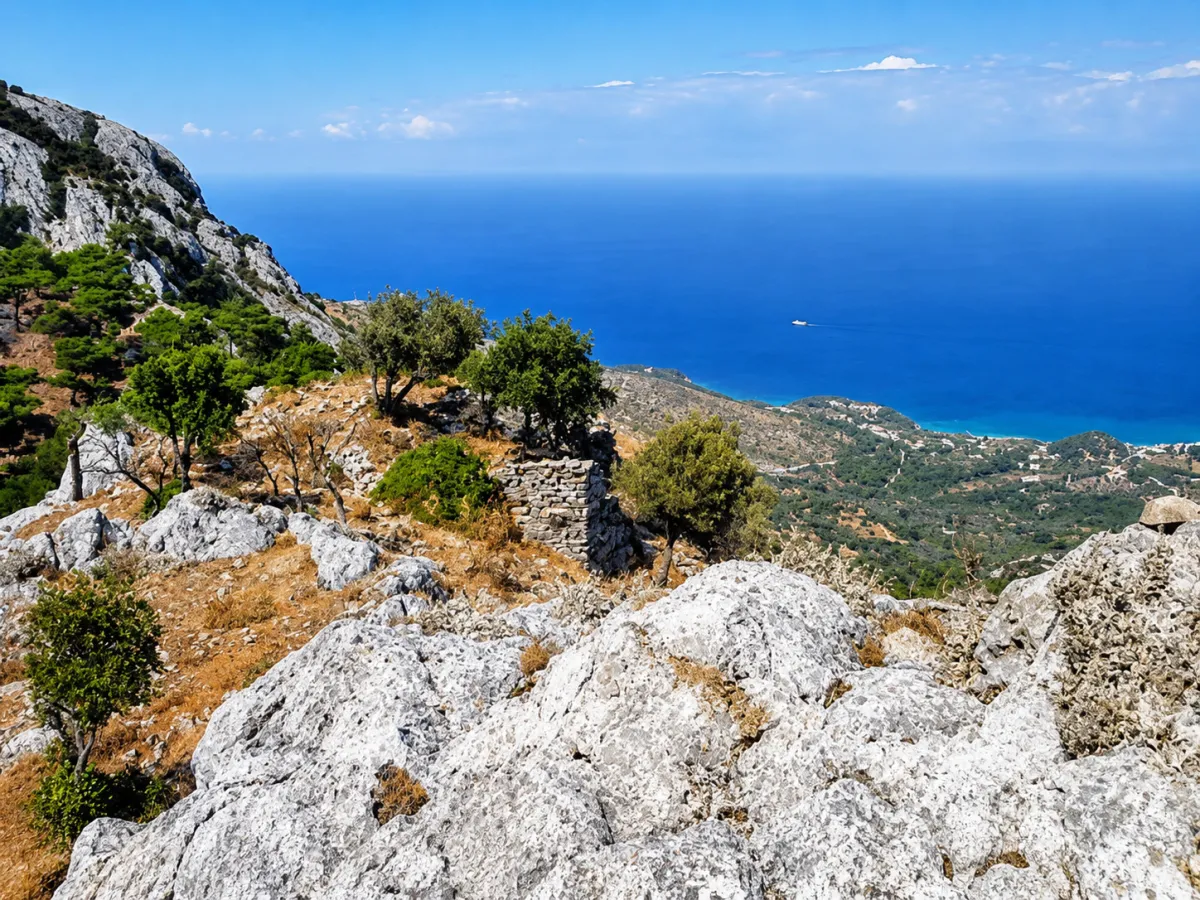
On a steep rocky hill of Mount Ampelos, also known as Karvounis, southeast of Vourliotes, lie the ruins of Loulouda Castle, one of the important fortified sites of Byzantine Samos.
Today, the site does not impress visitors with tall towers or fully preserved defensive walls. What survives is an archaeological landscape integrated into the natural rock itself: sections of fortification, rock-cut surfaces, foundations and traces of a settlement that made extensive use of the natural protection offered by the steep summit.
Modern archaeological research places Loulouda Castle within a wider network of fortified sites that developed on Samos during the transitional Byzantine period, approximately between the 7th and 9th centuries AD, when Arab raids profoundly changed settlement patterns and defensive organisation throughout the Aegean.
📍 Location & natural fortification
The castle lies southeast of Vourliotes, on a rocky prominence of Mount Karvounis, at an elevation of approximately 530 metres.
Its steep and naturally defensible position formed an essential part of its protection. Rather than relying entirely on massive artificial walls, the inhabitants could use the sheer slopes and rocky terrain themselves as defensive barriers.
The strategic location also provides extensive views over northern and eastern Samos and across the Aegean Sea.
Today, this panorama is one of the rewards of reaching the site. During the Byzantine period, however, visibility had a far more practical purpose: the ability to observe movements at sea and across the surrounding landscape could be crucial for the security of the population.
⚔️ Samos after the 7th century
From the second half of the 7th century AD, conditions throughout the Aegean changed dramatically.
Arab naval raids affected islands and coastal regions, leading to important changes in settlement patterns and defensive organisation.
On Samos, populations increasingly made use of naturally fortified locations in the island’s interior and mountainous areas. Archaeological research has identified a series of Byzantine fortifications associated with this period and with the need to protect both local communities and agricultural production.
Loulouda Castle is one of the characteristic examples of this new defensive landscape.
🛡️ Part of a network, not an isolated castle
One of the most interesting aspects of Loulouda is that it should not be understood as an isolated fortress.
Modern research into the Byzantine fortifications of Samos has identified around 15 fortified locations dating from approximately the 7th to the 13th centuries across the island.
Among the important fortified positions on Mount Ampelos are Loulouda Castle, Lazaros Castle and other smaller fortified sites.
Their distribution suggests that mountainous Samos functioned as a broader defensive landscape. Some locations offered visibility over maritime and inland routes and may have played a role in surveillance and warning systems.
This gives Loulouda Castle a wider significance: it was not simply a ruined stronghold on a mountain, but part of a larger system developed to help communities survive during periods of insecurity.
🏘️ The fortified settlement
Loulouda does not appear to have functioned solely as a military observation post.
At the site, visitors can identify rock-cut steps and levelled surfaces on which buildings once stood. Earlier descriptions of the monument also mention stepped paths carved into the natural rock and structures arranged on different levels of the slope.
The use of the natural terrain allowed the creation of a compact settlement in a location that was difficult to approach for attackers but suitable as a refuge during dangerous periods.
The complete layout of the settlement cannot be reconstructed today, and the buildings do not survive to a height that would allow visitors to imagine their original appearance easily.
Nevertheless, the rock cuttings and surviving foundations show that the summit was systematically adapted for human occupation.
🏺 Was the site used before the Byzantine period?
Several older descriptions suggest that the location had already been used in antiquity and that the Byzantines later reused or fortified it.
This claim requires caution.
Rock cuttings and fragments of ancient pottery have been reported from the site, suggesting that the location was probably used before the Byzantine period.
These traces, however, are not sufficient on their own to demonstrate that a complete ancient fortress existed here in the same form.
For this reason, it is more accurate to say that the site shows evidence of earlier activity, while the fortified character that can be identified archaeologically is primarily associated with the Byzantine period.
🧱 What survives today
Loulouda Castle survives today in a ruined condition.
Low sections of masonry and fortification, foundations and numerous surfaces carved into the natural rock remain visible.
The shape of the site still allows visitors to understand how the settlement and its defensive structures adapted to the steep rocky summit.
Because so much of the original architecture has disappeared, exploring the site requires some observation and imagination.
This is not a castle with a monumental gate, battlements and preserved rooms that visitors can easily walk through.
Here, the mountain itself forms part of the monument.
🌸 Where does the name “Loulouda” come from?
A characteristic local tradition survives regarding the name of the castle.
According to the story, a young woman from Vourliotes, the daughter of a priest and named Loulouda, was on the rocky height when she lost consciousness, fell from the cliff and died. The location is said to have taken its name from this event.
Another local interpretation connects the name with a word associated with stone or rock.
Neither explanation can be considered a historically proven etymology.
The story of Loulouda should therefore be understood as local folklore rather than documented historical fact.
👁️ The view as part of the defence
The castle commands a wide field of vision over the northern and eastern parts of the island and toward the sea.
Today, the view is one of the main reasons to make the ascent. In the Byzantine period, however, it represented a strategic advantage.
The ability to monitor the sea, nearby mountain passages and other fortified positions increased the defensive value of the site.
Modern research into Byzantine fortifications on Samos examines precisely these relationships of visibility between individual strongholds and observation points.
🥾 Access & visiting the site
Loulouda Castle is not an organised archaeological site with a guarded entrance, prepared pathways or visitor facilities.
The approach passes through mountainous terrain and requires walking.
Hiking routes in the wider area connect Vourliotes, Mount Karvounis and other nearby points, but the length and difficulty vary considerably depending on the starting point.
Visitors should wear sturdy closed footwear, carry sufficient water and take particular care near steep drops and exposed rocky sections.
The site is best visited in good weather and with enough time to explore the area safely.
👀 What visitors will see
Visitors reaching Loulouda Castle should not expect a restored medieval fortress.
Instead, they will encounter a rocky fortified landscape, where low defensive walls, foundations, carved paths and the remains of former building platforms merge with the natural terrain of Mount Karvounis.
The true importance of the site lies precisely in this relationship between people and landscape.
The inhabitants of a difficult period did not simply construct a wall; they selected an entire rocky summit and transformed it into a place of protection.
Loulouda Castle is therefore an important site for understanding Byzantine and medieval Samos, during a period when life across much of the Aegean increasingly shifted away from exposed coastal areas toward more protected and naturally defensible locations.


Add new comment