
Samos Archaeological Museum
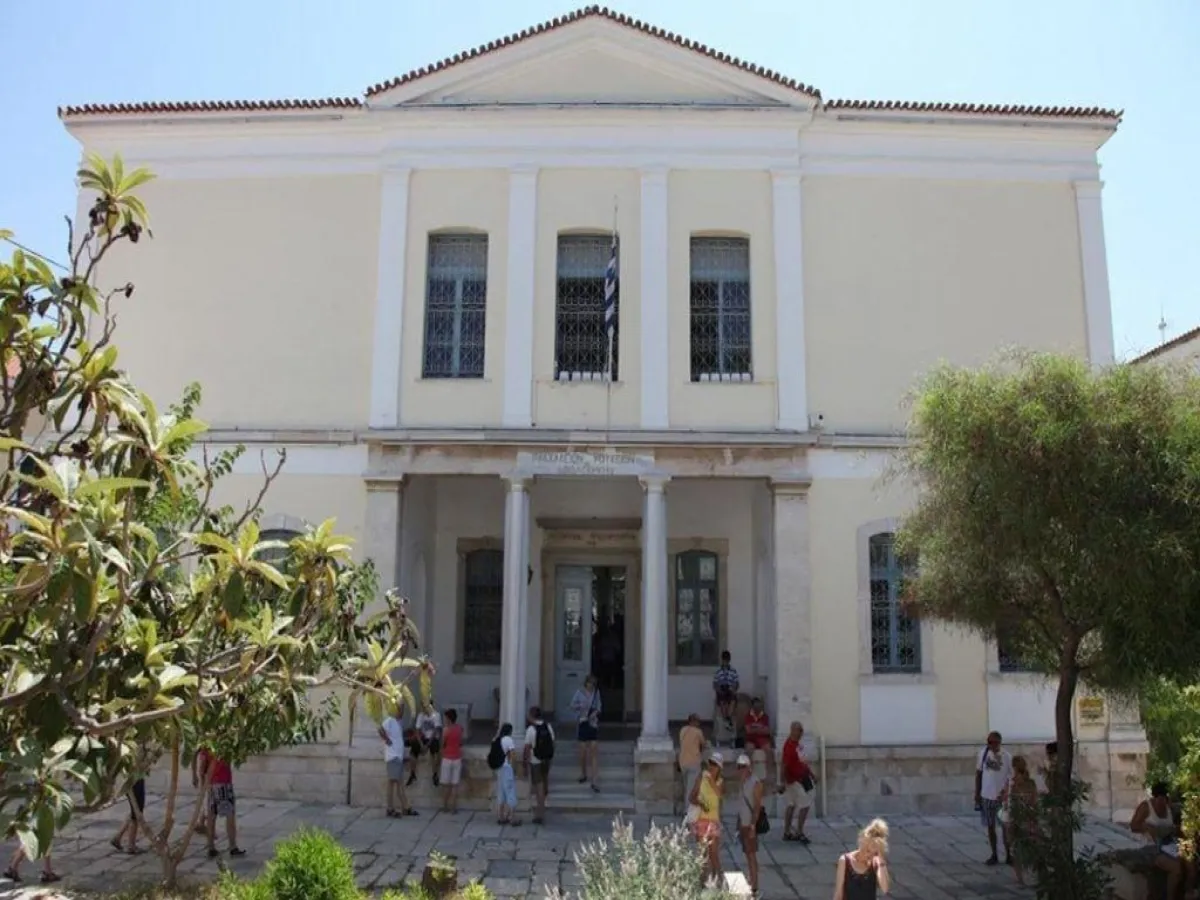
🏛️ Archaeological Museum of Vathy, Samos
In the town of Samos, in the Vathy area, stands the Archaeological Museum of Vathy, Samos, one of the most important places for discovering the island’s ancient history and, in particular, the Heraion, the great sanctuary dedicated to the goddess Hera.
Its collections include Archaic sculpture, pottery, bronze and ivory objects, wooden votive offerings and works of minor art, many of which come from excavations at the Heraion of Samos.
Among the museum’s most remarkable exhibits is the colossal Kouros of Samos, standing 4.80 metres high, while another major highlight is the famous sculptural group by Geneleos. Together with numerous votive offerings originating from different regions of the ancient world, these works reveal the wealth, artistic development and extensive international connections of Archaic Samos.
📍 Location
The museum is located at Town Hall Square in the town of Samos, within a short distance of Pythagoras Square and the seafront.
Its central location makes it easily accessible on foot from much of the town. The museum complex stands next to the Town Hall and consists of two separate but adjacent buildings, with courtyards and open spaces between them.
The museum’s present form developed in different stages. The older building was constructed in the early 20th century, while a second building was later added specifically to accommodate the important collection of Archaic sculpture.
🏛️ The Two Museum Buildings
The museum is housed in two buildings with different histories and exhibition functions.
The older building is the Paschaleion Archaeophylakeion, a two-storey historic structure built in 1912. It displays finds from the Heraion, including pottery, smaller sculptures and votive objects made of bronze, ivory, wood and other materials.
The newer building was completed in 1987, with financial support from the Volkswagen cultural foundation, in order to provide suitable conditions for displaying the museum’s major collection of Archaic sculpture.
This is where visitors can see the colossal Kouros of Samos, the Geneleos Group and other characteristic examples of Samian sculpture.
🌊 The Heraion and the Museum Collections
The identity of the museum is closely connected with the Heraion of Samos, one of the most important sanctuaries of the ancient world and a major centre of worship dedicated to Hera.
Long-term archaeological excavations in the area brought to light a vast number of votive offerings, sculptures and other objects that had been dedicated at the sanctuary over many centuries.
The significance of these finds lies not only in their artistic quality. Their origins reveal a network of contacts extending far beyond the Aegean.
Objects and valuable offerings reached the sanctuary from many regions of the ancient world, reflecting the commercial and cultural relations of Samos with the eastern Mediterranean, Egypt and the Near East.
⛵ Samos as a Naval and Commercial Power
During the Archaic period, and especially in the 6th century BC, Samos emerged as one of the major naval and commercial powers of the Aegean.
Its geographical position close to the coast of Asia Minor and along important maritime routes helped the island develop extensive trade connections with different parts of the Mediterranean.
The prosperity of this period supported the creation of major engineering, architectural and artistic works. The Heraion, the Tunnel of Eupalinos and the development of Samian sculpture are different expressions of the same period of growth.
The objects displayed in the museum complete this picture, showing that ancient Samos was not an isolated island society but an active participant in a broad network of trade and cultural exchange.
🗿 The Colossal Kouros of Samos
The museum’s most recognisable exhibit is the Kouros of Samos, a monumental marble statue of a young man created around 580 BC.
The restored statue reaches a height of 4.80 metres and is the largest known kouros of this type to survive almost intact.
Kouroi were nude male figures that appeared in Greek art during the Archaic period. Their frontal pose, one leg placed slightly forward and carefully organised symmetry are among the defining features of this sculptural type.
The Samian Kouros stands out both because of its enormous scale and because of the distinctive characteristics of East Aegean sculpture, which reveal different artistic influences from other major cultural centres of the period.
⛏️ The Discovery of the Kouros
The Kouros comes from the Sacred Way of the Heraion, the monumental route that connected the ancient city with the sanctuary of Hera.
The statue was not discovered intact in a single excavation. Its surviving pieces were uncovered gradually.
The enormous right lower leg was found during excavations in the 1970s, while the torso, thighs and arms were discovered later. The head and parts of the face came to light in a subsequent phase, eventually allowing the monumental statue to be reconstructed.
Despite its extraordinary size, the Kouros had been buried at relatively shallow depth in the area of the Sacred Way.
✍️ The Inscription of Isches
A particularly important feature is the inscription preserved on the statue’s right thigh.
It names Isches, son of Rhesis, as the man who commissioned the monumental work.
The ability to create and dedicate a statue of such dimensions reflects the considerable wealth concentrated within certain groups of Samian society and the importance attached to public acts of dedication at the sanctuary.
The sculptor responsible for the Kouros remains unknown.
🎨 Sculpture in Archaic Samos
During the 6th century BC, Samos developed a highly important sculptural tradition.
Its works are distinguished by careful marble carving, an emphasis on clear forms and an approach to the human figure that differs from other major workshops of the Greek world.
The island’s position between the Aegean and the coast of Asia Minor encouraged the exchange of techniques and artistic ideas, while contacts with more distant regions helped create a cultural environment open to new influences.
The Kouros and the other sculptures in the museum allow visitors to explore this important phase shortly before the major transformation of Greek sculpture during the Classical period.
👨👩👧👦 The Geneleos Group
Another major highlight of the collection is the Geneleos Group, a large family dedication that originally stood at the Heraion.
The original composition represented six members of a wealthy family. At one end sat the mother, Phileia, while at the opposite end was the semi-reclining figure of the father. Between them stood their four children, one boy and three girls.
Surviving inscriptions preserve names such as Philippe and Ornithe, while the monument is associated with the sculptor Geneleos.
The group presents a very different aspect of Archaic art from the colossal Kouros. Instead of a single monumental figure, it creates the presence of an entire family within the sacred space.
🌍 Votive Offerings from a Wider World
One of the most fascinating aspects of the collections is the variety of materials and artistic traditions represented.
Excavations at the Heraion have uncovered objects made of bronze, ivory, wood, clay and other materials, some of which show clear links with cultures beyond the Greek world.
Egyptian and Near Eastern characteristics visible in certain objects demonstrate the intensity of the contacts Samos maintained through navigation and trade.
For modern visitors, these smaller objects may appear less imposing than the Kouros, but historically they are extremely important because they record the movement of people, goods, techniques and ideas across the Mediterranean.
🏺 Pottery & Minor Arts
The collections also include pottery and works of minor art from different historical periods.
Ceramics allow archaeologists to trace changes in manufacturing techniques, decoration and trade connections, while small votive objects provide information about religious life and the practices of visitors to the sanctuary.
Bronze figurines, ivory objects, wooden works and clay offerings complete the picture of a religious tradition that was not expressed only through large and expensive monuments.
🛕 The Worship of Hera
The Heraion was one of the most important centres of worship dedicated to Hera in the ancient Greek world.
The enormous number of votive offerings discovered there shows that the sanctuary attracted worshippers and dedications over a very long period.
Through the museum collections, visitors can understand that an ancient sanctuary was not simply a place for religious ceremonies. It was also a place of encounter, social display, artistic creation and communication between people of different origins.
This aspect is essential for understanding both the Heraion and the special position Samos occupied in the ancient world.
🌍 Heraion, Pythagoreio & UNESCO
The Heraion and Pythagoreio have been included on the UNESCO World Heritage List since 1992.
Their importance is linked to the major architectural and technological achievements of ancient Samos, the development of the city and sanctuary, and the significant role played by the island in the ancient world.
A visit to the Archaeological Museum of Vathy greatly complements a visit to the Heraion, as many of the movable finds from the archaeological site are preserved and displayed in the museum’s collections.
👀 What Visitors Can Discover
Through the museum collections, visitors can better understand:
✅ The development of Samos during the Archaic period
✅ The major importance of the Heraion and the worship of Hera
✅ The development of Samian sculpture
✅ The colossal Kouros and the creation of monumental votive offerings
✅ The Geneleos family group
✅ The commercial connections of Samos with other parts of the Mediterranean and the East
✅ Pottery, minor arts and objects connected with everyday religious practice
✅ The wealth and social organisation of Archaic Samian society
🏗️ Museum Upgrade
The Greek Ministry of Culture has launched an extensive programme for the upgrade of the Archaeological Museum of Vathy.
The project includes the renovation and redesign of both buildings, a new presentation of the collections, improvements to visitor facilities and the provision of universal accessibility.
The plans cover both the historic Paschaleion building and the newer museum building, with the aim of creating a modern museum complex capable of presenting the exceptionally important collections of Samos more effectively.
As the improvement works may affect access or the operation of individual areas, visitors are advised to check the latest official information before planning their visit.
🕒 Opening Hours, Tickets & Contact
According to the current official information:
Opening hours: 08:30–15:30
Tuesday: Closed
Last admission: 20 minutes before closing
Regular admission: €10
Reduced admission: €5
Address: Town Hall Square, Samos 83100
Telephone: +30 22730 27469
Ephorate of Antiquities of Samos and Ikaria: +30 22730 23008
E-mail: efasam@culture.gr
Certain visitor categories are entitled to reduced or free admission, while state museums and archaeological sites also offer free admission on specific dates during the year.
Opening hours, ticket prices or access to individual spaces may change because of restoration work, public holidays or other special circumstances. Checking the latest official information before visiting is therefore recommended.
🧭 Places to Visit Nearby
The museum’s location in the town of Samos makes it easy to combine a visit with other points of interest in the area:
✅ Pythagoras Square and the seafront
✅ Ano Vathy, with its traditional settlement and narrow streets
✅ Church of Agios Spyridon
✅ Ecclesiastical Byzantine Museum of Samos
✅ Municipal Garden and the historic centre of the town
For a more complete archaeological tour of the island, the museum can also be combined with the Heraion, the Archaeological Museum of Pythagoreio, the Tunnel of Eupalinos and the remains of the ancient city of Samos.
🏺 A Museum That Explains Archaic Samos
The particular importance of the Archaeological Museum of Vathy lies not only in the scale or impressive presence of the Kouros.
Through its sculptures, votive offerings and smaller objects, the museum reveals a Samos with strong naval influence, considerable wealth, advanced artistic production and connections extending across much of the eastern Mediterranean.
The Kouros, the Geneleos Group and the numerous finds from the Heraion together create a multifaceted picture of the society that produced some of the most important works of the Archaic period.
For anyone who wants to understand why Samos occupied such an important position in the ancient world, the museum is one of the island’s essential cultural stops.


Add new comment