
Potami Waterfalls – The Natural Wonder of Western Samos

💧 Potami Waterfalls – Karlovasi, Samos
In the Potami area, west of Karlovasi, hidden inside a narrow and lush gorge, lie the Potami Waterfalls, one of the most distinctive natural attractions of Samos.
Water flows between large rocks, plane trees, ferns and dense vegetation, forming small natural pools and a series of waterfalls. The experience is quite different from an ordinary hike: the first section follows a path beside the stream, but to actually reach the waterfalls visitors must eventually enter the water and, in some places, swim.
📍 Location
The waterfalls are located in northwestern Samos, in the Potami area, a few kilometres west of Karlovasi.
The gorge has been shaped by the stream that descends towards the Potami coastline. In local geographical references it is known as the Kastania River, while the ancient name Kerkitios is also associated with the watercourse.
The riverbed is surrounded by dense vegetation, with plane trees and ferns being particularly characteristic of the landscape.
The most practical access is through Karlovasi and then along the coastal road towards Potami Beach. Visitors are better off approaching through Karlovasi and following the regular coastal road, as navigation apps may occasionally suggest alternative routes along mountain dirt roads.
🌿 The Potami Gorge
What makes the area special is not only the waterfalls themselves, but the entire river ecosystem surrounding them.
The water flows through a narrow rocky valley beneath dense shade. For much of the route, the path follows the riverbed and crosses from one side of the stream to the other using small wooden bridges.
The contrast with the summer landscape found elsewhere on Samos is striking. Even when temperatures are high in open areas of the island, the shade, running water and thick vegetation inside the gorge create a noticeably cooler environment.
💦 More Than One Waterfall
The name “Potami Waterfalls” is more accurate than describing the area as a single waterfall.
Inside the gorge there are successive drops and natural pools. Different guides do not always number them in the same way: some older descriptions focus mainly on two principal waterfalls, while experienced local guides describe as many as three successive waterfalls, depending on how far visitors continue into the gorge.
It is therefore more accurate to think of the site as a system of waterfalls and natural pools rather than assigning it one fixed number.
💧 The First Natural Pool
After the easy section of the trail, visitors reach a small natural pool where the ordinary dry hike effectively ends.
From this point onward, it is necessary to enter the water.
Reaching the first waterfall normally requires approximately 5–10 minutes of walking or swimming through the riverbed.
Water depth varies depending on the season and the volume of flow, so visitors should not assume that the entire distance can always be covered on foot.
🏊 Swimming Is Part of the Experience
One of the most important things visitors should know is that the waterfalls themselves are not normally visible from the dry trail.
To reach the first waterfall, it is necessary to continue through the narrow water-filled section of the gorge.
Even during the drier summer months, short sections may still require swimming.
This means that simply following the path without getting wet usually does not provide the full Potami Waterfalls experience.
💦 The Main Waterfall
The main accessible waterfall is described as having a drop of approximately 5 metres inside the gorge.
The water falls into a natural pool surrounded by rocks and dense vegetation.
Its appearance and the amount of water naturally change according to rainfall and the season.
This is not a waterfall that stands out because of enormous height. Its special appeal comes instead from the experience of reaching it through the narrow gorge, combined with the natural pools, the cool water and the forested surroundings.
🧗 The Next Waterfalls
Those who continue deeper into the gorge can encounter additional waterfalls.
From this point onward, however, the route is no longer a simple family walk.
It requires swimming, moving across wet rocks and, in places, climbing.
Local guides describe a larger second waterfall and a more remote third one, which can require around another 20 minutes of water trekking, swimming and climbing.
The largest of these drops is reported to be under 9 metres high.
Continuing beyond the first easily accessible waterfall should therefore be regarded as an adventurous gorge crossing, rather than an ordinary hiking trail.
🚶 The Route to the Water
The first part of the route is the easiest and most accessible section of the visit.
It takes approximately 20 minutes of walking to reach the point where the route begins to continue through the water.
The walk passes:
✅ Beneath the shade of plane trees
✅ Beside the riverbed
✅ Across small wooden bridges
✅ Between large rocks and dense vegetation
✅ Over relatively easy terrain until the first natural pool
The real difficulty begins after the dry section ends.
🥾 The Official Hiking Route
The waterfalls form part of the marked circular hiking route Potami – Waterfalls – Tsourlei – Potami.
The full route has:
✅ Distance: 4 km
✅ Duration: approximately 1 hour 30 minutes
✅ Elevation gain: 284 m
✅ Difficulty: 1/5
✅ Type: Circular route
These figures refer to the hiking route towards Tsourlei and back, not to exploring all of the waterfalls through the water, which has a different level of difficulty.
⛪ Church of the Transfiguration of the Saviour
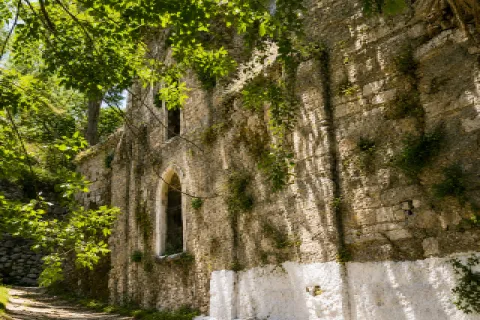
Before entering the main trail, visitors pass one of the most important Byzantine monuments of western Samos, the Church of the Transfiguration of the Saviour.
Its earliest construction phase dates to the 11th century, while later alterations continued into the 14th century.
Inside the church, four ancient marble columns are reused as supports for the dome.
The route to the waterfalls therefore combines natural scenery with Byzantine history from the very beginning of the visit.
🏰 Kastraki of Panagia in Potami
The same area is also home to the Kastraki of Panagia in Potami, the Byzantine fortified site associated with the medieval monumental complex of the valley.
The combination of Kastraki, the Church of the Transfiguration and the waterfalls makes the Potami valley particularly interesting, as medieval monuments, a river, a forested gorge and the beach all exist within a relatively small area.
🌳 Plane Trees, Ferns & Shade
The characteristic appearance of the gorge is largely created by its dense riverside vegetation.
Plane trees, ferns and other plants cover the riverbanks and in many places create an almost continuous natural canopy above the stream.
This is one of the reasons the area is particularly enjoyable in summer, when temperatures in the open parts of the island can be considerably higher.
🗓️ Best Time to Visit
The amount of water flowing through the waterfalls is not constant throughout the year.
Following the winter rains and during spring, water flow is generally stronger and the gorge offers its most impressive water scenery.
During summer, the flow decreases, but the route remains popular because the natural pools and cold water provide a welcome escape from the heat.
Even during the dry summer season, swimming may still be necessary in some sections.
⚠️ Extra Caution After Rain
Entering a narrow gorge should always be done with the weather conditions in mind.
After heavy rainfall, water levels and flow can rise, while rocks, wooden crossings and the trail itself can become particularly slippery.
It is therefore preferable to visit during stable weather and to avoid going deep into the gorge during periods of heavy rain or thunderstorms.
👟 What to Bring
For a properly prepared visit, it is useful to have:
✅ Water shoes or sports shoes that can get wet
✅ Swimwear
✅ Towel
✅ Waterproof bag for your phone or camera
✅ Drinking water
✅ Light equipment without unnecessary belongings
Flip-flops are not a good choice for exploring the gorge because they provide very little stability on wet and uneven surfaces.
📱 Limited Mobile Signal
Visitors planning to continue beyond the easy section should be aware that mobile phone coverage can be limited or completely unavailable in parts of the gorge.
This is particularly important for anyone attempting the more difficult sections without an organised guide.
🎟️ Access & Admission
The waterfalls are a natural attraction and there is no entrance fee for the basic visit.
Access is freely available by road and trail.
This is not an organised archaeological or tourist site with a guarded entrance, changing rooms or secure storage next to the waterfalls.
There is also no dedicated place to leave personal belongings near the natural pools, so anything taken beyond the dry section should be protected from water.
👨👩👧👦 Is It Suitable for Everyone?
That depends on how far visitors intend to continue.
The initial trail to the natural pool is relatively easy and is suitable for many visitors, including families accustomed to walking on natural terrain.
Reaching the waterfalls themselves, however, requires entering the water and potentially swimming, while continuing towards the next waterfalls involves climbing and moving over wet rock.
In practical terms:
✅ Trail: Relatively easy
✅ First waterfall: Requires entering the water and possibly swimming
✅ Further waterfalls: Require better physical condition, balance and greater experience
📷 What to Photograph
The area offers scenery very different from the usual coastal images of Samos:
✅ The narrow rocky gorge
✅ Waterfalls and natural pools
✅ Wooden bridges along the trail
✅ Plane trees and ferns beside the water
✅ The stream flowing between the rocks
✅ The Church of the Transfiguration of the Saviour
✅ The Byzantine landscape around Kastraki
Phones and cameras should be properly protected from water if you continue beyond the dry section of the trail.
🧭 Places to Combine with Your Visit
The Potami area is ideal for a more complete day excursion:
✅ Potami Beach
✅ Kastraki of Panagia in Potami
✅ Church of the Transfiguration of the Saviour
✅ Church of Agios Nikolaos
✅ Old Karlovasi
✅ Port of Karlovasi
Those looking for a longer walk can also follow the marked circular route towards the old settlement of Tsourlei, which connects with longer hiking routes towards Leka and Kosmadaioi.
⭐ One of the Most Distinctive Natural Experiences on Samos
The Potami Waterfalls are not remarkable because of an enormous vertical drop.
What makes the place special is the complete experience: the walk beneath the plane trees, the wooden bridges, the narrow gorge, the cold water, the natural pools and the need to continue through the river itself to discover the waterfalls.
Only a few kilometres from Karlovasi, visitors can move from the beach to Byzantine monuments and then into a cool, shaded gorge that feels far more like a mountain landscape than a typical setting on an eastern Aegean island.


Add new comment