
Natural History Museum of the Aegean – Mytilinioi, Samos
🦴 A window into Samos millions of years ago
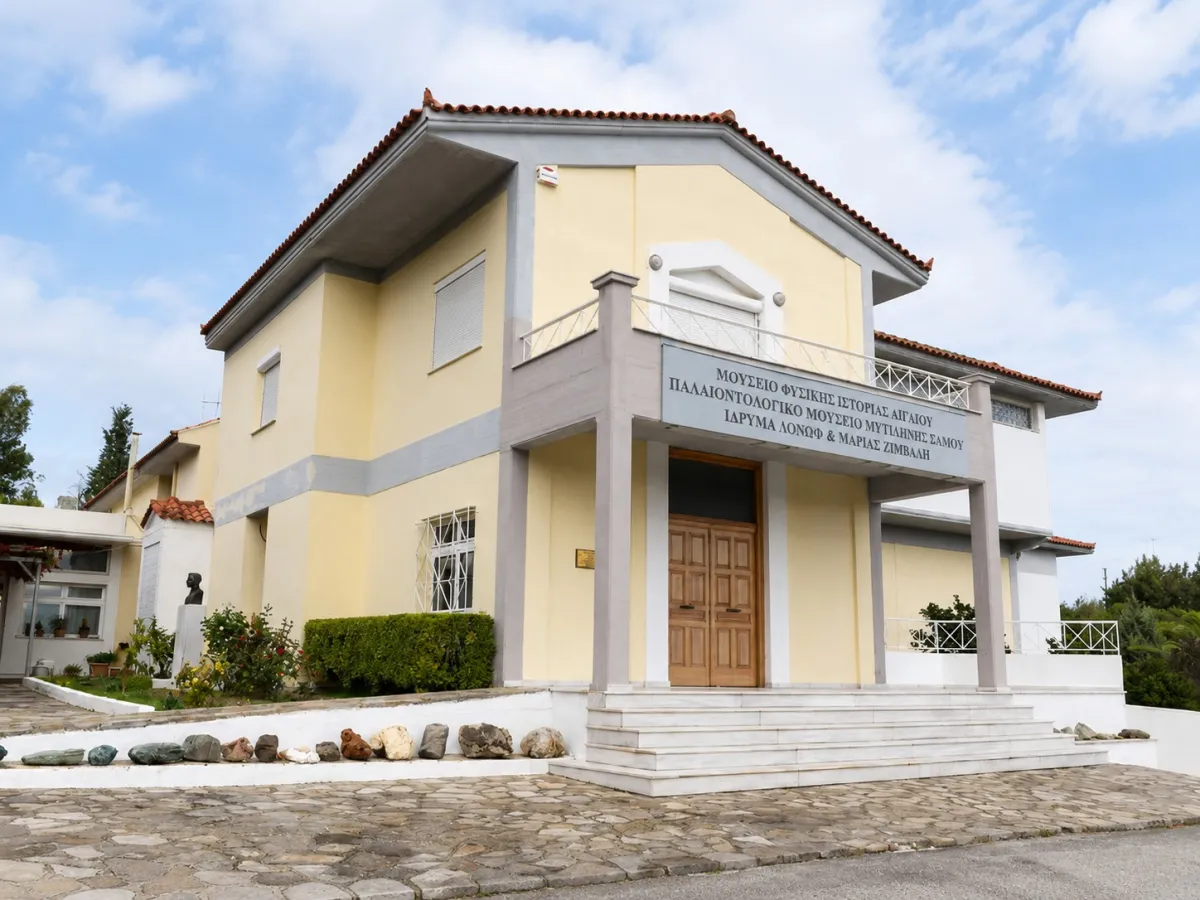
In Mytilinioi, Samos, visitors can explore the Natural History Museum of the Aegean – Paleontological Museum of Mytilinioi, one of the island’s most important places for discovering the natural, geological and paleontological history of the Aegean.
The museum is especially known for its paleontological collection, which includes fossils of animals that lived in the Mytilinioi area during the Late Miocene, approximately 8–10 million years ago.
Among them are hipparions, rhinoceroses, hyenas, proboscideans, gazelles and the famous Samotherium, an extinct giraffid whose scientific name is directly connected with Samos.
The museum, however, is not limited to fossils. Its collections also include animals and birds, minerals and rocks, marine life and botanical specimens from Samos and the wider Aegean region.
📍 Location
The museum is located in Mytilinioi, along the main road through the village and relatively close to its southern exit toward Pythagoreio.
Its location is particularly significant because the wider Mytilinioi Basin is one of the most important paleontological areas of Samos.
Fossils discovered in the sediments of this region have contributed greatly to scientific research into Late Miocene mammals of the eastern Aegean.
⏳ From a small Paleontological Museum to the present institution
The history of the museum began before the construction of the present building.
In 1963, Professor Ioannis Melentis carried out paleontological excavations in the Mytilinioi area. The discoveries formed the basis of a small Paleontological Museum, which was established in 1967 and initially contained 118 specimens.
In 1992, the Konstantinos and Maria Zimalis Foundation was established with the aim of creating a modern Natural History Museum and providing appropriate facilities for the preservation, protection and scientific study of the existing paleontological collection.
The present museum was subsequently completed and opened to the public in August 1994.
🦒 Samotherium – an animal named after Samos
One of the animals most closely associated with the paleontological history of the island is Samotherium.
Samotherium boissieri was an extinct giraffid that lived during the Late Miocene.
Samos occupies a special place in the scientific history of the genus because it is the type locality of the species, while the name Samotherium itself refers directly to the island.
The fossils of Samotherium, together with those of many other mammals, reveal an environment very different from the Samos we know today.
Scientific studies of the Mytilinioi fauna indicate that during the Late Miocene the region was characterised by relatively open landscapes with shrub vegetation and extensive grassy areas, supporting a rich community of large mammals.
🐎 Hipparions, rhinoceroses, hyenas and proboscideans
The displays of the Paleontological Department reveal a world that is difficult to imagine when looking at modern Samos.
The finds include fossilised bones and teeth of hipparions, ancient relatives of horses, as well as remains of rhinoceroses, hyenas, proboscideans, gazelles and other herbivorous animals.
Particularly interesting are fossils of horned mammals with different skull and horn forms, helping paleontologists reconstruct the diversity of wildlife that once inhabited the area.
🌍 When Samos was not the island we know today
These fossils date from a period when the geography of the eastern Aegean was very different.
The seas and islands had not yet acquired their present form, and terrestrial connections existed that allowed large mammals to move between Asia and southeastern Europe.
The fauna of Samos shows strong paleobiogeographical links with corresponding faunas from Asia, making the island particularly important for the study of mammalian migration and evolution during the Late Miocene.
⛏️ More than a century of paleontological research
The importance of the fossils of Samos had already attracted the attention of the scientific community during the 19th century.
Foreign and Greek researchers conducted excavations on the island, and large numbers of Samian fossils eventually entered museums and scientific collections abroad.
British paleontologist Charles Immanuel Forsyth Major collected fossils on Samos in 1877 and 1879, followed by several other important research expeditions.
The establishment of a local Paleontological Museum therefore had particular significance because it allowed fossils from Samos to remain on the island and to be displayed in the place where they were discovered.
🐾 The famous “Kaplani”
One of the museum’s best-known exhibits is not a fossil but the taxidermied feline known on Samos as “Kaplani”.
The exhibit is closely connected with local memory and became even more widely known through Alki Zei’s novel “The Wildcat Behind Glass”.
The exact origin and history of the animal are not fully documented, which has contributed to the development of different stories surrounding it.
🦅 Zoological Department
The Zoological Department contains a substantial collection of taxidermied animals and birds from Samos, the rest of Greece and other parts of the world.
The collection allows visitors to compare different species and gain a better understanding of animal diversity in the Aegean as well as in wider geographical regions.
💎 Minerals & rocks
The Geological Department contains approximately 300 mineral and rock specimens from Samos, the rest of Greece and other countries.
Some are rare examples, and the collection helps visitors understand that the natural history of a place is not only about animals and plants, but also about the geological materials on which ecosystems develop.
🐚 Marine life
A separate section is dedicated to marine life, with collections of shells, fish models and models of characteristic Aegean vessels.
The collection includes around 500 shells from Greece and other parts of the world, presenting another aspect of the natural diversity associated with the marine environment.
🌿 Botanical Department
The Botanical Department includes a collection of plant specimens from Samos and the Aegean preserved as a herbarium.
Through this collection, part of the region’s rich flora is documented, completing the picture of the island’s natural history from geology and fossils to present-day plant life.
🏛️ A 1,600 m² museum
The museum building covers approximately 1,600 square metres across three levels and includes exhibition areas, laboratories, a library and other facilities.
The Foundation also manages around 20,000 square metres of surrounding grounds, with plans and facilities connected with the development of a botanical garden.
The museum is a member of the International Council of Museums – ICOM and maintains scientific cooperation with academic institutions.
👨👩👧👦 A particularly interesting visit for families
The Natural History Museum of the Aegean is especially suitable for families and children because it combines easily recognisable exhibits — animals, fossils, shells and minerals — with a much broader story about the evolution of life and the natural environment.
For visitors with a deeper scientific interest, the paleontological collection has particular value because of the international importance of the Late Miocene fauna of Samos.
🎟️ Visiting
The museum is located in an easily accessible part of Mytilinioi, and a visit does not require hiking or any special preparation.
Its operation is mainly seasonal, usually from May to October, while during the rest of the year visits may be available by prior arrangement.
As opening hours and ticket prices may change, it is advisable to confirm them before visiting.
👀 What visitors will see
The Natural History Museum of the Aegean brings together different aspects of the natural world in one place.
Fossils, taxidermied animals and birds, minerals, rocks, shells and botanical specimens allow visitors to explore both the distant past and the present-day natural diversity of the Aegean.
The paleontological collection of Mytilinioi remains the museum’s most important feature, offering a rare glimpse into the life that existed in the area millions of years ago.




Add new comment