
Tabakika of Karlovasi – Historic Industrial District of Samos
🏭 The industrial heart of old Karlovasi
Along the waterfront of Karlovasi, in the area known as Riva or Ormos, extends one of the most important examples of industrial heritage on Samos: the Tabakika of Karlovasi.
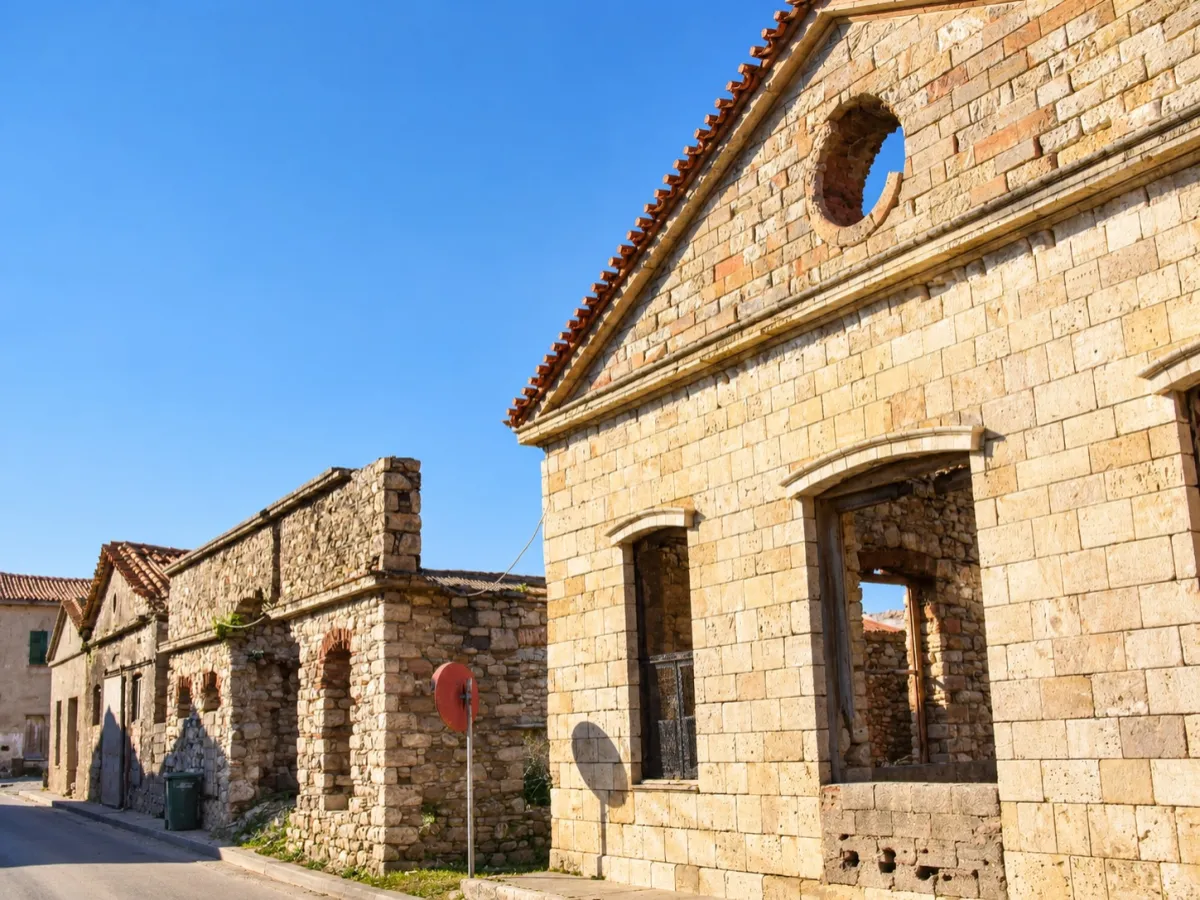
Stone factories, large rectangular façades, tall openings, chimneys, inner courtyards and the remains of production facilities recall the period when leather processing became one of the strongest sectors of the island’s economy.
The Tabakika are not a single building, but an entire historic industrial district, which developed gradually along the coast and deeply influenced the economic, social and architectural evolution of Karlovasi.
📍 Riva and the choice of a waterfront location
The development of the tanneries at Riva in Karlovasi was not accidental.
Leather processing required large quantities of water, while the coastal location facilitated both the early stages of production and the transport of raw materials and finished goods.
Small vessels, and later the organised harbour, made it possible to import raw hides and export processed leather products to markets across the Aegean, Asia Minor and other regions.
At the same time, Riva’s relative distance from the more densely populated neighbourhoods reduced the nuisance caused by a production process involving strong odours, waste and constant use of water.
🧤 From small workshops to industry
Leather processing was already present in Karlovasi during the first half of the 19th century, initially through small workshops using manual methods.
By the middle of the century, the activity had acquired a more organised form. In 1868, tanners appear collectively organised and requesting tax concessions, indicating that the sector had already gained significant economic importance.
Major expansion followed during the final quarter of the 19th century. Increased demand for leather goods during the Russo-Turkish War of 1877–1878 gave the businesses of Karlovasi a major boost and accelerated the transition from small-scale workshops to industrial production.
⚙️ Mechanisation in 1890
A major turning point came in 1890, when the mechanisation of tanning in Karlovasi effectively began.
The introduction of steam-powered machinery allowed larger quantities of leather to be processed more quickly and changed the form of the production units.
Smaller workshops gradually gave way to larger two-storey factories, with separate areas for the different stages of production and mechanical equipment that greatly increased capacity.
Within only a few decades, Riva was transformed into a genuine industrial district.
📈 The great period of prosperity, 1880–1930
The period from around 1880 to 1930 is considered the great era of the Tabakika.
At their peak, more than 50 tanneries operated in Karlovasi, employing approximately 300 workers.
Processed leather became an important export product, and Karlovasi developed into one of the major tanning centres in Greece and the eastern Aegean.
As late as 1920, 47 tanneries were still recorded, showing the scale the industry retained even after Samos had become part of Greece.
🧱 The architecture of the tanneries
The buildings of the Tabakika were designed primarily to serve production needs.
Most have an elongated rectangular plan and are positioned perpendicular or almost perpendicular to the coastline, ensuring a direct relationship with the sea.
They were usually two storeys high. The ground floor housed the “wet” stages of processing, with tanks, barrels and other installations used for washing, preparation and tanning.
The upper floor was used for the “dry” stages, such as drying, finishing, sorting and packing.
Large upper-floor windows provided more light and ventilation, while several façades incorporated Neoclassical architectural elements despite the strongly industrial character of the buildings.
🌲 From pine bark to modern tanning methods
During the early periods of tanning, vegetable tanning materials were widely used, especially pine bark.
The process was time-consuming and required repeated stages of washing, cleaning and soaking the hides in specialised tanks.
As production increased, the growing demand for vegetable materials placed pressure on the island’s pine forests and gradually led to restrictions and changes in processing methods.
The introduction of newer chemical processes and machinery significantly transformed factory operations during the 20th century.
⚓ The harbour and exports
The growth of the Tabakika was directly linked to the harbour of Karlovasi.
Construction of the harbour had already begun during the 19th century and was completed in the early 20th century, creating better conditions for the town’s commercial activity.
Raw hides arrived through the harbour for processing in the factories, while finished leather products were shipped to markets outside Samos.
The ability to connect the industrial district efficiently with maritime transport was one of the main reasons the Tabakika were able to develop such strong export activity.
🚋 The horse-drawn tram of Karlovasi
Industrial growth created the need for more efficient transport of goods between factories, warehouses and the harbour.
In 1905, a small horse-drawn tramway began operating in Karlovasi, with wagons running on rails and pulled by horses.
Part of the network served commercial transport and connected production facilities with the harbour.
The tram is a characteristic example of how strongly the economic development of the Tabakika influenced even the transport infrastructure of the town.
👷 The people behind the industry
Behind the large stone factories were hundreds of workers performing difficult and often unhealthy labour.
Contact with raw hides, constant humidity and the conditions inside the first-stage processing areas created serious challenges for workers.
In 1899, the tanners’ brotherhood “Profitis Ilias” was established, while in 1908 a workers’ association named “Brotherhood of Tannery Workers Agios Panteleimon” was founded.
The presence of these organisations shows that tanning created not only a major economic activity but also an entire working community around it.
🏘️ How the Tabakika transformed Karlovasi
The wealth generated by the leather industry was not confined to the waterfront.
Industrialists and merchants formed a new prosperous urban class that influenced the architecture, education and social life of Karlovasi.
Neoclassical houses, public buildings, schools and other town infrastructure are connected with the economic prosperity of this period.
The Tabakika are therefore essential for understanding not only the industrial history of Karlovasi but also the form of the town as it appears today.
📉 The decline of tanning
The great period of expansion did not continue beyond the middle of the 20th century.
The Second World War and the occupation caused a severe interruption in production and trade. After the war, only some of the businesses managed to reopen.
Economic difficulties, changes in processing techniques, competition from larger industries and the increasing use of synthetic materials gradually reduced demand and the viability of the old factories.
During the following decades, tanning in Karlovasi declined permanently, and the large factories of Riva ceased to function as an active industrial centre.
🛡️ Industrial monuments of Karlovasi
Today, a large part of the former tannery complex survives, although the condition varies considerably from building to building.
Some remain as large stone shells, others have suffered significant deterioration, while a number have been restored or adapted to new uses.
In 2017, a significant number of buildings within the complex were officially designated as monuments, recognising them as important examples of industrial architecture directly connected with the urban, architectural, economic and cultural development of Karlovasi during the late 19th and early 20th centuries.
One of the former tanneries also houses the Karlovasi Tannery Museum, preserving machinery, tools and material from the industrial history of the area.
🚶 Exploring the Tabakika
The area can be explored on foot from the public roads and waterfront passages of Riva.
It is not a single organised visitor site. Many buildings are old, closed or ruined and should not be considered safe to enter.
The best impression of the district is gained by walking along the waterfront, where the rows of former factories and their direct relationship with the sea can still be clearly seen.
A visit can be combined with the harbour and the Tannery Museum, helping visitors understand both the scale of the former industrial district and the way the factories once operated.
👀 What visitors will see
At the Tabakika, visitors do not encounter a reconstructed industrial park, but an authentic historic industrial landscape.
Large stone factories, rows of windows, arched openings, surviving industrial features and buildings standing almost directly beside the sea preserve the scale of the period when hundreds of people worked every day at Riva.
It is one of the places on Samos where the island’s modern history becomes visible through architecture itself: an entire district of Karlovasi shaped by production, trade and the sea.


Add new comment