
Heraion of Samos – The Largest Temple of Ancient Greece Dedicated to the Goddess Hera
🏛️ Heraion of Samos – The Sanctuary of Hera
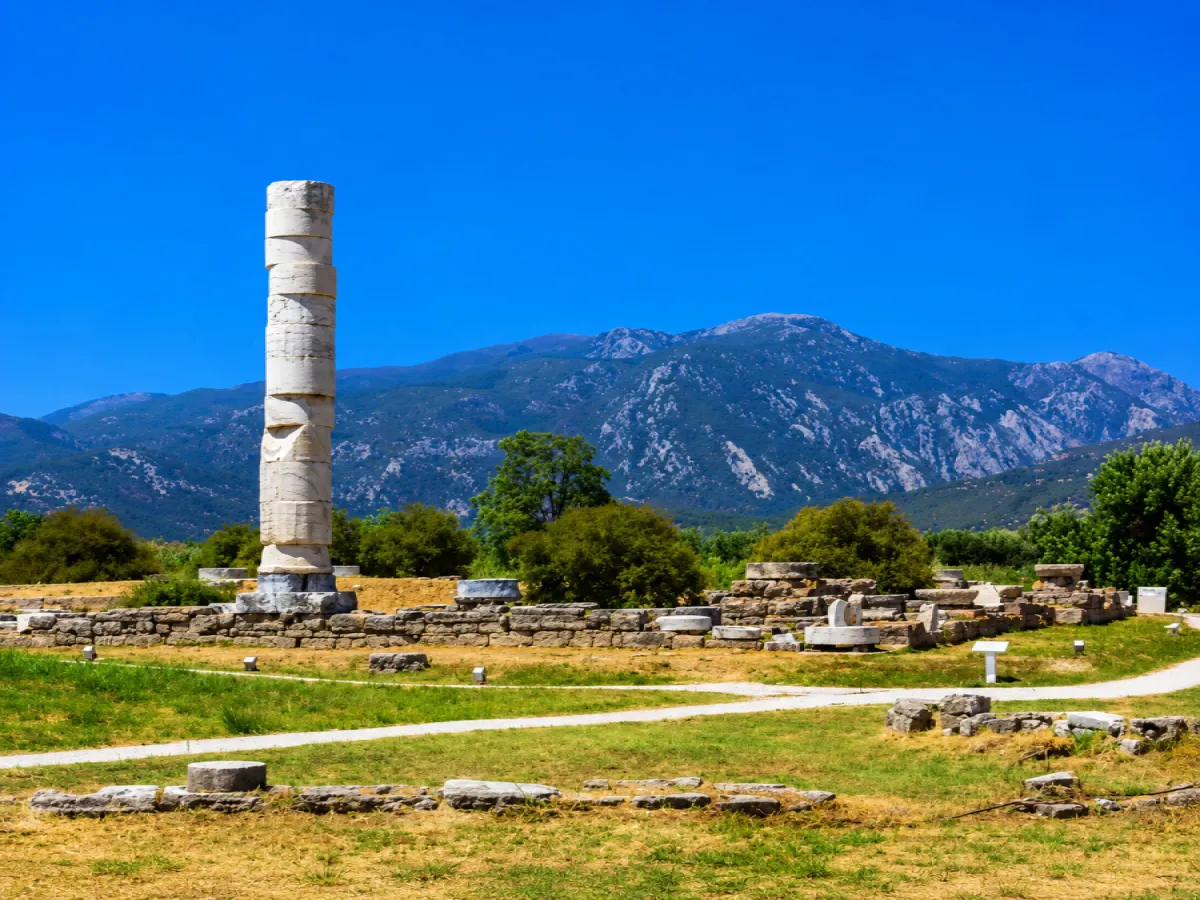
On the southern side of Samos, near the present-day seaside village of Heraion, lies one of the most important archaeological sites of the Aegean: the Heraion of Samos, the great ancient sanctuary dedicated to Hera.
Across the fertile plain near the former mouth of the River Imbrasos, temple foundations, altars, stoas, bases of votive monuments and sections of the Sacred Way bear witness to a history of worship spanning many centuries.
The most recognisable feature of the site today is the single standing column of the Great Temple of Hera. It survives to roughly half of its original height and represents only a small remnant of a temple that was designed with 155 columns approximately 20 metres high.
📍 Location
The Heraion lies on the southern plain of Samos, close to the sea and approximately 6 kilometres from the ancient city of Samos, on the site of present-day Pythagoreio. The sanctuary and the city formed two closely connected centres of ancient Samos.
The landscape surrounding the sanctuary was strongly associated with water even in antiquity. The River Imbrasos flowed through the area, while the low-lying and damp ground influenced both the development of the sanctuary and the technical difficulties encountered during its major construction projects.
Today, the archaeological site is easily accessible by road from Pythagoreio and the village of Heraion.
🌿 The Place Where Hera Was Born According to Tradition
According to ancient Samian tradition, Hera was born in the area of the Heraion, close to the River Imbrasos and beneath a chaste tree.
The sacred chaste tree became closely associated with the worship of the goddess and remained part of the sanctuary’s religious tradition for centuries. Samian tradition also connected the location with the union of Hera and Zeus.
This gave the sanctuary of Samos a particularly strong identity: for the ancient Samians, Hera was not simply a goddess worshipped on the island, but a deity intimately connected with the land itself.
🏺 Long Before the Great Temples
The history of the area is much older than the monumental Archaic temples.
Archaeological excavations have revealed prehistoric settlement in the region from as early as the Chalcolithic period, approximately 4500–3000 BC, as well as substantial remains from the Early Bronze Age.
Worship at the site of the later sanctuary can be traced back to very early periods. The origins of Hera’s cult in the area have been associated with the Bronze Age and particularly with the Mycenaean period.
The Heraion therefore did not suddenly appear in the 6th century BC as a monumental architectural project. It developed in a place that already possessed a long history of human presence and religious significance.
🔥 The Great Altar of Hera
In ancient Greek religion, the true focus of worship was not necessarily the interior of the temple but the altar, where sacrifices and religious ceremonies were performed.
At the Heraion, the early forms of the altar gradually developed into a large and monumental structure. During the 8th century BC, the altar acquired a rectangular form and an organised paved surface.
Its position remained essentially unchanged throughout successive building phases, demonstrating the remarkable continuity of worship at the same sacred location.
🏗️ The First Hekatompedos Temple
During the 8th century BC, the first large temple of Hera was built west of the altar. It is known as the Hekatompedos, meaning a temple approximately one hundred ancient feet in length.
It is considered the earliest known Greek temple to reach a length of one hundred feet. Its construction marked an important step in the transition from smaller early sanctuaries towards monumental Greek temple architecture.
🏛️ The Temple of the 7th Century BC
During the 7th century BC, the Hekatompedos was replaced by a new and more sophisticated temple.
This second phase was particularly innovative because it featured a double row of columns across the façade, an architectural solution that represented an important step towards the development of the later monumental dipteral Ionic temples.
The Heraion was already becoming a centre of architectural experimentation long before the enormous temples of the 6th century BC were constructed.
🏗️ The Temple of Rhoikos & Theodoros
Around 570–560 BC, construction began on an entirely new temple designed by the architects Rhoikos and Theodoros.
It was a colossal structure for its time, measuring approximately 52.5 × 10⁵ metres and surrounded by at least 100 columns. It represents one of the earliest monumental examples of the developing Ionic order.
Theodoros is also associated with important technical innovations in the shaping of column bases. Special turning techniques were used to produce the carefully formed architectural elements.
This temple is often referred to as Dipteros I or the Temple of Rhoikos.
⚠️ A Gigantic Temple with a Short Life
Despite its enormous size and innovative construction, the temple of Rhoikos and Theodoros did not remain standing for long.
Archaeological research indicates that it was destroyed or dismantled relatively soon after its completion, around the middle of the 6th century BC. The precise cause remains debated, with unstable ground conditions and possible seismic activity among the explanations that have been proposed.
An even larger temple was subsequently planned on the site.
👑 The Great Temple of Hera under Polycrates
During the period of the tyrant Polycrates, approximately 535–522 BC, construction began on the new Great Temple of Hera, also known as Dipteros II.
This is the temple to which the single standing column visible today belonged.
Its dimensions were extraordinary:
✅ Length: 108.63 m
✅ Width: 55.16 m
✅ Columns: 155
✅ Planned column height: approximately 20 m
It was one of the largest and most ambitious religious buildings ever planned in the ancient Greek world.
🧱 A Temple That Was Never Fully Completed
Despite the enormous scale of the building programme, the Great Temple was never completely finished.
Several columns never received their final surface treatment, while parts of the wider architectural programme remained incomplete. The decline of large-scale construction activity after the period of Polycrates had a decisive effect on the project.
Even in its unfinished state, however, its extraordinary dimensions were sufficient to impress ancient visitors.
📜 Herodotus & the Largest Temple He Knew
Herodotus included the Temple of Hera among the great achievements of the Samians and described it as the largest temple known to him.
His testimony is particularly valuable because he lived relatively close in time to the great period of prosperity experienced by Archaic Samos.
It is therefore more accurate today not to describe the temple absolutely as “the largest temple ever built in Greece”, but rather as one of the largest and most ambitious building projects of the ancient Greek world.
🛤️ The Sacred Way
The sanctuary was connected with the ancient city of Samos, present-day Pythagoreio, by the Sacred Way, a monumental route approximately 6 kilometres long.
Statues and votive monuments were placed along the road, creating an impressive ceremonial approach to the sanctuary.
The Sacred Way was not simply a route used for transportation. It formed an essential part of religious processions and of the ritual experience of approaching the sanctuary.
Sections of it are still visible within the archaeological site today.
🗿 Statues Along the Sacred Way
The monumental decoration of the Sacred Way included large sculptural dedications commissioned by wealthy Samian families.
Among them were colossal kouroi and family dedications such as the famous Geneleos Group, one of the most important ensembles of Archaic Ionic sculpture.
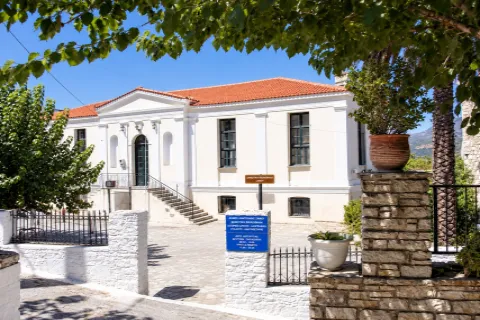
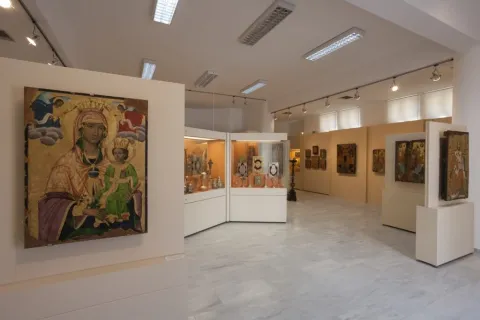
Many of the most important sculptures and votive offerings discovered at the Heraion are now preserved in the Archaeological Museum of Vathy, Samos, whose collections include statues, pottery and offerings made of bronze, ivory and wood from the sanctuary.
🌍 A Sanctuary with International Influence
The Heraion did not serve only the local population of Samos.
During the Archaic period, when Samos developed into a major naval and commercial power in the eastern Mediterranean, votive offerings reached the sanctuary from many different regions of the ancient world.
Excavations have uncovered objects and artistic influences connecting the island with:
✅ Asia Minor
✅ Cyprus
✅ Egypt
✅ The Syro-Palestinian coast and the Near East
✅ Other centres of the Aegean and the Greek world
The diversity of these offerings reflects the extensive commercial and cultural networks developed by ancient Samos.
🐘 Bronze, Ivory, Wood & Exotic Offerings
The wealth of the sanctuary was expressed not only through architecture.
Excavations have uncovered numerous votive offerings made of bronze, ivory, wood and other valuable materials, many of which show artistic styles or origins outside Samos.
These objects are particularly important because they reveal the Heraion as a meeting point of different artistic traditions from across the eastern Mediterranean.
⚓ Hera & Maritime Samos
The great development of the sanctuary coincided with the period when Samos became one of the most powerful naval and commercial centres of the Greek world.
During the 6th century BC, the Samians maintained close commercial contacts with Asia Minor and mainland Greece and also developed trading activity across more distant parts of the Mediterranean.
The wealth and international presence of the city are directly reflected in the enormous scale of the sanctuary’s building projects and in the valuable offerings dedicated at the Heraion.
🏛️ From Archaic Prosperity to the Roman Period
Religious and building activity at the Heraion did not end with the Archaic period.
The sanctuary continued to be used during the Classical, Hellenistic and Roman periods, although its role and physical form changed according to historical circumstances.
Archaeological research has uncovered buildings and votive material extending into the Late Roman period.
The Roman phase therefore cannot accurately be reduced to a simple period in which the temple became an “art gallery” and ceased to function as a place of worship. The history of the sanctuary was considerably more complex.
🏺 What Visitors Can See Today
Today, visitors do not encounter a well-preserved standing temple, but rather an extensive archaeological landscape in which the successive phases of the sanctuary can be understood through their surviving remains.
Visible across the site are:
✅ The single standing column of the Great Temple
✅ The enormous foundations and column bases of the temple
✅ Remains of earlier temples
✅ The Great Altar
✅ Sections of the Sacred Way
✅ Bases of Archaic votive monuments
✅ Remains of stoas and auxiliary buildings
✅ Numerous architectural blocks and column drums
Organised visitor paths and interpretation around the site help explain the different building phases and the historical development of the sanctuary.
🗼 The Single Standing Column
The column that dominates the archaeological landscape today belongs to the Great Temple of Hera from the period of Polycrates.
Of the 155 columns included in the design, only this one remains standing, and even this survives to approximately half of its original height.
For centuries it became such a distinctive landmark that the area of the ancient Heraion was also known locally as “Kolona”, meaning “the Column”.
Standing before this solitary architectural element, it is difficult to imagine that it once formed part of an entire forest of more than one hundred and fifty monumental columns.
🔍 Archaeological Excavations
Systematic archaeological investigation of the Heraion extends back more than a century.
In 1902–1903, the Archaeological Society conducted excavations under the direction of Panagiotis Kavvadias and Themistoklis Sofoulis.
From the early 20th century onwards, German archaeological research became increasingly important, while the German Archaeological Institute has continued to investigate the sanctuary for more than a century in cooperation with the Greek archaeological authorities.
Research is still ongoing, as new information continues to emerge regarding the prehistoric settlement, religious practices, buildings, water management and overall development of the sanctuary.
🌊 A Monument within a Sensitive Natural Environment
The Heraion lies in a low-lying coastal area characterised by high humidity and significant surface and groundwater activity.
These conditions have in some cases helped preserve organic archaeological remains, but they also create serious conservation challenges.
Humidity, vegetation, standing water and coastal erosion all affect the preservation of the archaeological landscape and require continuing protection and management.
🌍 Pythagoreion & Heraion – UNESCO World Heritage Site
In 1992, Pythagoreion and the Heraion of Samos were jointly inscribed on the UNESCO World Heritage List.
UNESCO recognises the two sites as exceptional testimony to the political, commercial, artistic and technological development of ancient Samos.
In the case of the Heraion in particular, the successive architectural innovations introduced through its different temples are considered highly significant for the development of Greek temple architecture and, ultimately, Classical architecture.
🏺 Finds from the Heraion at the Archaeological Museum of Vathy
To gain a fuller understanding of the sanctuary, it is well worth combining a visit with the Archaeological Museum of Vathy, Samos.
The museum’s older building contains important finds from the Heraion, including pottery, statues and offerings made of bronze, ivory and wood. The newer building houses the important collection of Archaic sculpture from Samos.
These exhibits help visitors appreciate the wealth and artistic richness that can no longer be seen among the architectural remains of the sanctuary itself.
🕒 Opening Hours, Tickets & Contact
According to the current visitor information:
Opening hours: 08:30–15:30
Tuesday: Closed
Regular admission: €6
Reduced admission: €3
Address: Heraion, Samos 83103
Telephone: +30 22730 62813
Opening hours and admission prices at archaeological sites may change, particularly seasonally or because of conservation work, so checking the latest information before visiting is recommended.
👀 What to Look Out for During Your Visit
During your walk through the site, it is especially worth observing:
✅ The single standing column and the enormous scale of its base
✅ The foundations revealing the true dimensions of the Great Temple
✅ The different construction phases of the earlier temples
✅ The location of the Great Altar
✅ The surviving sections of the Sacred Way
✅ The bases where monumental votive sculptures once stood
✅ The relationship between the sanctuary and the low, water-rich landscape of the River Imbrasos
🧭 Places to Combine with Your Visit
A visit to the Heraion can easily be combined with:
✅ The seaside village of Heraion
✅ Pythagoreio and the monuments of the ancient city
✅ The Archaeological Museum of Pythagoreio
✅ The Tunnel of Eupalinos
✅ The Monastery of Panagia Spiliani
For a more complete understanding of the finds from the sanctuary itself, the Archaeological Museum of Vathy, Samos is particularly worthwhile.
⭐ One of the Most Important Sanctuaries of Ionia
The Heraion of Samos is not important because a spectacular temple survives intact. In reality, most of its buildings are preserved today mainly at foundation level.
Its importance lies in the succession of structures that reveal, almost step by step, the development of monumental Greek architecture: from the 8th-century Hekatompedos, to the innovative temple of the 7th century, the colossal temple of Rhoikos and Theodoros, and finally the even larger temple of the period of Polycrates.
At the same time, the thousands of votive offerings from different parts of the Mediterranean reveal a sanctuary where religion intersected with trade, diplomacy, art and cultural exchange.
The solitary column that rises from the plain today is therefore only the most visible trace of a far greater world: a sanctuary that for centuries stood at the heart of the religious and cultural identity of ancient Samos.
Additional Information
The area of the Heraion was a place of religious worship from very ancient times. The site where the Heraion stands appears to have been inhabited as early as the second half of the 5th millennium BC, while archaeological evidence confirms the existence of an important fortified settlement there during the Middle and Late Bronze Age, with large houses and public buildings.
However, little is known about the forms of worship practised in this settlement, and there is no evidence of their uninterrupted continuation during the period following the settlement’s abandonment.
Particularly important, however, are the finds from the area of the sanctuary’s altar: a. an initial paved floor dating to 1700–1600 BC, where conical cups associated with Minoan religious practices were discovered; b. a second paved floor from the Mycenaean period (c. 1445/1415–1000 BC), with evidence of a mud-brick altar; and c. the first stone altar, found in a layer dating to around 1000 BC.
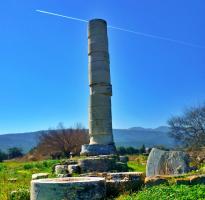 As regards worship during historical times, the area contains the remains of at least four temples: Hekatompedos I – 8th century BC, Hekatompedos II – 7th century BC, the temple of Rhoikos and Theodoros – 6th century BC, the temple in the form whose remains survive today – dating from the reign of the tyrant Polycrates, 538–522 BC – as well as temples from the Roman period.
The cult statue, a work attributed to Smilis, is generally dated to around the beginning of the 7th century BC, according to the chronology proposed by the German archaeologist D. Ohly, and is believed to have been placed in the Hekatompedos II Temple of Hera on Samos (History of the Greek Nation, Ekdotiki Athinon, volume on Archaic Hellenism, chapter on Architecture, article “The First Greek Temples”).
Herodotus states that the Heraion of Samos contained the largest temple in Greece. Excavations have revealed a dipteral Ionic temple with 105 columns, one of which remains standing today, though not intact, surviving to a height of approximately 11 metres.
The temple was built to replace the earlier Hekatompedos of the 7th century BC, although at a different location within the sanctuary. In its first phase, known as Dipteros I, it was constructed around 575 BC from limestone. Because of inadequate foundations and a fire, it was rebuilt on the same site between 530 and 520 BC as Dipteros II, with some parts made of marble and with the outer columns of the peristyle left unfluted. The temple was never fully completed.
During the Roman period, it was no longer used as a place of worship but functioned only as an art gallery, since the worship of Hera had been transferred to the peripteral temple built by Augustus above the foundations of the entrance area of the Hekatompedos, between the site of the Altar and the base of the cult statue in the sanctuary’s earlier monumental temple.
A characteristic indication of the high standard of construction is the existence of a network of clay pipes designed to drain rainwater.
The votive offerings that have been discovered and are displayed in the Archaeological Museum of Vathy indicate that the religious influence of the sanctuary extended throughout Greece and Asia Minor and as far as Egypt, comparable in reach to the influence of the Oracle of Delphi.
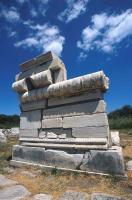
The Sacred Way also formed part of the sanctuary complex. Paved with stone, it connected the Heraion with the capital of ancient Samos, present-day Pythagorio.
Excavations within the sacred area of the Heraion began more than one hundred and twenty-five years ago and continue to the present day. The first systematic excavations were carried out in 1902–1903 by the Archaeological Society at Athens under the supervision of Panagiotis Kavvadias and Themistoklis Sofoulis.
Since 1910, research has been undertaken by German archaeological teams and, from 1925 onward, through the Athens Department of the German Archaeological Institute (DAI), with the support of the Greek Archaeological Service.
Almost the entire area of the sanctuary has been brought to light. The great temple, the altars, smaller temples, houses and countless finds reveal the scale of a remarkable civilisation that flourished in the region. The worship of Hera of Samos was not only Panhellenic in character; as the numerous archaeological finds demonstrate, its influence extended throughout much of the known world of the time. Alongside offerings dedicated to the great goddess by the Samians and other Greeks, votive objects have also been discovered from Cyprus, Egypt, Asia Minor and the wider regions of the Near East.


Add new comment