
Kastrovouni of Kontakaiika – Medieval Fortified Settlement of Samos
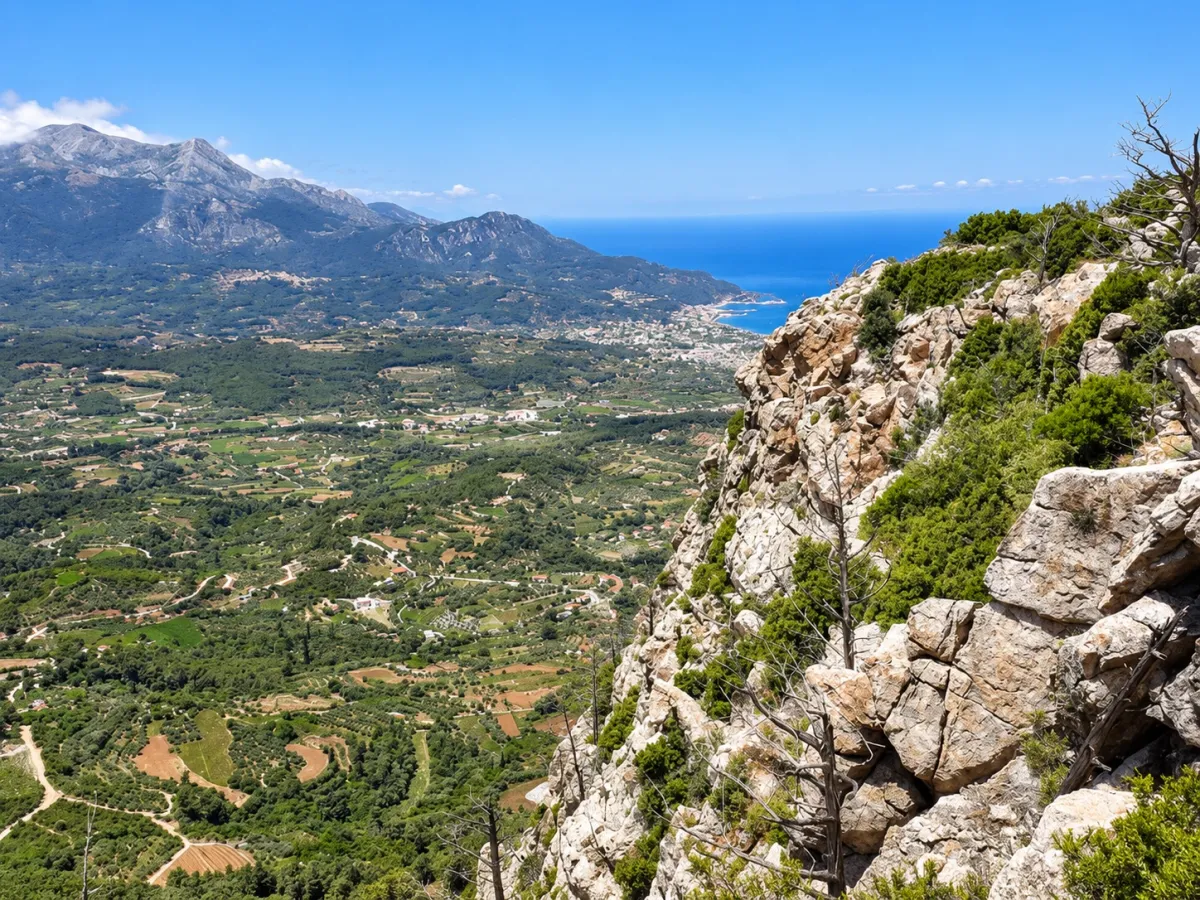
🏰 A medieval fortified settlement above Kontakaiika
On the northwestern slopes of Mount Ampelos – Karvounis, above Kontakaiika, lies Kastrovouni, one of the most important yet lesser-known medieval fortified sites of Samos.
On a naturally protected summit at an elevation of about 700 metres, remains of walls, buildings, cisterns and churches reveal that this was not simply a small fortress, but an organised fortified settlement.
The location also offers excellent views towards Karlovasi, the northern coast of Samos and the Aegean, helping explain its strategic importance during the medieval period.
📍 The location of Kastrovouni
Kastrovouni lies east of Kontakaiika and west of the deep Kourou Dere ravine, on a steep elevation of the Ampelos mountain range.
The summit is naturally defensive, with steep slopes around much of its perimeter and easier access mainly from the southeast.
From the height there are wide views towards the Karlovasi area, the northern and northwestern coast and, when visibility is clear, towards the coast of Asia Minor.
The ability to monitor both the interior of the island and the sea was a key factor in the choice of the site.
🕰️ From the Late Byzantine period to Genoese rule
The establishment of the fortified settlement is most likely connected with the Late Byzantine period, around the middle or second half of the 13th century.
This was a time of considerable instability in the Aegean, with frequent political changes, pirate raids and a growing need for populations to move away from exposed coastal areas towards safer mountain locations.
During the following centuries, Samos repeatedly came under Genoese influence and was eventually controlled by the Genoese Giustiniani.
Kastrovouni appears to have remained in use during this later period as well, which explains why it became locally known as a “Genoese Castle.” However, the original creation of the fortified settlement appears to predate the full establishment of Giustiniani rule on Samos.
🧱 Walls, gates and fortifications
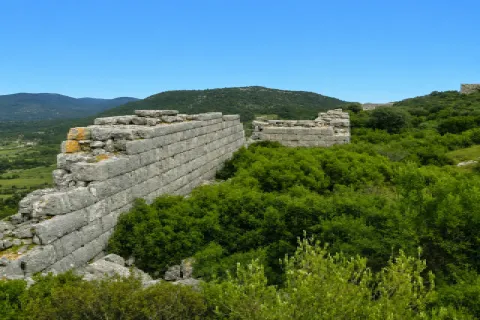
Sections of the old fortifications can still be seen at Kastrovouni.
Across different parts of the hill, visitors can identify:
✅ Sections of strong defensive walls
✅ Remains of gates and entrances
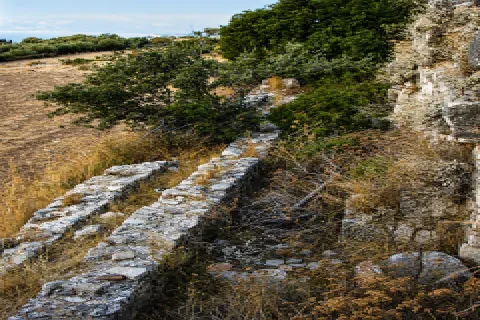
✅ Foundations and walls of buildings
✅ Water-storage cisterns
✅ Ruins of ecclesiastical buildings
✅ Traces of habitation inside and around the fortified area
Some sections of the walls were particularly thick, indicating that defence was a major element in the planning of the settlement.
Today, many of the remains have blended into the natural landscape and careful observation is needed to understand the true extent of the old complex.
💧 The water cisterns
The water cisterns are among the most important features of Kastrovouni.
For a settlement built at such an elevation and far from a permanent water source, storing water was essential both for everyday life and for survival during a siege or prolonged isolation.
Several large cisterns have been recorded in the area, some of which are still clearly visible among the ruins.
Their existence strongly suggests that Kastrovouni was intended for organised and relatively long-term habitation, rather than serving only as a temporary military outpost.
⛪ The churches of the fortified settlement
Remains of ecclesiastical buildings have been recorded within the fortified area.
The churches of Agios Nikolaos and Agios Konstantinos are associated with the site, while older descriptions also mention traces of wall paintings surviving on interior surfaces.
The presence of more than one church strengthens the interpretation of Kastrovouni as an organised settlement with a permanent population rather than a simple military position.
The remains visible today are more limited than those described in the 19th century, but the ecclesiastical presence remains an important element in understanding the history of the site.
👁️ Watchtowers and control of the Aegean
The protection of Kastrovouni did not depend on the walls alone.
The surrounding slopes included watchtowers, small observation points used to monitor the sea and provide early warning in case of danger.
One of these was known as the Watchtower of Agia Melanara, on the northern side of the mountain.
Such lookout points were an important part of defensive networks across the medieval Aegean. Through visual signals, warnings could be transmitted quickly between different heights and fortified positions.
🏘️ More than a simple castle
One of the most interesting aspects of Kastrovouni is that the area preserves evidence of a true fortified settlement.
Inside and around the defensive enclosure there are remains of many buildings, while traces of habitation have also been identified on the slopes beyond the main fortifications.
This indicates the existence of a community that needed houses, places of worship, water storage and defensive structures.
Kastrovouni should therefore be understood as a small medieval fortified settlement rather than as an isolated military structure.
⚔️ The need for protection from raids
The development of fortified settlements at high elevations is closely connected with the insecurity that affected the Aegean during the Middle Ages.
Coastal areas were especially vulnerable to pirate and military raids, and the ability to observe the sea from a distance could be vital.
Kastrovouni offered natural protection, difficult access and panoramic control over a wide area.
The geography of the mountain itself therefore became an essential part of the defensive system.
🌿 Abandonment and the return of nature
After the end of medieval habitation and the depopulation that affected Samos in the late 15th century, Kastrovouni was abandoned.
When the island was repopulated during the 16th century, new settlements were created or developed in different locations and the old fortified settlement did not return to its former function.
Over the centuries, buildings collapsed and vegetation covered much of the site.
Today, stone walls, foundations and cisterns appear among trees, shrubs and rocky slopes, creating a landscape in which history has almost merged with nature.
🥾 Hiking to Kastrovouni
Visiting Kastrovouni requires hiking, and the site is not an organised archaeological attraction with easy tourist access.
From Kontakaiika, a mountain route leads towards the summit, following in places an old path through vegetation and the slopes of Karvounis.
Access is also possible from mountain dirt roads, although road conditions may vary and access with a normal passenger car should not be taken for granted.
The final approach to the archaeological site should in any case be treated as a hiking route.
⚠️ What visitors should know
Kastrovouni is an unorganised historic site.
There are no developed paths throughout the area, safety railings or organised visitor facilities.
Visitors should have:
✅ Closed hiking shoes
✅ Water
✅ Sun protection
✅ An offline map or GPS
✅ Caution around loose stones and dense vegetation
✅ Avoidance of the route during bad weather or very strong winds
Particular care is needed near old cisterns, cavities and ruined walls, as the site has no modern safety infrastructure.
🌊 The view from Kastrovouni
One of the major rewards of the ascent is the view.
From the higher points, a wide panorama opens towards Karlovasi, the northern coast of Samos, the slopes of Karvounis and the northern Aegean.
The view makes it immediately clear why this particular location was chosen for the development of a fortified settlement.
Even today, the ability to observe such a large area remains one of the most impressive features of the site.
👀 What visitors will encounter
Kastrovouni does not have the appearance of a restored castle with high towers and complete defensive walls.
Visitors encounter an authentic ruined medieval landscape: sections of fortification, scattered walls of houses, cisterns, remains of churches and traces of a community that once lived on this isolated summit.
Its value lies precisely in this sense of an abandoned fortified settlement and in the ability to read in the landscape the relationship between habitation, defence and the natural terrain.
Kastrovouni is one of the most important sites of medieval history in northwestern Samos and, at the same time, a distinctive hiking experience for those who want to discover a less visible side of the island.


Add new comment