
Ancient Underground Quarries of Agiades – Mytilinioi, Samos
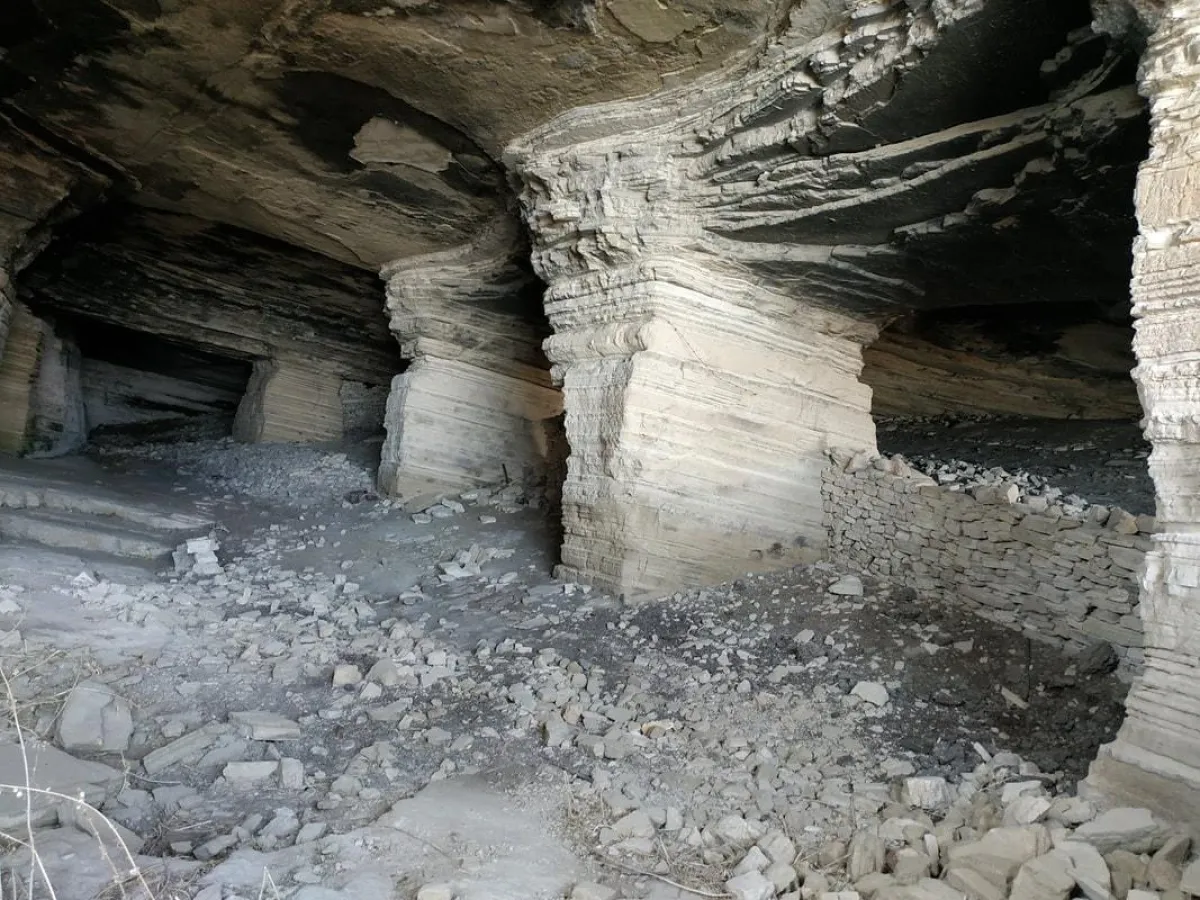
⛏️ Inside the underground stone workshops of ancient Samos
In the Agiades area, between Chora and Mytilinioi on Samos, lies one of the island’s lesser-known but particularly fascinating technical landscapes: the Ancient Underground Quarries of Agiades.
This is not a single quarry, but an extensive system of underground galleries created through the systematic extraction of limestone. Around 45 underground galleries have been recorded in the area, arranged along the slopes on two different levels.
Large quantities of building stone were extracted here and used in important construction projects of ancient Samos. The quarries therefore represent a different side of the island’s history: not the finished monument, but the place where the construction process began.
📍 Location & geological setting
The quarries are located on the hill of Agiades, in the wider area between Chora, Mytilinioi and Pythagoreio.
The underground galleries were developed at an elevation of approximately 150 metres and are arranged in two rows, with a height difference of around 10 metres between them. Their entrances are mainly oriented towards the south or southeast.
The rock exploited by the ancient quarry workers is a hard yellowish to brown limestone belonging to the so-called Pythagoreio Formation. The ancient craftsmen appear to have understood the local geology well and selected the most suitable layers for the production of building stone.
🏛️ The large three-part underground gallery
The most impressive of the known Agiades quarries is a large underground excavation extending approximately 50 metres into the rock, with an average height of about 5 metres and a total width of around 20 metres.
The interior was divided into three parallel corridors.
During extraction, sections of natural rock were initially left between the corridors as supporting walls. As more material was removed, these walls were reduced to large rock pillars supporting the ceiling. Some measure approximately 3 × 8 metres.
The interior is particularly impressive: large artificial chambers, parallel passages and massive rock pillars reveal the scale of ancient quarrying activity.
🪨 How the stone was extracted
Traces of the extraction process are still visible on the walls and floors of the quarries.
In several places, cut grooves can be seen around the stone blocks that workers prepared before detaching them. Characteristic marks left by different types of picks and metal tools have also been identified on the quarry walls.
These traces help explain the extraction techniques and distinguish different phases of quarry activity.
The underground spaces therefore preserve a direct imprint of the people who removed stone from the mountain before it was transported and used in major construction projects.
🏺 The Archaic phase – 6th century BC
The large three-part underground quarry is considered the most likely candidate for activity already during the 6th century BC.
This dating is supported by Archaic-period pottery discovered in the quarry area.
This period coincides with the great architectural and economic prosperity of ancient Samos, when large-scale projects were being carried out at the Heraion, in the ancient city and within the water-supply system.
The demand for large quantities of worked stone made organised quarries such as those at Agiades an essential part of the technical infrastructure of the ancient state.
🏛️ The connection with the Heraion of Samos
Limestone from Agiades has been connected with building activity at the Heraion of Samos, particularly with the great Temple of Rhoikos.
Approximately 6,000 cubic metres of limestone are estimated to have been used for construction work associated with this phase of the Heraion.
This connection highlights the importance of the quarries as part of the organised production and transport of building material for one of the largest architectural projects of Archaic Samos.
🛤️ The Sacred Way & the Roman period
Quarrying activity does not appear to have been limited to the Archaic period.
Limestone from the Agiades area was also used for the large paving slabs of the Sacred Way of the Heraion during Roman times.
This renovation dates to the late 2nd and early 3rd centuries AD, indicating that quarry activity in the area either continued over a long period or was revived during later phases.
Around 10,000 cubic metres of limestone are estimated to have been required for paving the Sacred Way. Together with the quantities associated with the Heraion, these two major uses represent approximately 16,000 cubic metres of extracted stone.
⚒️ Different periods, different techniques
The galleries of Agiades are not all identical.
Differences in their layout and in the surviving tool marks indicate that quarrying did not take place entirely during a single period.
The large three-part underground gallery is probably connected with the Archaic phase, while some smaller galleries in the lower row may belong to later, possibly Roman, exploitation.
Some of the smaller galleries continued to be used even into the 20th century for the extraction of small, lightweight limestone slabs.
🔎 Traces of the people who worked here
Unlike a temple or a statue, the quarries mainly preserve traces of the people who worked behind the great construction projects of antiquity.
Tool marks on the walls, grooves surrounding removed stone blocks and the overall form of the underground spaces are direct remains of the quarry workers’ daily labour.
These traces reveal not only the techniques of extraction, but also the intensity of the manual work required to remove large quantities of rock systematically.
🔱 Was there a connection with the Sanctuary of Hera?
An interesting but unproven possibility concerns a relationship between the quarries and the Sanctuary of Hera beyond the supply of building material.
The letters ΗΡ have been found on stone slabs connected with ancient works in the area, and it has been suggested that they may refer to Hera or her sanctuary.
Combined with the use of Agiades limestone in the Temple of Rhoikos, this has led to the hypothesis that the Heraion may have exercised some degree of control or supervision over quarry exploitation.
This connection remains a hypothesis rather than a proven historical fact.
🥾 Access & visiting
The quarries are located in a rural and semi-mountainous environment and are not an organised archaeological site with controlled access.
Access is via rural roads and footpaths, while remains of ancient hydraulic works can also be found in the wider area.
Suitable footwear and caution are required. The underground galleries are ancient quarry structures rather than a developed visitor cave, so entering deeper into them requires particular care.
👀 What visitors will see
The most impressive feature of the quarries is the scale of the underground spaces.
The large entrances, artificial chambers, rock pillars and visible tool marks reveal a place designed exclusively for the systematic extraction of stone.
It is not a monument created to impress, but an ancient workplace that still preserves the image of the production process behind the great building projects of Samos.


Add new comment