
Lion of Samos – Heroes’ Monument in Pythagoras Square
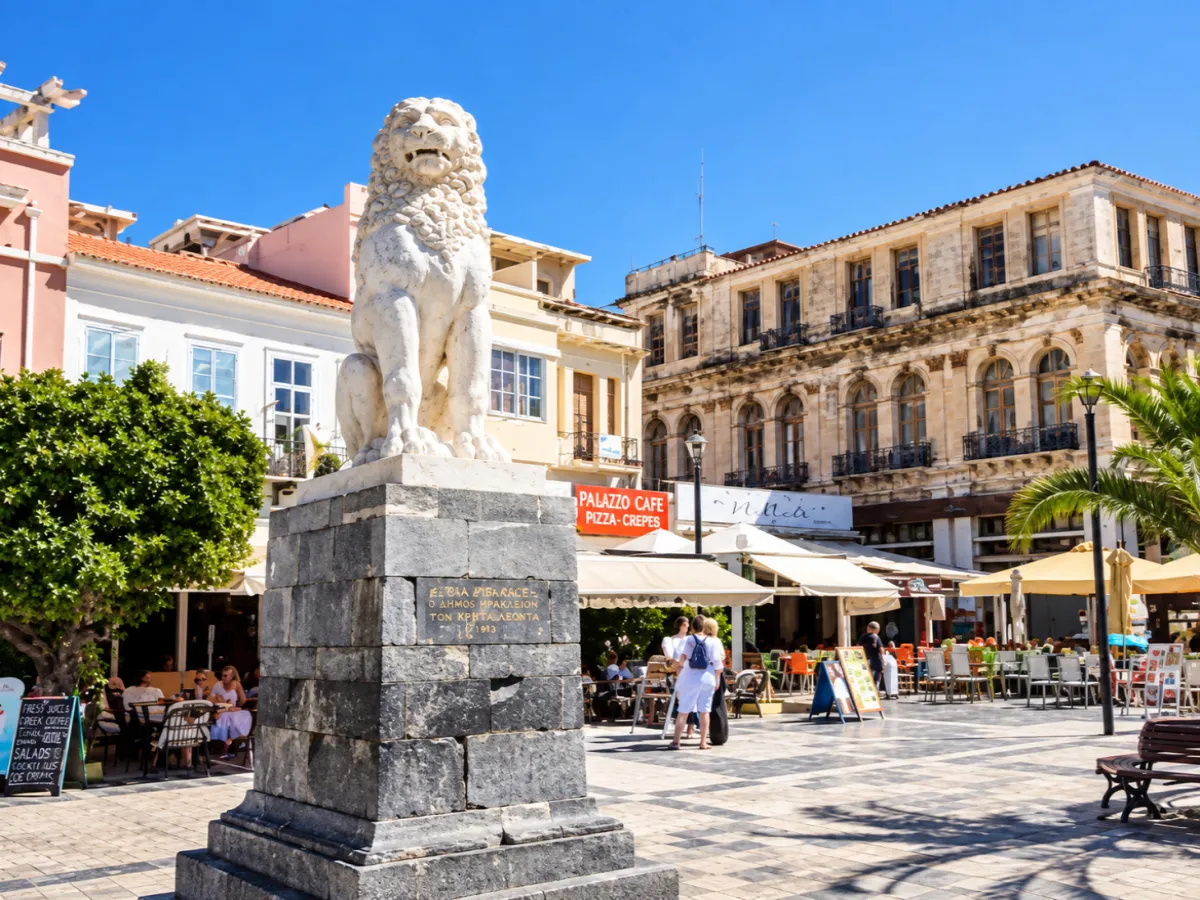
The iconic Lion of Samos Town
In the heart of Pythagoras Square, along the waterfront of Samos Town, stands the marble Lion of Samos, one of the most recognisable monuments in Vathy.
The imposing lion was not created simply as a decorative feature of the square. It is a Heroes’ Monument, dedicated to the memory and bravery of those who fought in the Greek War of Independence, with particular reference to the contribution of the people of Samos to the struggle for freedom.
Over the decades, it became an inseparable part of the image of the town and today remains one of the most characteristic meeting points and landmarks of the island’s capital.
📍 In Pythagoras Square
The Lion stands in the centre of Pythagoras Square, just a few metres from the sea and the harbour.
The square was developed during the 19th century and gradually became one of the most important public spaces in the town.
The monument was placed in a prominent central position, visible both from the waterfront and from the streets leading towards the commercial centre.
Today, the Lion forms the main visual focal point of the square.
🇬🇷 A monument to the Greek struggle for independence
The creation of the Lion was connected with the commemorations marking 100 years since the Greek Revolution of 1821.
During the early 20th century, monuments were planned throughout Greece to honour the fighters of the Revolution and symbolise freedom, sacrifice and national memory.
On Samos, a local committee was formed with the aim of creating a corresponding monument for the island.
Rather than depicting a specific fighter, the choice was made to use a powerful symbolic figure: the lion, representing bravery and sacrifice.
🗿 Inspired by the Lion of Chaeronea
The famous Lion of Chaeronea served as the model for the Samian monument.
The ancient monument in Boeotia was erected in honour of the members of the Sacred Band of Thebes who were killed in the Battle of Chaeronea in 338 BC.
The lion had long been established as a powerful symbol of courage and honour towards the fallen.
Choosing a similar sculpture for Samos transferred this symbolism into the island’s modern history, connecting it with the fighters of the Greek War of Independence.
🎨 Sculptor Ioannis Koulouris
Several artistic proposals were considered for the construction of the monument.
The design by sculptor Ioannis Koulouris was eventually selected, and he was commissioned to create the Lion.
The sculpture was made from white Pentelic marble, a material used in many important monuments and sculptures of modern Greece.
The lion itself is approximately 2.5 metres high and is depicted seated on its hind legs, with its body upright and head facing forward.
🪨 The imposing marble pedestal
The Lion was placed on a tall pedestal approximately 2.75 metres high, made from dark bluish marble.
The contrast between the white Pentelic marble of the sculpture and the darker pedestal makes the figure of the lion stand out even more strongly.
Together, the sculpture and its base rise to more than five metres, creating a monument that dominates the open space of the square.
📅 The unveiling in 1930
The monument was installed in Pythagoras Square in 1930.
Its official unveiling took place on 6 August 1930, a date of particular symbolic importance for Samos.
The 6th of August is associated with the island’s commemoration of its deliverance during the Greek War of Independence, following the victorious naval events off Samos in the straits of Mykali in 1824.
The unveiling of the new monument was therefore linked not only with the national memory of the Revolution, but also with one of the most important dates in the modern history of Samos.
⚓ Samos in the Greek War of Independence
Samos participated actively in the Greek War of Independence and repeatedly resisted attempts by Ottoman forces to restore full control over the island.
A decisive event was the Battle of Samos in 1824, when the Greek fleet confronted Ottoman forces in the straits between Samos and the coast of Asia Minor.
The victory prevented a major Ottoman landing on the island and acquired a particularly important place in the collective memory of the Samians.
The Lion of Pythagoras Square acts as a symbol of this long tradition of resistance and struggle for freedom.
💰 A monument created with the participation of the people of Samos
Funds for the construction of the monument were collected through contributions from across Samos.
This gives the Lion a special character, since it was not simply a state project but an effort supported by local society.
From the beginning, the monument was intended as a public symbol of remembrance representing the island as a whole and the struggles of its people.
📰 The debate surrounding its creation
The choice of the lion was not made without controversy.
During the period when the monument was being created, there was public debate over whether a symbolic monument should be erected or whether statues of specific Samian fighters would be more appropriate.
Part of the local press strongly criticised the choice of a sculpture based on the Lion of Chaeronea, arguing that a specifically Samian subject would better represent the island’s history.
Despite the criticism, the monument was completed, and over time the lion itself became one of the most recognisable symbols of the town.
🔄 Its temporary relocation
The Lion did not remain continuously in exactly the same position.
During the military dictatorship of 1967–1974, the monument was moved from the centre of Pythagoras Square and placed near the Town Hall.
A different decorative monument was installed in the square during that period.
After the restoration of democracy, the Lion returned to Pythagoras Square and once again occupied the position with which it had already become strongly identified in the minds of local residents.
🌴 A symbol of Pythagoras Square
Today, it is difficult to imagine Pythagoras Square without its characteristic lion.
The square is one of the liveliest places in Samos Town, surrounded by cafés, shops, Neoclassical buildings and the waterfront avenue.
The white marble Lion stands prominently in the centre and is a popular subject for photographs among both residents and visitors.
For many people, its image has become synonymous with Vathy itself.
🎖️ The Heroes’ Monument today
The site continues to have an active commemorative and ceremonial role.
At the Heroes’ Monument in Pythagoras Square, wreath-laying ceremonies and official commemorations take place during national anniversaries and other days of remembrance.
The Lion is therefore not only a historic sculpture dating from 1930, but also a living place of public memory for the town and the island as a whole.
🚶 Visiting the Lion of Samos
Access to the monument is free and extremely easy, as it stands right in the centre of Samos Town.
Pythagoras Square forms part of the waterfront promenade and can easily be reached on foot from the harbour, the market and most central parts of the town.
Visitors can view the sculpture from all sides while also experiencing one of the most historic public spaces in Vathy.
👀 What the Lion represents
Behind the familiar image of the marble lion lies a history that connects the Greek War of Independence, Samian historical memory, sculpture and the development of the town itself.
The monument was created to symbolise the courage of those who fought for freedom and, almost a century later, it continues to fulfil that role.
The Lion of Samos is not simply a distinctive sculpture in a central square. It is one of the island’s most recognisable modern monuments and an enduring symbol of Samos Town.


Add new comment