
Folklore Museum of Mesogeio – Samos
🧿 Everyday life in a mountain village of Samos
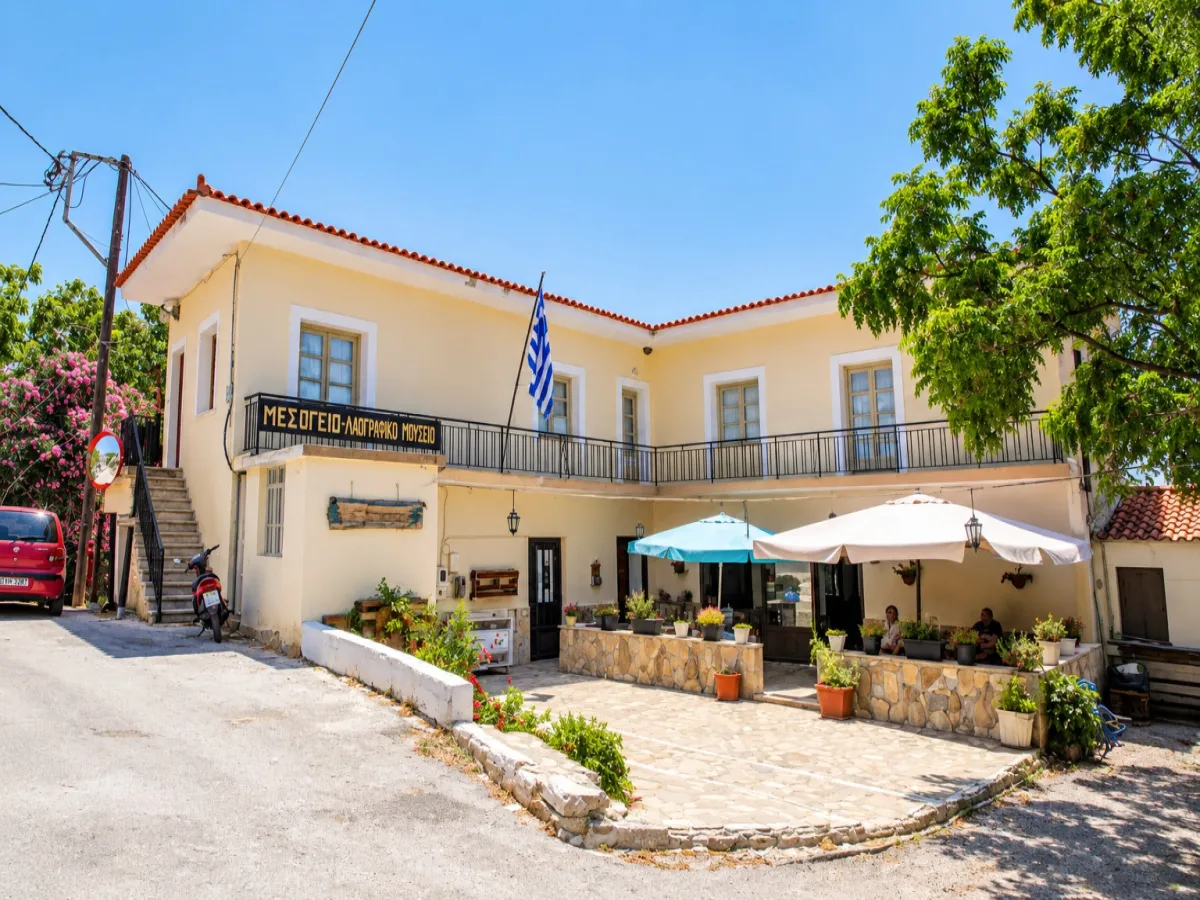
In the mountain village of Mesogeio on Samos, formerly known as Kato Arvanites, stands the Folklore Museum of Mesogeio, a small but particularly characteristic museum dedicated to everyday life, agricultural work and family traditions.
The collection mainly covers the period from the late 19th century to the 1960s and consists largely of objects originating from families of the village itself.
Furniture, household utensils, tools, photographs, documents, a loom, a plough and a grape press recreate the image of an era when life in Mesogeio was closely connected with the home, the land and agricultural production.
🏛️ In the building of the former cooperative
The museum is housed in the two-storey building of the former cooperative, at the entrance to Mesogeio and close to the junction leading to Pandrosos.
The upper floor, which once contained the cooperative’s offices, was converted to house the folklore collection.
The choice of this particular building is significant, since the cooperative formed part of the economic and social life of a village that depended heavily on viticulture and other agricultural activities.
⏳ From 1972 to the creation of the museum
The roots of the collection go back to 1972, when the first floor of the building was constructed and objects from village residents began to be gathered.
The initial effort gradually expanded through further donations of family possessions, eventually creating a collection that presents many different aspects of life in Mesogeio.
The museum was later organised by the Cultural and Beautification Association of Mesogeio “Zoodochos Pigi” and has operated in its organised form since August 2009.
🏡 The Samian household
An important part of the collection is devoted to everyday life inside the home.
Traditional furniture, cooking utensils, storage vessels and other household objects show how a rural household functioned before modern domestic appliances became widespread.
The exhibits reflect a way of life in which many tasks were carried out by hand and the home served simultaneously as a place of residence, production and storage.
🧶 The loom & household production
The loom is one of the museum’s most characteristic objects.
Weaving was an important part of the household economy, since many fabrics and items needed by a family could be produced at home.
The loom recalls both the skill and the considerable amount of time required to produce textiles before ready-made industrial products became widely available.
🌾 Agricultural tools & cultivation
The agricultural life of Mesogeio is represented through tools used for cultivating and caring for the land.
Among the characteristic exhibits is the traditional plough, together with tools connected with different types of agricultural work.
The collection shows how closely the household depended on farming and how much manual labour was required to cultivate the mountain slopes of Karvounis.
🍇 The grape press & viticultural tradition
The grape press occupies a particularly important place in the collection, as Mesogeio lies within one of the traditional wine-growing areas of mountainous Samos.
The vineyards on the slopes around the village formed an important part of the local economy, and vine cultivation influenced the annual cycle of work for local residents.
The press and related tools illustrate the first stages of transforming grapes into must and wine, linking the museum collection directly with the agricultural landscape that still surrounds the village.
📷 Old photographs & documents
Old photographs and documents form another important part of the collection.
The photographs preserve images of people, families, landscapes and moments from the social life of the village, while the documents provide information about the economic and administrative life of earlier decades.
Together with the everyday objects, they create a broader picture of the development of Mesogeio from the late 19th to the mid-20th century.
🤝 The contribution of local residents
The creation of the collection depended greatly on the participation of the residents of Mesogeio.
Family possessions that might otherwise have been lost or abandoned were gathered, preserved and incorporated into the museum.
As a result, the collection does not present a general picture of Samian folklore, but is directly connected with the families, work and history of this particular village.
🏘️ A museum within its natural environment
The location of the museum adds particular interest to the visit.
Leaving the building, visitors find themselves in the same mountain environment that shaped many of the activities presented inside: vineyards, olive groves, cultivated slopes and small roads connecting Mesogeio with nearby Pandrosos.
The agricultural tools and grape press are therefore not isolated museum pieces, but parts of a way of life directly connected with the landscape of Karvounis.
🎟️ Visiting
The museum is located at the entrance to Mesogeio, in the building of the former cooperative.
It does not follow a fixed daily schedule throughout the year. Visits mainly take place during the summer season and may also be arranged in advance.
For this reason, it is advisable to confirm visiting arrangements before travelling to the museum.
👀 Why it is worth discovering
The Folklore Museum of Mesogeio preserves a representative picture of life in one of the mountain farming villages of Samos.
Household objects, the loom, plough, grape press, photographs and documents present different aspects of a society organised around family life, manual work and cultivation of the land.
Its particular value lies in the strongly local character of the collection and its direct connection with the village and its people.


Add new comment