
Folklore and Historical Museum of Pagondas – Samos
🧿 A journey into the everyday life of old Pagondas
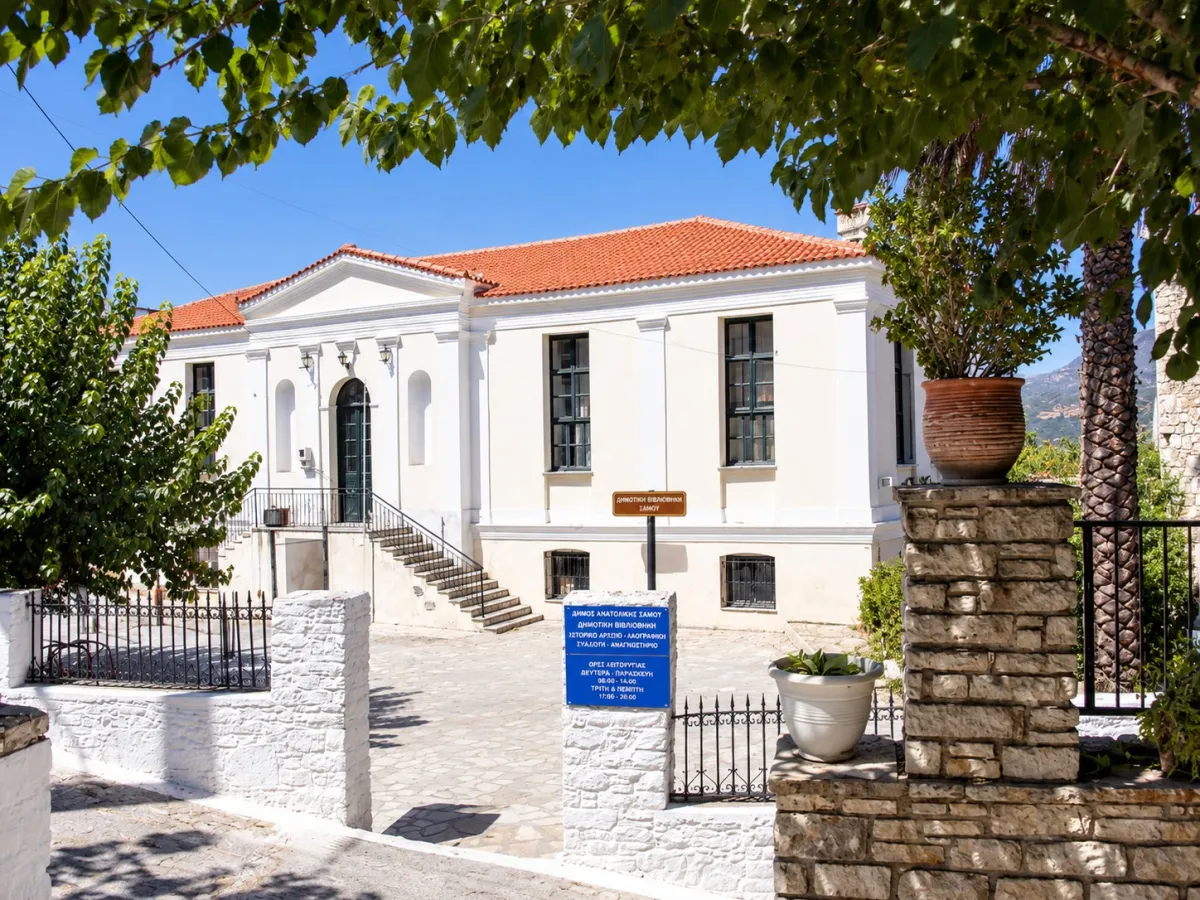
In Pagondas, in southern Samos, close to the village’s central square, stands the Folklore and Historical Museum of Pagondas, a space dedicated to the traditional Samian home, rural life, old professions and the historical memory of the local community.
The collection was created largely from objects gathered and donated by the residents of Pagondas themselves.
For this reason, the exhibition is not simply a general representation of life on Samos, but strongly reflects the character and memory of the village itself.
🏛️ The first organised folklore museum on Samos
The creation of the museum is closely connected with the Association of Women and Young Women of Pagondas “Omonoia”, founded in 1976, which developed significant activity aimed at preserving local traditions.
The systematic collection of folklore material began in the early 1980s.
After approximately two years of preparation, the museum was organised and established in 1984 inside the old Primary School of Pagondas.
Available local sources describe it as the first organised folklore museum on Samos.
🔨 Renovation & reopening in 2008
The museum operated until 1993, when renovation work began on the old Primary School building.
A long period of restoration followed, during which the building gradually developed into a wider cultural centre.
After the completion of the works, the museum reopened to the public on 23 March 2008.
Its reopening allowed the Omonoia Association not only to continue presenting the collection but also to organise cultural and educational activities connected with the history of Pagondas.
🏡 A traditional Samian home inside the museum
A central part of the exhibition recreates the rooms of a traditional Samian house.
Visitors can see the kitchen, bedroom, dining area and sitting room, together with furniture, utensils, woven textiles and everyday household objects.
A particularly characteristic feature is the corner around the fireplace with the traditional sofras, the low table around which the family gathered for meals.
The exhibition is not limited to isolated objects but attempts to reconstruct the atmosphere of the home and the way everyday family life was organised.
🧺 The “katoi” – the foundation of the traditional household
A separate section is dedicated to the katoi.
In a traditional Samian house, the katoi was the lower part of the building, usually on the ground floor or partly below ground level.
It was used to store food, agricultural produce, tools and other essential items, while in some cases it could also be used to shelter animals.
The museum displays storage vessels for dry and liquid products, agricultural and harvesting tools, as well as equipment connected with rural production.
🧶 The loom & traditional weaving
The loom is one of the most characteristic exhibits.
Together with handmade textiles and other objects of domestic production, it recalls a period when much of the fabric used by a family was produced inside the home itself.
Weaving required time, skill and experience and formed an important part of women’s everyday work in the rural communities of Samos.
Woven fabrics served practical purposes, but their patterns and quality also expressed family tradition, craftsmanship and local aesthetics.
🌾 Agricultural tools & harvesting
For generations, Pagondas was one of the important agricultural villages of southern Samos.
This character is strongly reflected in the museum collection.
Visitors can see tools used for cultivating the land and harvesting crops, storage vessels and equipment associated with processing the products of the rural household.
The exhibits help demonstrate that the traditional home was not simply a place to live, but also a small centre of production and storage.
🍇 The connection with vineyards & Samian wine
Viticulture was an important part of the agricultural life of Pagondas, and this is also reflected in the museum collection.
Among the exhibits are tools and vessels connected with cultivation, harvesting and the storage of agricultural products, together with objects related to the traditional production and handling of wine.
These objects illustrate the close relationship between the village, the land, the vineyards and the rural economy of Samos.
🛠️ Tools of traditional professions
In addition to agricultural equipment, the collection also contains tools used by traditional craftsmen and professionals.
These objects show how tasks that are now carried out with modern machinery once depended almost entirely on manual labour and specialist knowledge passed from one generation to the next.
The museum therefore also acts as a record of the professions and working practices of a community before the widespread mechanisation of the 20th century.
📜 The Historical Museum in the same building
An especially interesting feature is that the same premises also house a Historical Museum of Pagondas.
The historical collection was created to present aspects of the village’s political, social, civic and scientific history, complementing the folklore exhibition.
Visitors therefore learn not only how a traditional house was organised or which tools people used, but also gain a broader view of the social history and individuals who shaped Pagondas.
🤝 The contribution of the local community
The Omonoia Association of Women and Young Women of Pagondas played a decisive role in the creation and preservation of the museum.
For many decades, the association worked to collect, document and present objects connected with everyday life, traditional professions and the history of the village.
Thanks to this effort, an important part of the local cultural memory has been preserved for younger generations and visitors.
📱 Digital presentation of the collection
The Folklore Museum of Pagondas is included among eight folklore museums on Samos that became part of a programme for the digital promotion of their collections.
The programme includes digital applications, interactive material, virtual tours and augmented-reality technologies designed to present the island’s folklore heritage through modern tools.
⚠️ The 2020 earthquake & visiting today
The building housing the museum was affected by the strong earthquake of 30 October 2020 and required restoration work.
Access and opening hours may vary depending on the period.
For this reason, it is advisable to confirm the museum’s current operation and opening hours before visiting.
🏘️ Combining the museum with a walk through Pagondas
The museum is located very close to the central square, making it easy to combine a visit with a walk through the narrow streets and older neighbourhoods of the village.
Pagondas retains traditional houses, uphill lanes, a public washhouse and viewpoints overlooking the Chora plain and southern Samos.
The museum visit therefore becomes even more meaningful, as many of the objects displayed inside can be connected with the real architectural and agricultural environment of the village.
👀 Why the museum is particularly valuable
The Folklore and Historical Museum of Pagondas preserves the image of a society based on agricultural production, manual work and the family economy.
The sofras, loom, agricultural tools, storage vessels, furniture and historical documents help visitors understand the way previous generations lived and the changes the village experienced during the 20th century.


Add new comment