
Archaeological Site of Thermes of Samos
♨️ Roman Baths of Pythagoreio, Samos
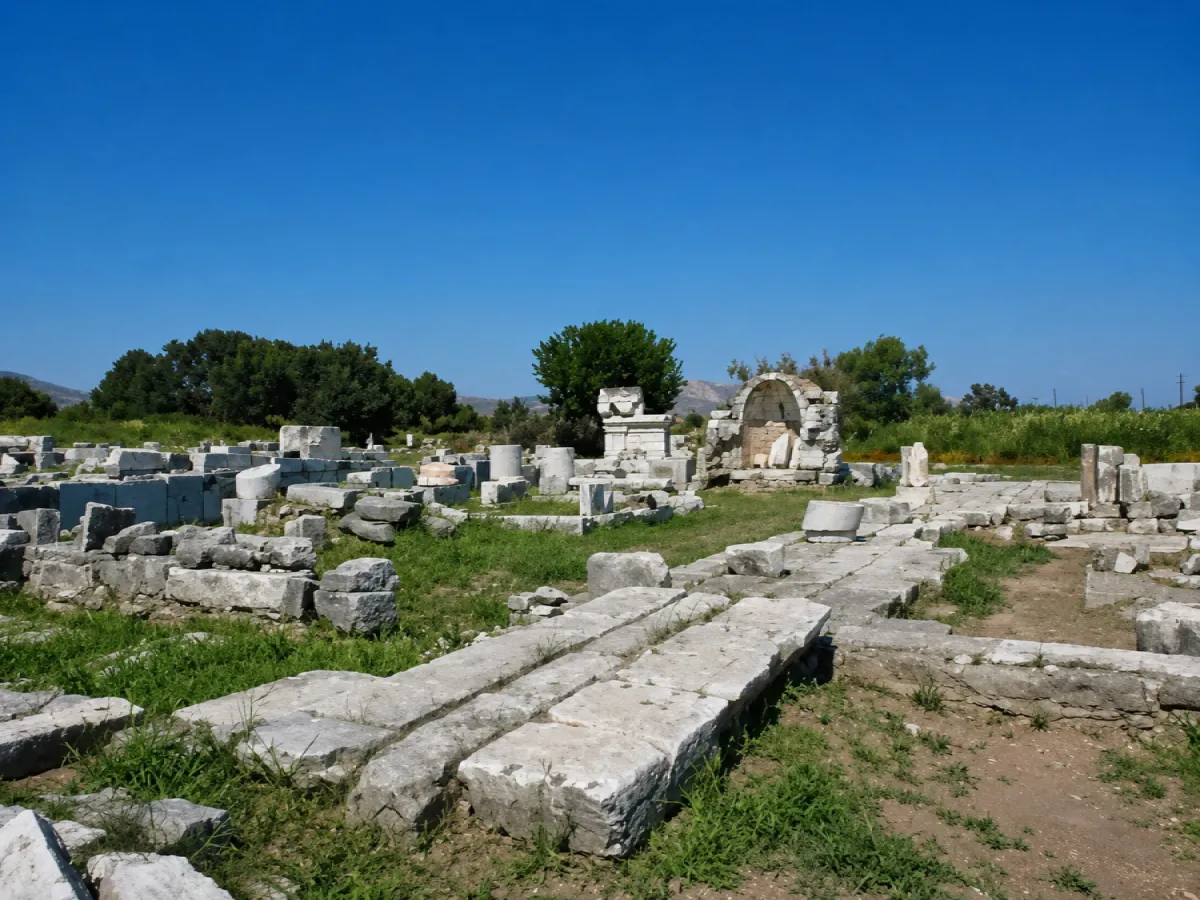
To the west of present-day Pythagoreio lie the remains of one of the most important public complexes of the Roman city: the Roman Baths of Pythagoreio.
The bathing complex was constructed during the second half of the 2nd century AD and formed part of a wider area dedicated to athletics and public life in ancient Samos, where a gymnasium, palaestra and stadium were also located.
The Baths were not simply a place for washing. As in many cities throughout the Roman Empire, public baths were important centres of daily social life, relaxation, physical exercise and interaction.
The surviving remains reveal an organised architectural complex with changing rooms, areas for cold and hot bathing, water tanks, a distinctive octagonal pool and hypocaust heating installations.
📍 Location
The Roman Baths are located on the western side of Pythagoreio, within the wider area of the ancient city of Samos.
Their location was closely connected with the urban and athletic organisation of the ancient city. The Baths developed beside existing facilities associated with physical exercise and were functionally linked with the gymnasium, palaestra and stadium.
The ancient stadium stood to the south of the bathing complex and measured approximately 190–200 metres in length and 40–50 metres in width, indicating the scale of organised athletic activity in this part of the city.
🏛️ From the Ancient City to Roman Samos
The area occupied by present-day Pythagoreio lay at the heart of the ancient city of Samos, an important urban centre that continued to be inhabited and developed for many centuries after the great prosperity of the 6th century BC.
During the Roman period, the city acquired new public buildings and infrastructure, including the large bathing complex.
The construction of such an organised public facility reflects the Roman concept of urban life, where physical exercise, personal care and social interaction could take place within the same architectural environment.
The Baths therefore provide important evidence for the transformation of ancient Samos during Roman times and for the continuation of urban life in the area of present-day Pythagoreio.
🏺 The Baths as Part of a Larger Athletic Complex
Before the Roman baths were constructed, the area already contained facilities associated with athletics.
The gymnasium was an important institution in the ancient Greek city and was not used solely for physical exercise. It was also a place of education and social activity, while the palaestra was primarily associated with sports such as wrestling.
With the construction of the Baths in the 2nd century AD, bathing facilities were incorporated into this already established environment, creating a broader complex dedicated to exercise, bodily care and social interaction.
This relationship is characteristic of the evolution of large public complexes during the Roman period.
🧱 Organisation of the Bathing Complex
The surviving spaces make it possible to identify several of the main functions of the Roman Baths.
On the northwestern side were areas used as changing rooms, where bathers prepared before entering the other sections.
The northern part contained the cold bathing areas, together with a distinctive octagonal pool.
The southern section housed the heated rooms and the facilities used for hot bathing.
The complex also included a small vaulted chamber used as a laconicum or sudatorium, a room designed for intense heat and sweating, functioning in a manner comparable to a hot-air or steam bath.
🔥 The Hypocaust Heating System
One of the most important technological features of the Baths was the hypocaust heating system.
In the heated rooms, the floor was not built directly on the ground. Instead, it was raised on small pillars, creating an empty space underneath.
Hot air generated in a furnace circulated below the floor and could also pass through specially designed channels within the walls, heating the rooms.
This system made it possible to create different temperature conditions throughout the bathing complex and represents a characteristic example of the advanced engineering used by the Romans in public bath buildings.
The Baths therefore did not depend on natural thermal springs or geothermal energy. Their heat was produced artificially through an organised system of furnaces and hot-air circulation.
💧 Cold & Hot Bathing Areas
Moving between spaces of different temperatures was a fundamental feature of Roman bathing.
Visitors could pass from cooler areas to progressively warmer rooms, depending on the sequence followed within the complex.
At the Roman Baths of Pythagoreio, this distinction can still be recognised in the architectural layout, with the cold-bathing areas concentrated mainly in the north and the heated installations in the south.
The large octagonal pool is one of the most distinctive surviving features of the northern section.
🎨 Marble & Mosaics
The Baths were not purely functional spaces.
Surviving remains indicate that the rooms were decorated with marble and mosaic elements on floors and walls, giving the public complex a more monumental character.
The substantial masonry, architectural fragments and traces of decoration help visitors imagine a setting very different from the ruins visible today.
In their original form, the Baths would have created a complex architectural environment of water basins, vaulted rooms, heated halls and decorated surfaces.
👥 Public Baths as Centres of Social Life
In the Roman world, public baths formed an important part of everyday urban life.
Visiting the baths was not simply about personal cleanliness. People could meet, talk, rest and combine bathing with physical exercise.
For this reason, the Roman Baths of Pythagoreio provide information not only about architecture and engineering, but also about the daily habits and social life of the inhabitants of the city.
Their proximity to the gymnasium, palaestra and stadium further highlights the close relationship between public life, athletics and bodily care.
✝️ Transformation During the Early Christian Period
The history of the site did not end when the Baths ceased to function in their original form.
During the second half of the 5th century AD, a three-aisled Early Christian basilica with auxiliary spaces was constructed in the northern part of the complex.
Parts of the earlier Roman structures were incorporated into the new use of the area.
The small vaulted heated chamber that had once functioned as a laconicum or sudatorium was converted into a baptistery.
This transformation is a characteristic example of how buildings and spaces of the Roman city acquired new functions as Christianity spread.
⚰️ From Bathing Complex to Baptistery and Burial Use
Further changes occurred during the following centuries.
In the 7th century AD, one of the rooms on the northwestern side of the former Baths was converted into a funerary crypt.
The same archaeological site therefore preserves evidence of several distinct phases: the Roman bathing complex, the Early Christian basilica, the baptistery and later funerary use.
This sequence makes the Roman Baths particularly interesting, as they do not represent only a single moment in the city’s history, but rather the adaptation of the same urban space to changing social and religious needs.
🌍 The Roman Baths & UNESCO
The Roman Baths lie within the archaeological area of Pythagoreio of ancient Samos, which, together with the Heraion, has been included on the UNESCO World Heritage List since 1992.
UNESCO recognises Pythagoreio as exceptional evidence of the cultural, architectural and technological achievements of ancient Samos.
The Baths form part of this broader historical picture and are particularly important for understanding the Roman and Early Christian phases of the city.
👀 What Survives Today
Visitors can identify:
✅ Sections of the bathing rooms
✅ Remains of the hypocaust heating system
✅ The octagonal pool
✅ Substantial masonry and vaulted spaces
✅ Traces of marble and mosaic decoration
✅ Remains of the Early Christian basilica
✅ The room later converted into a baptistery
✅ Architectural remains belonging to different construction phases
Although only part of the original complex survives today, the layout of the ruins still provides an impression of the considerable scale and complexity of the Baths.
🚧 Access & Visiting Information
The Roman Baths should not be presented as a freely accessible, organised archaeological site.
Current available information indicates that the monument is closed to the public and does not have an active visiting schedule.
Because access conditions at archaeological sites may change, visitors planning to see the area are advised to seek up-to-date information from the Ephorate of Antiquities of Samos and Ikaria or the Archaeological Museum of Pythagoreio.
Archaeological Museum of Pythagoreio: +30 22730 62813
E-mail of the Ephorate of Antiquities of Samos and Ikaria: efasam@culture.gr
🧭 Places to Visit Nearby
The Roman Baths lie within one of the richest archaeological landscapes of Samos and can be combined with visits to:
✅ Archaeological Museum of Pythagoreio
✅ Remains of the ancient city of Samos
✅ Ancient stadium and athletic facilities of the area
✅ Tunnel of Eupalinos
✅ Castle and Tower of Lykourgos Logothetis
✅ Statue of Pythagoras
✅ Heraion of Samos
🏛️ A Different Chapter of Ancient Samos
The Roman Baths of Pythagoreio reveal a side of ancient Samos that differs from the great achievements of the Archaic period.
Here, the focus shifts to everyday life in a Roman city: athletics, social interaction, public architecture and sophisticated systems of heating and water management.
At the same time, the conversion of part of the bathing complex into an Early Christian basilica and baptistery demonstrates how the same urban environment continued to be used and transformed as society and religious beliefs changed.
The Roman Baths therefore form an important part of the long historical continuity of Pythagoreio, linking the Roman city with the first centuries of Christianity.


Add new comment