
Panagia’s Little Castle in Potami – The Tranquil Fortress of Medieval Samos
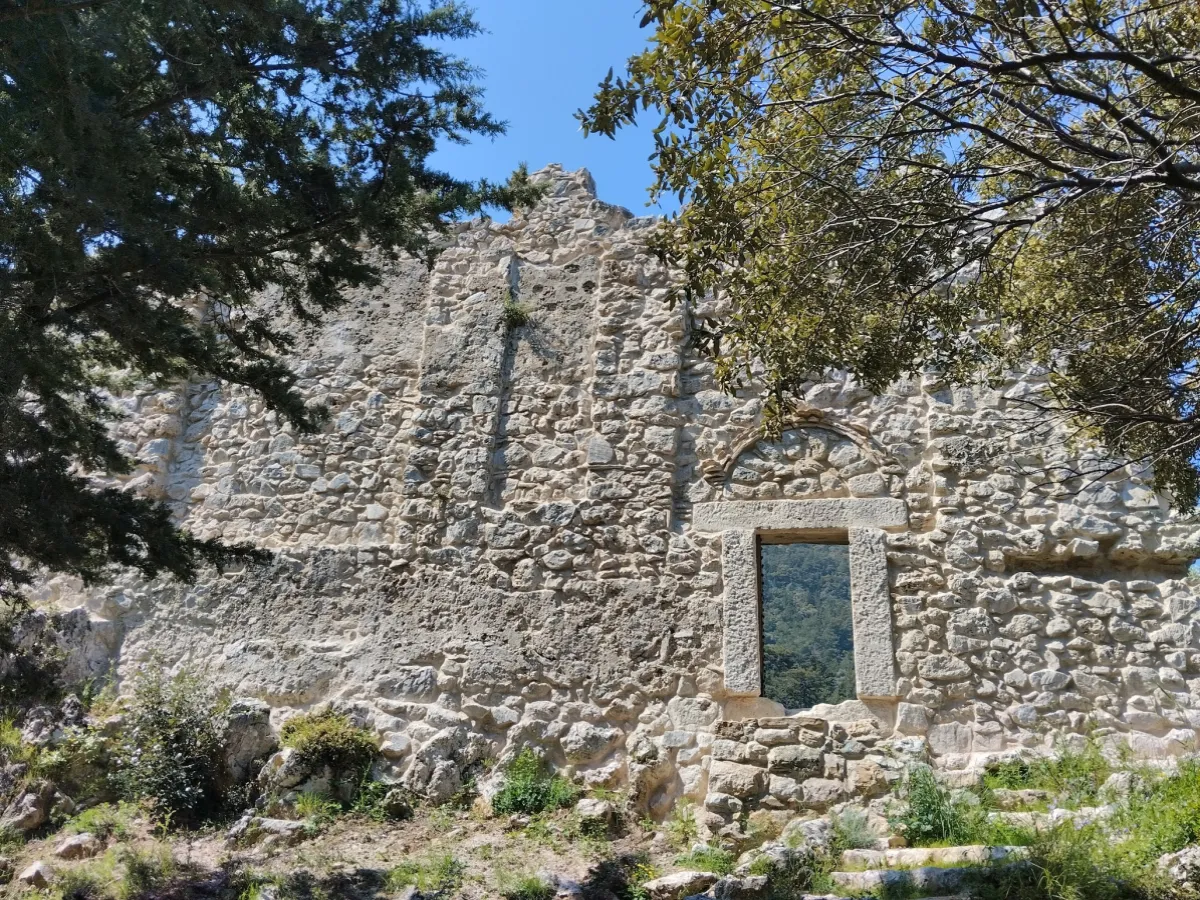
🏰 Kastraki of Panagia in Potami – Potami, Karlovasi
In the lush Potami area, west of Karlovasi, on a rocky hill rising above the river valley, stands the Kastraki of Panagia tou Potamou, a small but particularly interesting Byzantine fortification on Samos.
Kastraki forms part of a wider medieval monumental complex that includes the important Byzantine church of the Transfiguration of the Saviour, the small church of Agios Nikolaos, and the fortification on the summit of the rock.
The location combines Byzantine architecture, natural defensive terrain and the distinctive landscape of Potami, only a short distance from the beach and the well-known route leading towards the waterfalls.
📍 Location
Kastraki lies approximately 3 kilometres west of Karlovasi, in the Potami area, on a rocky outcrop close to the riverbed.
The rock itself provides natural protection on the northern, western and southern sides, while the easiest approach is from the east. For this reason, the strongest section of the fortification and its entrance gate were constructed on the eastern side.
The site lies behind Potami Beach and very close to the path that continues inland through the valley towards the waterfalls.
🏛️ Byzantine – Not Reliably Identified as Genoese
Kastraki is sometimes referred to in older tourist descriptions as the “Genoese Castle”. This attribution, however, is not considered sufficiently well documented.
The monument is officially regarded as a Byzantine castle, while specialised studies of the fortification have not established that it was built by the Genoese.
Its association with the Genoese appears to be a later local or tourist tradition, probably encouraged by the wider presence of Western powers in the Aegean during the later medieval centuries.
It is therefore more accurate to present the site as a Byzantine fortified complex at Potami.
🕰️ When Was Kastraki Built?
The exact date of the fortification has not been definitively established.
Architectural studies have suggested that it was most probably constructed during the period of the Laskarid emperors of Nicaea, approximately in the middle or second half of the 13th century, while an early 14th-century date has also been considered.
Other interpretations have examined the possibility that the fortification was more closely connected with the monastic complex of the Transfiguration, whose earliest phase dates to the 11th century.
For this reason, it is better to avoid assigning the castle an exact construction date without qualification.
🛡️ A Refuge in a Period of Insecurity
Kastraki does not have the characteristics of a major military fortress.
The interior does not contain the extensive barracks, administrative spaces or permanent residential buildings usually associated with a major garrison.
For this reason, researchers have suggested that it functioned primarily as a temporary refuge during periods of danger, possibly for people from the surrounding area or for the monastic community associated with the neighbouring churches.
Its position also provided surveillance over the coastal area and maritime approaches.
At a time when small coastal settlements and monastic communities in the Aegean were vulnerable to sudden raids, even a relatively small naturally fortified location could provide valuable temporary protection.
⛪ Connection with the Monastic Complex
Of particular interest is the close relationship between the fortification and the Byzantine ecclesiastical monuments at the foot of the rock.
The area does not appear to have been simply an isolated military outpost. It had a strong ecclesiastical and probably monastic character.
The central monument of the complex is the Church of the Transfiguration of the Saviour, while the Church of Agios Nikolaos lies a short distance away.
Inside the fortification itself, the remains of a small church and a water cistern are also preserved.
The combination of places of worship, water-storage infrastructure and defensive walls suggests an organised complex capable of serving both daily religious needs and protection during times of danger.
🧱 Layout of the Fortification
Kastraki occupies the summit of a narrow, sloping rocky outcrop.
The fortification measures approximately 15 × 45 metres and follows the natural shape of the rock, forming an irregular elongated enclosure covering around 700 square metres.
The steep slopes acted as natural defensive walls on most sides. As a result, the principal defensive construction was concentrated on the eastern side, from which the summit could be approached more easily.
This adaptation of the fortification to the natural terrain is characteristic of small medieval refuges, where the landscape itself was used as effectively as possible for defence.
🚪 The Eastern Gate
The entrance to Kastraki is located on the eastern side, at the most accessible point of the hill.
Access was provided by stone steps leading to a small and relatively narrow gateway.
Its limited width had a clear defensive purpose, making it easier to control entry into the enclosure.
The eastern wall is also the most impressive surviving section of the fortification.
🧱 The Impressive Eastern Wall
The eastern defensive wall survives to a height of approximately 7.5–8 metres and preserves sections of its battlements.
Its masonry consists of stones bonded with strong lime mortar, while fragments of roof tiles were also incorporated into the construction.
Vertical reinforcements on the exterior acted as buttresses, increasing the stability of the wall.
The much greater strength of the eastern side was not accidental: it was the only part of the hill that could be approached relatively easily.
🌄 Natural Defence of the Rock
On the other sides, the rock itself provided much of the defence.
The northern and southern slopes are steep, while the western side descends sharply towards the valley.
It was therefore unnecessary to construct equally massive walls around the entire perimeter.
This topography explains why, although the fortification is relatively small, the position could still offer effective protection during a short-term raid or attack.
⛪ The Small Church Inside Kastraki
Within the fortified enclosure, archaeologists have identified the remains of a small triconch church, located only a short distance from the entrance.
The structure survives to a relatively low height today, but its presence is one of the most important clues for understanding the character of the complex.
A place of worship within the protected enclosure would have allowed basic religious practices to continue even while people were sheltering inside the fortification.
💧 The Water Cistern
A water collection and storage cistern also survives within Kastraki.
The cistern was originally covered with roof tiles, and traces of waterproof plaster remain visible on its interior.
Its presence was essential for a place intended to provide refuge, even for relatively short periods.
A fortified position needed some independent capacity to store water if people were forced to remain inside during danger.
⛪ Church of the Transfiguration of the Saviour
At the foot of the rock stands the most important Byzantine monument of the complex, the Church of the Transfiguration of the Saviour, historically also associated with the name Panagia tou Potamou.
Its earliest architectural phase dates to the 11th century, and it is regarded as one of the most important and best-preserved Byzantine monuments on Samos.
The church is not a simple single-room chapel. Architecturally, it belongs to the type of the cross-in-square, simple four-column church.
Its exterior masonry also displays influences associated with the architectural tradition of Constantinople.
The church acquired its present form through modifications and interventions carried out over the following centuries, continuing into the 14th century.
⛪ Church of Agios Nikolaos
The small Church of Agios Nikolaos also forms part of the same archaeological and ecclesiastical landscape.
It stands approximately 150 metres north of the Church of the Transfiguration and survives today in a ruined condition.
Agios Nikolaos, the Transfiguration and Kastraki together demonstrate that the site formed a much more complex medieval ensemble than a single isolated castle.
🔧 Restoration of the Monumental Complex
In recent years, an important programme of stabilisation, conservation and restoration has been carried out across the site.
The project included:
✅ The Church of the Transfiguration of the Saviour
✅ The neighbouring Byzantine Kastraki
✅ The Church of Agios Nikolaos
✅ Stabilisation and structural reinforcement of the monuments
✅ Repointing and conservation of structures within the fortification
✅ Landscaping and enhancement of the interior
✅ Improvements to access along the river
✅ Restoration of the surrounding area
The project had a total budget of €763,000 and was completed in 2024.
In 2025, the restoration of the monumental complex was announced as complete and the site was reopened to the public.
🚶 The Visitor Experience
Visiting Kastraki is quite different from touring a large, organised medieval castle.
The route follows the natural terrain of the area, leading from the river and the ecclesiastical monuments towards the rocky hill and the fortification.
Visitors can observe:
✅ The restored eastern wall
✅ The old entrance gate
✅ The battlements and structural reinforcements
✅ The remains of the small triconch church
✅ The water cistern
✅ The Church of the Transfiguration at the foot of the hill
✅ The neighbouring Church of Agios Nikolaos
✅ The natural landscape of Potami and the river valley
Following the recent conservation works, the site should no longer be described simply as an abandoned ruin without interpretation or restoration.
🎟️ Access & Useful Information
The site has been reopened to the public following completion of the restoration works.
Current official information does not specify a separate entrance ticket or fixed daily opening hours for Kastraki itself.
Access requires walking over natural and sometimes uneven terrain, so visitors are advised to bring:
✅ Sturdy footwear
✅ Enough daylight for the visit
✅ Extra caution on damp or slippery sections, particularly near the river
✅ Respect for the restored structures and archaeological remains
🌿 Kastraki, the River & the Natural Landscape
One of the features that makes the site particularly special is the close relationship between the monuments and the surrounding natural environment.
The castle rises above the valley, while the river flows below through dense vegetation.
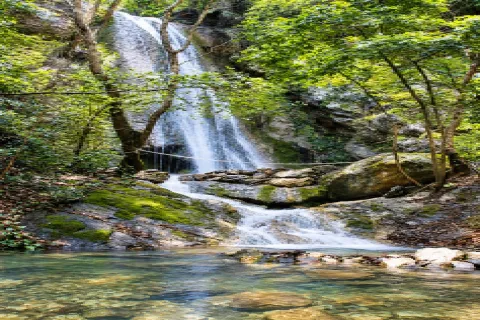
The same route continues deeper into the valley towards the well-known natural setting of the Potami Waterfalls.
Within a relatively small area, visitors encounter a Byzantine fortification, two medieval churches, a river, a wooded valley, waterfalls and the coastline of Potami.
🧭 Places to Combine with Your Visit
The area is ideal for a broader excursion around Potami:
✅ Church of the Transfiguration of the Saviour
✅ Church of Agios Nikolaos
✅ Potami Waterfalls
✅ Potami Beach
✅ Old Karlovasi
✅ Port of Karlovasi
The close proximity of these sites makes it possible to combine the medieval history of the area with one of the best-known natural routes in western Samos.
⭐ A Different Side of Byzantine Samos
Kastraki of Panagia tou Potamou does not impress through the scale of a major medieval fortress.
Its importance lies elsewhere: in the way the fortification makes use of the natural terrain, in its close relationship with the neighbouring ecclesiastical monuments, and in the insight it offers into life in a coastal area of medieval Samos where worship, monastic presence and the need for protection existed side by side.
Together with the Church of the Transfiguration of the Saviour and the Church of Agios Nikolaos, it forms one of the most interesting surviving groups of Byzantine and medieval monuments on the island, given new prominence following the completion of restoration works in 2024.


Add new comment