🪵 Agios Isidoros Tarsanas – Traditional Shipyard of Samos
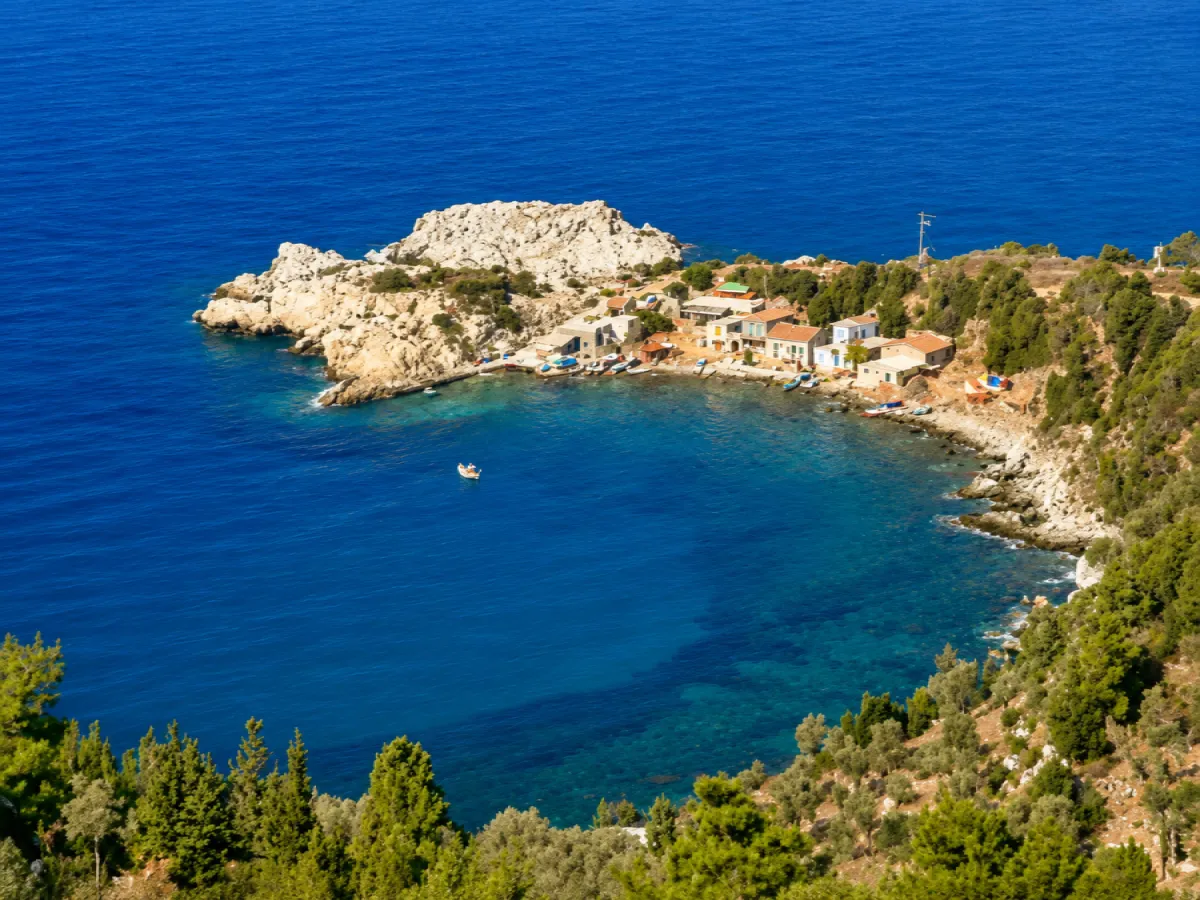
In the secluded Agios Isidoros Bay, on the northwestern edge of Samos, lies one of the island’s most important sites of traditional Greek wooden shipbuilding.
The Agios Isidoros Tarsanas is not a museum reconstruction of a vanished craft. It is a historic shipbuilding site where the construction and repair of wooden boats continued from generation to generation and where the art of the traditional boatbuilder remains alive today.
Modern records identify Vangelis Manoliadis as one of the craftsmen continuing this family tradition at Agios Isidoros.
📍 Location
Agios Isidoros lies in northwestern Samos, in the area associated administratively with Drakaioi and the western part of the island.
For many years, the small bay served as the maritime outlet for the mountain villages of Drakaioi and Kallithea. Before road connections were developed during the 20th century, communication with other parts of Samos depended to a significant extent on the sea.
The secluded setting, sheltered coastline and proximity to timber from the surrounding forests created favourable conditions for the development of wooden shipbuilding.
⚓ What Is a Tarsanas?
The Greek word tarsanas traditionally refers to a place where wooden vessels are built, repaired and maintained.
Unlike a modern industrial shipyard, a traditional tarsanas relies heavily on manual work and the practical knowledge of experienced boatbuilders.
Traditional Greek wooden shipbuilding is now recognised as a form of Intangible Cultural Heritage and has been included in Greece’s National Inventory of Intangible Cultural Heritage.
🏛️ A Protected Historic Site
The importance of Agios Isidoros extends beyond the shipbuilding craft itself.
In 2007, the traditional shipbuilding site was officially designated by the Greek Ministry of Culture as a protected historic site, under:
Ministerial Decision ΥΠΠΟ/ΔΝΣΑΚ/28789/837/16-5-2007 – Government Gazette 240/ΑΑΠ/12-06-2007.
The designation recognises the historical and cultural significance of the wider site and the traditional shipbuilding activity that developed there.
📜 The Shipbuilding Tradition of Samos
Samos has a long and important tradition of wooden boatbuilding.
At different periods, tarsanades and boatbuilding workshops operated in several parts of the island, drawing on the maritime experience of local communities and the availability of timber.
Samian wooden vessels were known for their robust construction, while the island’s pine wood was particularly valued for shipbuilding because of its durability.
🌲 Samian Pine
The extensive forests of western Samos offered an important advantage to local boatbuilders.
Timber could be transported from relatively nearby areas and then prepared and shaped at the shipyard.
Traditional shipbuilding communities included far more than boatbuilders alone. The production process involved:
✅ Woodcutters
✅ Timber carriers
✅ Hewers and axe workers
✅ Boatbuilders
✅ Assistants and apprentices
✅ Other craftsmen involved in construction and fitting out vessels
Shipbuilding therefore supported an entire local economic network.
🏗️ Six Shipbuilding Units at Agios Isidoros
During the 20th century, as many as six independent small shipbuilding and repair units operated at Agios Isidoros.
People from Drakaioi, Kallithea and other villages of Samos worked in the trade. Agios Isidoros was therefore a genuine small shipbuilding settlement rather than a single isolated workshop.
The area also had permanent residents and basic facilities supporting the everyday life of those working at the tarsanas.
🛶 What Types of Boats Were Built
A variety of traditional Greek wooden vessels were constructed at the shipyards of Agios Isidoros.
Among the types recorded are:
✅ Trechantiria
✅ Trawlers
✅ Peramata
✅ Varkalades
✅ Karavoskaro-type vessels
✅ Smaller boats
✅ Wooden barges and auxiliary craft
The trechantiri in particular became one of the characteristic products of the Samian shipbuilding tradition.
🚢 Large Wooden Vessels in the 20th Century
Shipbuilding at Agios Isidoros was not always limited to small fishing boats.
Local historical records state that in the mid-20th century, the boatbuilder Psilopatis constructed a wooden vessel there with a displacement of around 500 tonnes, approximately 25 metres long and 8 metres wide.
This information comes from local documentation and testimonies associated with the island’s shipbuilding tradition and illustrates the capabilities that craftsmen in the area had developed.
🪚 How a Wooden Boat Is Built
Traditional wooden shipbuilding is based on technical knowledge that, for centuries, was passed down primarily through apprenticeship beside an experienced master boatbuilder.
Construction involves a series of stages:
✅ Selecting and preparing the timber
✅ Building the keel
✅ Shaping the frames – the “skeleton” of the vessel
✅ Planking the hull
✅ Caulking and waterproofing
✅ Constructing the deck and superstructure
✅ Painting and finishing
✅ Launching
The craft is not based solely on fixed plans. Much depends on experience, proportions and the judgement of the boatbuilder.
Traditional wooden shipbuilding is valued precisely because it represents living technical knowledge passed from one generation to the next.
👨🔧 The Manoliadis Family
For many years, the Manoliadis family has been closely associated with the shipyard at Agios Isidoros.
Giannis Manoliadis was a well-known local boatbuilder and passed the craft on to his son, Vangelis Manoliadis.
Recent publications and academic research have documented Vangelis continuing to build wooden vessels at Agios Isidoros.
🔨 The Craft Continues
The present-day tarsanas is not maintained as a tourist display.
It is a real working shipyard, where new wooden boats may still be constructed and older vessels repaired.
In 2024, the construction of a new trechantiri approximately 8 metres long was documented at the site, demonstrating that the tradition continues in practice rather than surviving only as a memory.
⚠️ Not the Only Boatbuilder on Samos
An important correction is needed here compared with older descriptions.
It is not accurate to say that Agios Isidoros is home to “the last boatbuilder of Samos.”
Other active craftsmen have also been documented on the island, including Giorgos Kiassos in Drakaioi, while academic and journalistic sources confirm that traditional wooden shipbuilding on Samos, although now very limited, is not represented by only one person.
Agios Isidoros nevertheless remains the island’s most important historically preserved shipbuilding site and the only one with this specific official designation as a protected historic site.
🏴☠️ What About the Pirates?
Local tradition includes stories suggesting that the secluded position of Agios Isidoros may once have been used by pirates as a hidden place for building or repairing vessels.
The shape and isolation of the bay could indeed have offered shelter and concealment, but this association has not been sufficiently documented as a historical fact.
It is therefore better presented only as a local tradition, not as the proven origin of the shipyard.
🕰️ Is It Really the Oldest Shipyard on Samos?
This point also requires caution.
Older tourism sources sometimes describe Agios Isidoros as the oldest active traditional shipyard in Greece. More recent academic research on Samian wooden shipbuilding, however, suggests that Varsamo may represent an earlier known shipbuilding location than Agios Isidoros.
In addition, the traditional “Tarsanas” shipyard on Syros also documents continuous activity dating back to the 19th century and is likewise described as one of the country’s oldest active wooden shipyards.
The safest and most accurate wording for Go Samos is therefore:
“One of the oldest active traditional shipyards in Greece and one of the most important historic wooden shipbuilding sites in the Aegean.”
📉 The Decline of Traditional Wooden Shipbuilding
From the early 20th century onward, large wooden merchant and passenger vessels gradually began to be replaced by metal ships.
Later, the widespread use of plastic and fibreglass boats further reduced demand for traditional wooden craft.
Wooden shipbuilding still survives, but the number of craftsmen and active shipyards has fallen dramatically.
The preservation of the craft is now recognised as an important issue of intangible cultural heritage.
🎓 Efforts to Preserve the Craft
Samos also plays an important role in efforts to preserve traditional wooden shipbuilding.
The Museum of Aegean Shipbuilding and Maritime Crafts in Heraion was designed not only as a place to display vessels and maritime traditions, but also as a centre supporting the teaching and transmission of traditional wooden shipbuilding skills.
This gives even greater significance to places such as Agios Isidoros, where the knowledge is still being practised.
⛪ The Chapel of Agios Isidoros
The small settlement and bay take their name from the chapel of Agios Isidoros, located in the area.
Local historical records date its construction to 1530 and associate it with Agios Isidoros of Chios, whose feast day is celebrated on 14 May.
The small chapel, old buildings and wooden hulls together create a distinctive historic landscape beside the sea.
🏚️ The Old Shipyard Buildings
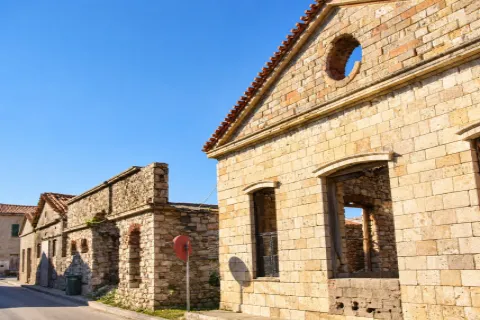
Around the active shipyard, older buildings survive from the period when several independent shipbuilding units operated at Agios Isidoros.
Some are now abandoned, but together with the launching ramps, wooden structures and equipment they preserve the character of a historic shipbuilding landscape.
Modern accounts describe the site as one of the most emblematic places associated with wooden shipbuilding in Greece.
🚗 Access
Agios Isidoros is reached by road from western Samos.
The final section of the route includes approximately 4.5 kilometres of dirt road.
Indicative road distances are approximately:
✅ 40 km from Karlovasi
✅ 20 km from Kampos Marathokampou
✅ 56 km from Pythagoreio
✅ 70 km from Samos Town
Conditions on dirt roads can change depending on the season, so reduced speed and extra caution are advisable, especially after rainfall.
🚤 Access by Sea
The bay has a small pier and can also be approached from the sea by a suitable vessel.
Historically, this maritime connection was much more important, as Agios Isidoros served the nearby mountain villages before the development of the modern road network.
👀 What You Can See
Visitors may be able to observe:
✅ Wooden boats at different stages of construction or repair
✅ Timber frames forming the skeleton of a new vessel
✅ Old shipbuilding tools and equipment
✅ Timber prepared for use
✅ Launching ramps leading towards the sea
✅ Old buildings of the shipbuilding settlement
✅ The Chapel of Agios Isidoros
✅ The small sheltered bay
⚠️ It Is a Working Area
Despite its historical importance, the active tarsanas is not an organised museum or conventional archaeological site.
It is a professional workspace where real shipbuilding work takes place.
Visitors should therefore respect the working environment, avoid touching tools or timber without permission and make sure not to interfere with the craftsmen.
The surrounding area is generally accessible, but this does not mean that every workshop or building is open to the public.
📷 Photography
Agios Isidoros is one of the most distinctive photographic locations in western Samos.
Particularly interesting subjects include:
✅ Wooden hulls beside the sea
✅ Exposed timber frames of new boats
✅ Old workshops and stone buildings
✅ Launching ramps leading into the water
✅ Timber and traditional boatbuilding tools
✅ The chapel and the small bay
When craftsmen are working or people are present in the area, it is courteous to ask permission before taking close-up photographs.
🧭 Places to Combine with Your Visit
In the wider area you can also visit:
✅ Drakaioi
✅ Kallithea
✅ Varsamo Beach
✅ The western slopes of Mount Kerkis
Varsamo Beach lies approximately 2 kilometres away via dirt road from Agios Isidoros.
⭐ A Living Part of the Maritime Heritage of Samos
The Agios Isidoros Tarsanas is special because it does not simply preserve traces of a craft that has disappeared.
Traditional wooden shipbuilding continues here, in the same place where six shipbuilding units once operated and where generations of boatbuilders constructed vessels for Samos and the Aegean.
Its designation as a protected historic site, the continuation of handcrafted wooden boatbuilding and the presence of a newer generation of craftsmen make it one of the most important places for understanding the maritime and technical heritage of Samos.
It is not simply an old shipyard beside the sea. It is a place where wood, the sea, craftsmanship and human memory still come together in practice.



Add new comment