
Agioi Theodoroi Village – Samos

🏡 Agioi Theodoroi, Samos – A Peaceful Village Between Mount Kerkis and Mount Ampelos
Agioi Theodoroi is a small, semi-mountainous village in western Samos, built at an altitude of approximately 300 metres in a lush valley between Mount Kerkis and Mount Ampelos.
The village lies south of Neo Karlovasi, approximately 7.5 kilometres from Karlovasi by road, and is surrounded by pine forests, vineyards, olive groves, gardens and small cultivated fields. Its sheltered location creates a peaceful and refreshing natural environment, especially during the warmer months.
Administratively, the village is the seat of the Municipal Community of Agioi Theodoroi, which belongs to the Municipal Unit of Karlovasia, within the Municipality of Western Samos, the Regional Unit of Samos and the North Aegean Region. According to the 2021 census, the community had 93 permanent residents.
📜 History and the Village’s Former Name
At the end of the 19th century, Agioi Theodoroi was a small settlement administratively connected to the village of Platanos and was known as “Kavaseika”.
The name is associated with Dimitrios Kavesis, who is mentioned as the first settler of the area and is believed to have originated from Platanos. As the settlement gradually developed and more houses were built, the name of the village church eventually prevailed: Agioi Theodoroi.
The settlement was officially recognised in 1918 and designated as the administrative seat of the Community of Agioi Theodoroi. In 1997, it became part of the Municipality of Karlovasia, in 2010 it was incorporated into the unified Municipality of Samos and, following the administrative division of the island in 2019, it became part of the Municipality of Western Samos.
⛪ The Church of Agios Theodoros Tiron
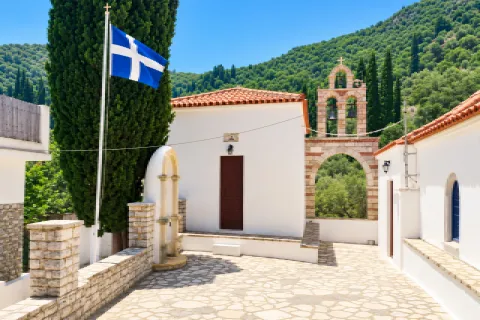
At the centre of the village stands the parish church of Agios Theodoros Tiron, from which the settlement received its present name.
The current church was rebuilt from its foundations in 1964 on the site of an older church dating back to 1807. It remains the main religious and social landmark of the village and is distinguished by its characteristic blue dome rising above the surrounding houses and vegetation.
Agios Theodoros Tiron is celebrated on 17 February, while the common feast of the Agioi Theodoroi is observed on the first Saturday of Great Lent. The date changes each year according to the Orthodox liturgical calendar.
🏡 Traditional Architecture and Neighbourhoods
The neighbourhoods of Agioi Theodoroi preserve several elements of traditional Samian architecture. Stone-built and plastered houses, tiled roofs, wooden windows, external staircases and narrow village lanes shape the character of the settlement.
Among the older residences are carefully restored houses as well as buildings that still bear the visible marks of time. Stone has always played an important role in the village’s architecture and economic history, as a small number of residents were also involved in stone processing.
🍇 Vineyards and Rural Life
The economy and daily life of the village have always been closely connected to the land. Viticulture was one of the most important occupations of the local population, alongside olive cultivation, vegetable growing and the care of fruit trees.
At the end of the 19th century, tobacco cultivation also held an important place in the local economy, although it gradually declined. Today, vineyards, olive groves and small family gardens remain an essential part of the surrounding landscape.
🚰 The Public Fountain and Old Washhouses
Near the village square and the church stands the historic public fountain, which was constructed on 27 July 1929 and restored during the early 1990s.
Its newer design includes a work by Giorgos Mavrikis, an artist originating from Agioi Theodoroi. Together with the old public washhouses, the fountain recalls an era when communal water sources were an essential part of everyday and social life in the village.
🌊 The Old Watermills
Two old watermills are recorded in the streams and valleys surrounding the village. They bear witness to the former use of running water for grinding grain and supporting the agricultural needs of the local community.
One of the watermills survives in comparatively better condition. Reaching them requires knowledge of the area and appropriate caution, as they are not organised or signposted visitor attractions.
🌿 What to See
During your visit to Agioi Theodoroi, take time to discover:
✅ The parish church and its characteristic blue dome
✅ The historic public fountain dating from 1929
✅ The old communal washhouses
✅ Traditional houses and narrow village lanes
✅ The surrounding vineyards, olive groves and small gardens
✅ The large plane tree near the church
✅ The forest routes towards Kontakeika and Platanos
✅ The streams and valleys where the old watermills are located
☕ A Stop in the Village Square
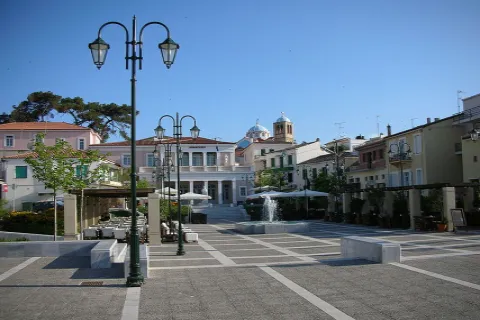
The square and the area around the church form the natural centre of the village. Beneath the shade of the large plane tree lies the traditional gathering place of the local residents.
Options for coffee or food are limited and may vary according to the season and opening days. Visitors planning a stop for refreshments or a meal should check availability before travelling.
🌿 The Visitor Experience
Agioi Theodoroi is not a village of intense tourism or extensive visitor infrastructure. Its appeal lies in its simplicity, peaceful atmosphere and the feeling of a small rural settlement that continues to follow its own quiet rhythm.
The village is particularly suitable for visitors interested in photography, traditional architecture, peaceful driving routes and authentic rural settlements. Its beauty can be found in the courtyards, the old stone walls, the shade of the plane tree and the vineyards surrounding the houses.
A relaxed walk around the central part of the village usually takes approximately 30 to 60 minutes.
📆 When to Visit
Spring: The ideal season to enjoy the lush green landscape, flowering gardens and vegetation surrounding the village streams.
Summer: Morning and late afternoon visits are recommended, when temperatures are milder and the shade of the trees makes exploring more comfortable.
Autumn: The grape harvest gives the rural landscape a distinctive atmosphere and highlights the long-standing winemaking tradition of the area.
Winter: The village remains peaceful and authentic, although extra care is advised on days of heavy rain, fog or poor weather.
🧭 How to Get There
From Karlovasi, follow the paved provincial road towards the interior of western Samos, in the direction of Pyrgos and Marathokampos. The village is approximately 7 to 7.5 kilometres away, along a pleasant uphill route with gentle bends.
Agioi Theodoroi can also be reached through Kontakeika or Platanos, following scenic routes through pine forests, vineyards and agricultural land. The road network is paved, although the streets within the village are narrow and require careful driving.
ℹ️ Useful Information
✅ Altitude: Approximately 300 metres
✅ Population in 2021: 93 residents
✅ Distance from Karlovasi: Approximately 7–7.5 kilometres
✅ Postal code: 83200
✅ GPS coordinates: 37.744940, 26.731920
✅ Road access: Paved road
✅ Suggested visiting time: Approximately 30–60 minutes
✅ Ideal for: Village walks, photography, traditional architecture and rural landscapes
✅ Visitor facilities: Limited – carrying drinking water is recommended



Add new comment