
Palaiochori of Marathokampos
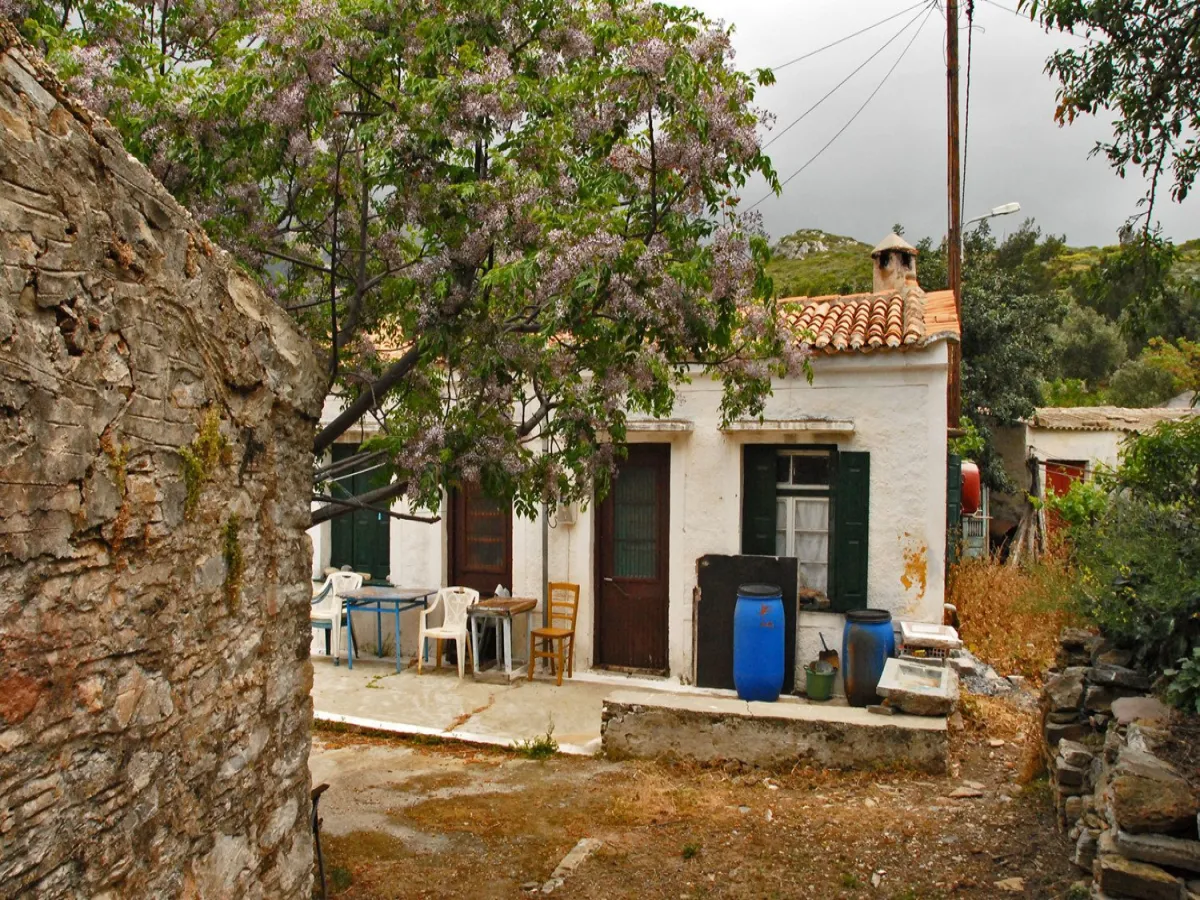
🏡 Palaiochori, Marathokampos, Samos – A Small Settlement among Olive Groves and the Sea
Palaiochori is a very small rural settlement in southwestern Samos, situated on the lower slopes of the wider Marathokampos area. It lies at an altitude of approximately 170 metres, among olive groves, Mediterranean scrub, stone terraces and small cultivated plots.
Its limited development, distance from busy coastal centres and direct connection with the natural landscape shape its peaceful character. It is not a compact village with a large square and densely built historic centre, but a scattered settlement consisting of only a few houses and agricultural buildings.
According to the 2021 census, Palaiochori has 10 permanent residents. It belongs to the Municipal Community of Marathokampos, the Municipal Unit of Marathokampos, the Municipality of Western Samos, the Regional Unit of Samos and the North Aegean Region.
📍 Location and Character
Palaiochori lies west of Marathokampos and close to the small coastal areas of Agia Kyriaki and Limnionas. Its straight-line distance from Marathokampos is approximately 10 kilometres, although the road journey is around 19 kilometres because of the terrain and the route followed by the local road network.
The settlement is built on a low hillside and has no dense urban development. The houses are located a short distance apart or among cultivated properties, giving the area the appearance of a rural neighbourhood rather than an organised village.
Agia Kyriaki lies approximately 2.5 kilometres to the east and Limnionas around 3.5 kilometres to the east in a straight line, while Kallithea is located farther north.
🏛️ Administrative Development
Palaiochori was officially recognised as a separate settlement on 17 March 1991 and was attached to the former Community of Marathokampos.
Following the administrative reform of 1997, it became part of the Municipality of Marathokampos. In 2010, it was incorporated into the unified Municipality of Samos and, since 2019, has belonged to the Municipality of Western Samos.
The official name used in the records of the Hellenic Statistical Authority is “Palaiochorion”, while “Palaiochori” is the name commonly used in everyday speech.
👥 Population Development
Palaiochori has always had a very small population. The 1991 census recorded 16 residents, followed by 12 in 2001 and 15 permanent residents in 2011.
In 2021, the population fell to 10 permanent residents. Its small population reflects the scattered rural character of the settlement and its dependence on Marathokampos and the larger centres of the area for everyday services.
🏘️ The Settlement Today
Modern Palaiochori consists of a few houses, small courtyards, storage buildings and agricultural structures situated among olive groves and natural vegetation.
It does not have an organised commercial centre, tourist businesses or the intense social activity found in larger villages. Daily life remains closely connected with Marathokampos, Kampos, Ormos and the other settlements of southwestern Samos.
Limited traffic and the absence of large-scale tourist development create a calm atmosphere suitable for visitors who wish to discover a less familiar side of the island.
🏡 Rural Architecture and the Human Landscape
The form of Palaiochori reflects the needs of a small agricultural community. Houses are accompanied by utility spaces, storage buildings, vegetable gardens and small cultivated properties.
Stone walls, dry-stone walls and terraces that retain the soil on the sloping terrain can be seen throughout the area. These structures are characteristic elements of the traditional agricultural organisation of Samos.
The settlement’s interest lies mainly in the overall rural landscape rather than in any single major architectural monument.
🫒 Olive Groves and Cultivated Land
Olive cultivation is the most important feature of the area’s agricultural character. Olive trees cover a significant part of the lower slopes, while small rural roads lead towards cultivated plots and scattered properties.
Family gardens, fruit trees and small-scale crops are also maintained, mainly to meet the needs of local households.
The olive harvest continues to give the area a seasonal rhythm, especially during the autumn and winter months.
🌿 The Natural Environment
The landscape surrounding Palaiochori includes olive groves, low Mediterranean vegetation, pine trees in certain areas, rocky slopes and small streams.
During spring, the countryside becomes greener and wildflowers appear among the cultivated plots and dry-stone walls. In summer, the landscape becomes drier and particular care is required because of the increased risk of wildfires.
From open points along the route, visitors can see the lower slopes of southwestern Samos and sections of the coastline towards Limnionas and Agia Kyriaki.
🔥 The Wildfire of 2022
On 13 July 2022, a major wildfire broke out in the wider Palaiochori area. Strong winds made firefighting operations difficult, while the fire front moved towards Limnionas, Makria Punta and the surrounding agricultural and forested land.
The fire affected a significant part of the natural and cultivated landscape of southwestern Samos and led to the precautionary evacuation of nearby areas. It remains one of the most important events in the recent history of Palaiochori and the wider Marathokampos region.
🥾 Hiking and Rural Routes
Palaiochori can serve as an intermediate point on hiking routes through southwestern Samos.
A circular route connecting Limnionas, Palaiochori and Agia Kyriaki has been recorded in the area. It passes through cultivated land, low hillsides and sections of the southwestern coastline.
The condition of trails and unpaved roads may change following rainfall, wildfires or agricultural work. Longer routes require sturdy footwear, sufficient water, sun protection and reliable orientation.
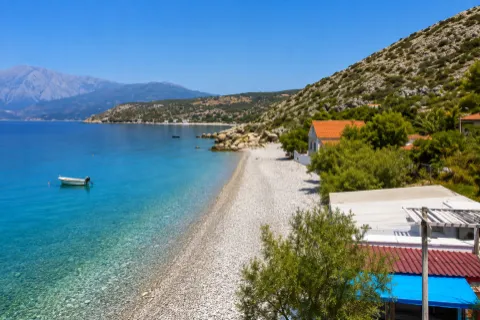
🏝️ The Nearby Coast
Palaiochori’s location makes it possible to combine a visit with the quiet coastal areas of Agia Kyriaki and Limnionas.
Farther east are Kampos Marathokampou and Votsalakia, while to the west the more isolated coastline continues towards Plaka and the areas below Kallithea.
The coastal roads have numerous bends and are narrow in certain sections, so careful driving is necessary.
🌿 What to See
During your visit to Palaiochori, take time to discover:
✅ The few houses of the small settlement
✅ The old agricultural buildings and storage structures
✅ The olive groves surrounding the houses
✅ The stone terraces and dry-stone walls
✅ The small rural roads
✅ The open viewpoints across southwestern Samos
✅ The route towards Agia Kyriaki
✅ The connection with Limnionas
✅ The natural landscape of the lower slopes
✅ The contrast between cultivated land and wild vegetation
🚶 The Visitor Experience
Palaiochori is not a destination with numerous organised attractions. The value of the visit lies in its peaceful atmosphere, rural scenery and the opportunity to explore a remote part of Samos.
A short stop is sufficient to walk around the settlement and observe the terraces, houses and surrounding landscape. The visit becomes more rewarding when combined with a route towards Limnionas, Agia Kyriaki or Marathokampos.
Approximately 30–45 minutes are sufficient for a simple exploration. Half a day or a full day is required for hiking or a combined excursion to the nearby coastal areas.
📆 When to Visit
Spring: The best period for walking, wildflowers and greener scenery.
Summer: Choose the morning or late afternoon and avoid any activity that could start a fire.
Autumn: Temperatures are milder and the period of agricultural work begins.
Winter: The area is particularly quiet, but care is required on small roads and unpaved sections following heavy rainfall.
🧭 How to Get There
Palaiochori is reached through the local road network of the Municipal Unit of Marathokampos. The most common approach begins in the Marathokampos area and continues towards the southwestern part of the island.
The road distance from Marathokampos is approximately 19 kilometres. The route includes bends, narrow sections and variations in road-surface quality, so low speeds and careful driving are necessary.
A four-wheel-drive vehicle is not required for the normal approach. A vehicle with greater ground clearance may be useful only on secondary agricultural roads or following severe weather conditions.
ℹ️ Useful Information
✅ Official name: Palaiochorion
✅ Administrative community: Municipal Community of Marathokampos
✅ Municipal unit: Marathokampos
✅ Municipality: Western Samos
✅ Population in 2021: 10 residents
✅ Population in 2011: 15 residents
✅ Official recognition: 17 March 1991
✅ Settlement type: Small rural settlement
✅ Altitude: Approximately 170 metres
✅ Straight-line distance from Marathokampos: Approximately 10 kilometres
✅ Road distance from Marathokampos: Approximately 19 kilometres
✅ Nearby areas: Agia Kyriaki, Limnionas and Kallithea
✅ GPS coordinates: 37.6947, 26.5890
✅ Postal area: 83102
✅ Main agricultural activity: Olive cultivation
✅ Available services: Very limited
✅ Road access: Local road with bends and narrow sections
✅ Suggested visiting time: Approximately 30–45 minutes
✅ Ideal for: Nature, rural landscapes, photography, peaceful exploration and hiking


Add new comment