
Old Karlovasi of Samos
🏘️ Old Karlovasi, Samos – The Historic Settlement on the Hills above the Port
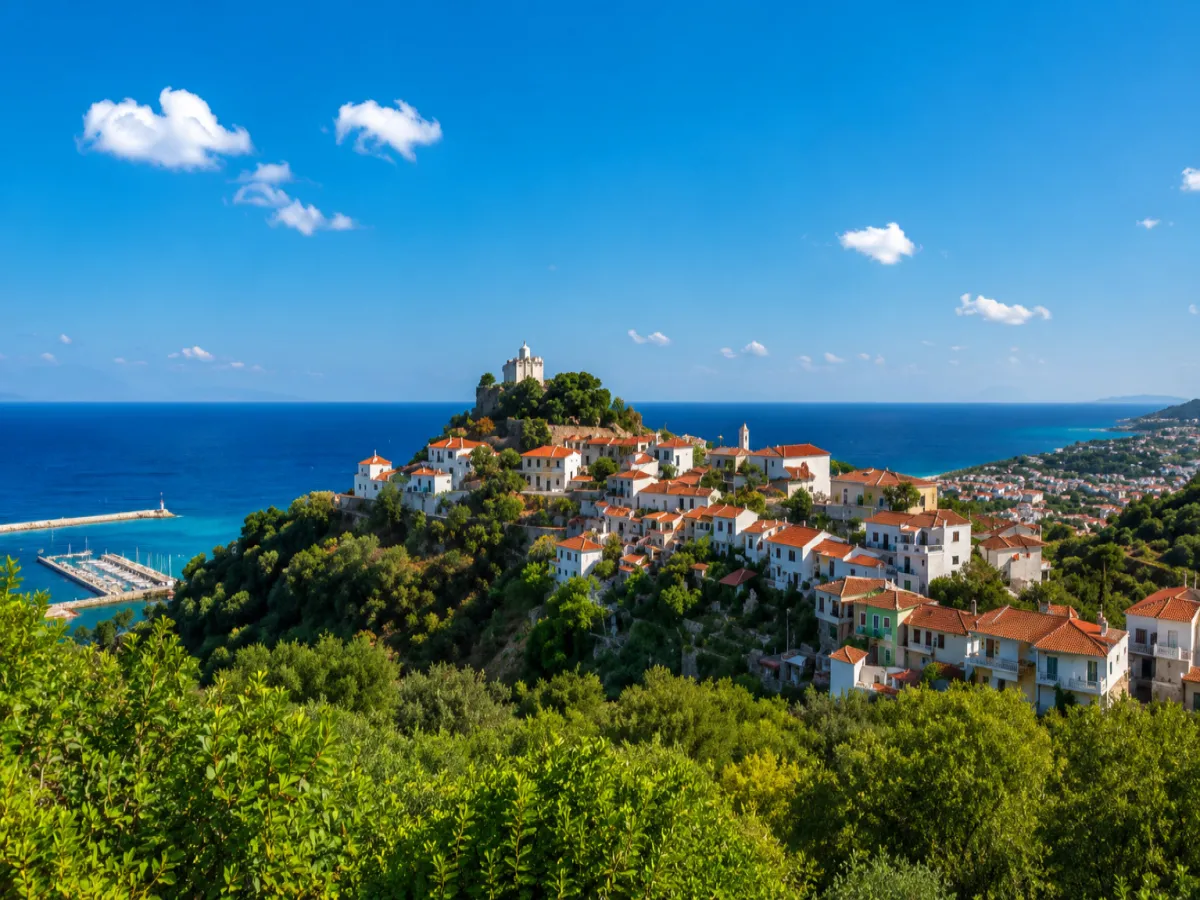
Old Karlovasi, formerly also known as Panochori, is the oldest of the historic settlements that contributed to the formation of present-day Karlovasi. It extends in a linear pattern across the hills south of the port, in a location close to the sea but protected from direct visibility from the open water.
The settlement preserves the character of an old Samian village, with uphill lanes, stone steps, traditional houses, small courtyards and historic churches. Its two main neighbourhoods are Akamatra to the east and Galatas to the west. They follow the sequence of the hills and form an extensive but clearly identifiable residential area.
Administratively, Old Karlovasi is no longer recorded as a separate census settlement. Since 1961, it has been incorporated into the settlement of New Karlovasi and today forms a historic part of the Municipal Community of Karlovasi, the Municipal Unit of Karlovasi and the Municipality of Western Samos.
📍 Location and Character
Old Karlovasi lies on the hills immediately south of Karlovasi Port. Its position allowed the first residents to remain close to the coast and cultivated land without the settlement being easily visible to pirate vessels sailing through the northern Aegean.
The settlement is not organised around a single flat centre. Its houses and churches stand at different elevations, connected by narrow passages, stairways and old stone-paved roads leading towards the port, Lekka and the Potami area.
From the higher points, there are open views over Karlovasi, the port, the northern coast of Samos and, in clear weather, the coast of Asia Minor.
📜 The Origins of the Settlement
Old Karlovasi was founded during the second half of the 16th century, in the early period following the repopulation of Samos. It is considered the oldest of the three original settlements of Karlovasi, preceding the development of New and Middle Karlovasi.
The first residents are associated with the Chiosamians, descendants of Samians who had taken refuge on Chios during the period when the island was largely deserted. During the 18th century, additional families arrived from the Peloponnese, particularly the Nafplio region, as well as smaller groups from Ikaria.
The presence of settlers from the Peloponnese is preserved in the religious tradition connected with Agios Nikolaos Anapliotis.
🏰 The Castle and Protection from Raids
Remains of older fortifications have been reported on the hill where the Church of Agia Triada stands today. The wider location was known as Kastro and appears to have served as a place of refuge and observation over maritime activity.
During the Greek War of Independence in 1821, the site was used as a watchpoint for monitoring the movement of enemy fleets. A similar strategic role was probably used during earlier periods of pirate raids, when early warning was essential for the safety of the residents.
🏛️ Administrative Development
In 1918, Old Karlovasi was designated as the administrative seat of the independent Community of Old Karlovasi. Karlovasi Port also belonged to the community, followed in 1920 by the Monastery of Agios Ioannis Theologos.
In 1952, the Community of Old Karlovasi was abolished and the settlement was incorporated into the Community of Karlovasi. On 19 March 1961, it ceased to exist as a separate administrative and census settlement and was incorporated into New Karlovasi.
This administrative integration did not erase its historical identity. The name Old Karlovasi continues to be used for the historic settlement, its neighbourhoods, churches and walking routes.
👥 Population in the Past and Today
In 1869, Old Karlovasi had 173 houses, three churches and one school, with a total population of 591 residents. A large proportion of the working population was connected with shipping, craftsmanship, small-scale industry and agriculture.
Today, no separate population figure is published for Old Karlovasi because it is not an independent census settlement. The 2021 census recorded a total of 7,363 residents in the Municipal Community of Karlovasi, which also includes the area of Old Karlovasi.
🏘️ The Residential Form
Old Karlovasi developed along the hills rather than around a single central point. The houses form smaller clusters, while the historic churches served as focal points around which the individual neighbourhoods were organised.
Single-storey and two-storey houses survive throughout the settlement, with stone foundations, plastered façades, tiled roofs, wooden frames and small courtyards. Old terraces, stone walls and narrow passages complete the appearance of a village adapted to steep terrain.
The importance of Old Karlovasi lies in the settlement as a whole rather than in neoclassical mansions or industrial facilities. The large tanneries and industrial buildings associated with Karlovasi’s period of economic prosperity are located mainly around the port and the Tampakika industrial zone.
🏡 Akamatra and Galatas
Akamatra occupies the eastern part of Old Karlovasi and is connected with the hill of Agia Triada. Some of the most characteristic panoramic viewpoints over the port and the town are found in this area.
Galatas lies farther west and maintains a stronger connection with the natural landscape and the routes towards Agios Antonios, Agia Paraskevi and the western edge of the settlement.
The two neighbourhoods are connected by uphill streets and passages, preserving the linear form that has characterised Old Karlovasi since the earliest stages of its development.
⛪ Agia Triada
Agia Triada stands at the top of the hill above the port and is one of the most recognisable landmarks of Karlovasi. The church has a cruciform design, while its surroundings provide panoramic views over the town, the port, the northern Aegean and the opposite coast.
The present church was constructed in 1904 according to plans by architect Panos Diakostamatis and was financed by the residents of the settlement.
Agia Triada celebrates on the feast of the Holy Spirit, with vespers and the Divine Liturgy. Access is on foot and includes an uphill section and steps. The church is therefore not accessible by car or wheelchair.
🕯️ The Church of the Dormition of the Virgin Mary
The Church of the Dormition of the Virgin Mary, formerly known as Panagia Kastrini because of its proximity to Kastro, was one of the three historic parishes of Old Karlovasi.
Its architectural and stylistic features date its initial construction to the late 16th or early 17th century. Its marble bell tower was built in 1862 and follows the form of the elaborate bell towers found on Aegean islands.
A carved wooden iconostasis and old icons survive inside, while the wall paintings were added during the restoration of 1995. The church celebrates on 15 August with a distinctive local ritual for the Dormition of the Virgin Mary and a procession of the Epitaphios.
⛪ Agios Nikolaos Anapliotis
Agios Nikolaos Anapliotis is one of the oldest churches in the Karlovasi area. An inscription at its entrance mentions the year 1500, although its most likely construction date is shortly after the repopulation of Samos, during the final quarter of the 16th century.
The title “Anapliotis” is associated with families from the Nafplio region who settled on Samos during the 18th century. The church is a domed basilica and served as a parish church until 1875.
The icons of the iconostasis date from the early 19th century and are attributed to the Samian icon painter Georgios tou Ioannou. The absence of extensive modern interventions has helped the church preserve much of its earlier form.
⛪ The Church of the Nativity of Christ
The Church of the Nativity of Christ is the parish church of Old Karlovasi. Its construction is dated to the late 16th or early 17th century, during the first period of the settlement’s development.
It is a three-aisled basilica. The central aisle is dedicated to the Nativity of Christ, the left aisle to Agia Aikaterini and the third to the Transfiguration of Christ.
An old carved wooden iconostasis and icons from the 18th and 19th centuries survive inside, reflecting the settlement’s long religious tradition.
🕳️ The Cave of Agios Antonios
On the western side of Old Karlovasi lies the chapel of Agios Antonios, built inside a low but deep cave where water is also present.
According to historian Epameinondas Stamatiadis, the cave was once used as a residence by ascetics. From the middle of the 19th century, the chapel was recorded as a dependency of the Monastery of Sinai. It celebrates on 17 January with an all-night vigil and Divine Liturgy.
Approximately 300 metres farther west lies the chapel of Agia Paraskevi beside a spring and a large plane tree. Access to the area is on foot and suitable footwear is necessary.
⛪ The Monastery of Agios Ioannis Theologos
Above Old Karlovasi stands the small women’s Monastery of Agios Ioannis Theologos, in a location with open views over Karlovasi and the northern Aegean.
The monastery was formerly a dependency of the Monastery of Profitis Ilias and, during a period of prosperity, accommodated approximately 16 nuns. A founding inscription states that Manolis Angelinas, a Karlovasi sea captain and fighter in the Greek War of Independence, financed the complete reconstruction of the church in 1823.
The monastery’s older icons are now preserved in the Ecclesiastical Museum of Samos.
🏫 The Old Primary School
The Primary School was an important public building of Old Karlovasi and was closely connected with the organised educational life of the settlement.
An architectural plan of the school dated 12 December 1887 is preserved in the General State Archives of Samos. The document confirms the importance that the community placed on education during the late 19th century.
🥾 The Old Stone Roads
Old Karlovasi was connected with nearby areas by stone-paved roads and paths that were used before the construction of the modern road network.
The historic routes include the stone road from the port to Old Karlovasi, the connection between Old Karlovasi and Lekka, and the route from the settlement towards Potami.
Some sections remain suitable for walking, although their condition may vary depending on vegetation, rainfall and maintenance work. Sturdy footwear, water and care on slippery or uneven sections are required.
🌿 The Natural Environment
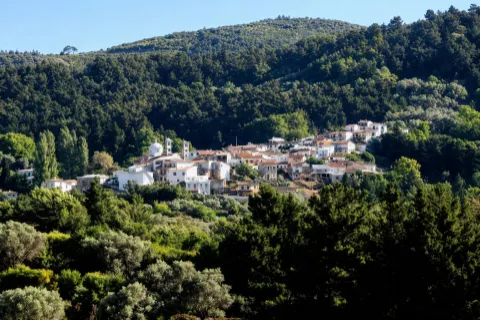
The hills around Old Karlovasi are covered with pine trees, olive trees, cypresses, shrubs and seasonal vegetation. Small springs and streams appear along the western routes, particularly towards Agios Antonios and Agia Paraskevi.
Spring is especially suitable for walking among wildflowers and green hillsides. During summer, care is required because of the heat and increased wildfire risk, particularly on paths with dense and dry vegetation.
🌿 What to See
During your visit to Old Karlovasi, take time to discover:
✅ The neighbourhoods of Akamatra and Galatas
✅ Agia Triada and the views towards the port
✅ The Church of the Dormition of the Virgin Mary
✅ The marble bell tower dating from 1862
✅ Agios Nikolaos Anapliotis
✅ The parish Church of the Nativity of Christ
✅ The old Primary School
✅ The cave and chapel of Agios Antonios
✅ The spring and chapel of Agia Paraskevi
✅ The Monastery of Agios Ioannis Theologos
✅ The stone steps and old lanes
✅ The historic roads towards the port, Lekka and Potami
✅ The panoramic viewpoints over Karlovasi and the Aegean
🚶 The Visitor Experience
A visit can begin in the lower residential part of the settlement and continue towards the historic churches, the neighbourhoods and the hill of Agia Triada.
The uphill sections and numerous steps require comfortable and sturdy footwear. Vehicle traffic is limited in the narrowest areas, although some roads continue to serve local houses and care is necessary.
Approximately 90 minutes to two hours are required for a basic exploration of the settlement and the climb to Agia Triada. More time is needed when the route includes Agios Antonios, Agia Paraskevi, the Monastery of Agios Ioannis or one of the old paths.
📆 When to Visit
Spring: The best season for walking, flowering vegetation and clear views.
Summer: Visit early in the morning or late in the afternoon, as the uphill sections and steps are tiring in high temperatures.
Feast of the Holy Spirit: Religious celebrations take place at Agia Triada.
15 August: The Church of the Dormition of the Virgin Mary celebrates with a distinctive local ritual.
Autumn: Suitable for photography, quiet routes and lower temperatures.
Winter: After rainfall, care is required on the stone steps and old paths.
🧭 How to Get There
Old Karlovasi is reached from central Karlovasi and the port area by paved local roads.
Several parts of the settlement can be approached by car, although the inner roads are narrow and parking is limited. It is preferable to leave your vehicle in a safe and suitable location and continue on foot.
Agia Triada, the cave of Agios Antonios and certain sections of the historic routes cannot be reached by vehicle. Exploring the area involves uphill walking, steps and uneven sections.
ℹ️ Useful Information
✅ Name: Old Karlovasi
✅ Former name: Panochori
✅ Character: Historic settlement of Karlovasi
✅ Period of foundation: Second half of the 16th century
✅ Main neighbourhoods: Akamatra and Galatas
✅ Former administrative status: Seat of the Community of Old Karlovasi
✅ Establishment of the former community: 21 September 1918
✅ Abolition of the former community: 16 January 1952
✅ Administrative incorporation into New Karlovasi: 19 March 1961
✅ Current administrative community: Municipal Community of Karlovasi
✅ Municipal unit: Karlovasi
✅ Municipality: Western Samos
✅ Separate current population: Not recorded
✅ Population in 1869: 591 residents
✅ Main parish church: Nativity of Christ
✅ Principal landmark: Agia Triada
✅ Construction date of the present Agia Triada church: 1904
✅ Historic churches: Dormition of the Virgin Mary and Agios Nikolaos Anapliotis
✅ Religious site inside a cave: Agios Antonios
✅ Nearby monastery: Monastery of Agios Ioannis Theologos
✅ Postal code: 83200
✅ Road access: Paved local roads
✅ Exploration: Mainly on foot
✅ Suggested visiting time: Approximately 90 minutes–3 hours
✅ Ideal for: History, traditional architecture, religious monuments, photography and hiking



Add new comment