
Chora of Samos
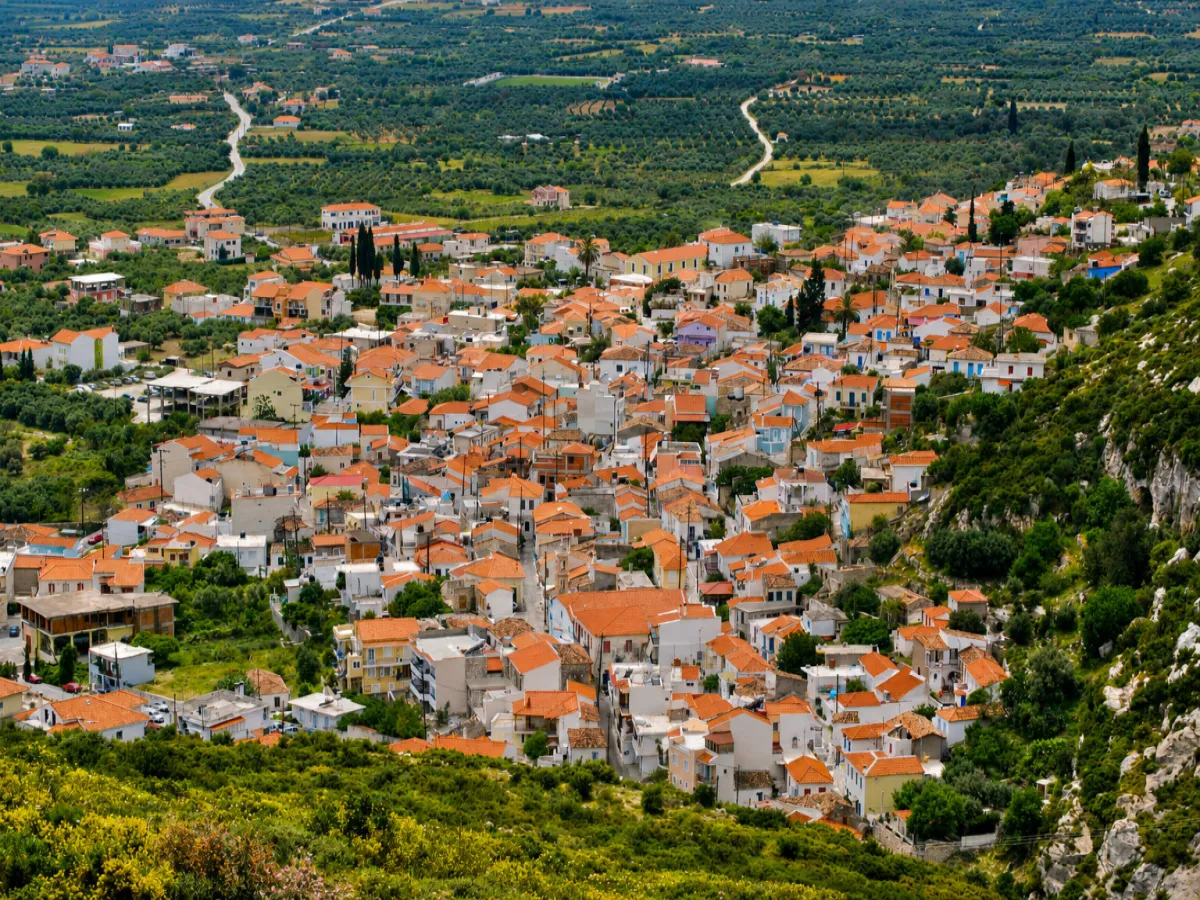
🏘️ Chora, Samos – The Historic Capital Beside the Fertile Plain
Chora is one of the largest and most historic villages in eastern Samos. It lies on the northeastern edge of the plain that bears its name, approximately 3.5 kilometres northwest of Pythagoreio and 17 kilometres from the town of Samos.
Built at an altitude of around 40 metres, Chora combines the character of a lively village with the strong historical legacy of the island’s former capital. According to the 2021 census, the settlement had 1,408 permanent residents.
Administratively, it forms the Municipal Community of Chora, which belongs to the Municipal Unit of Pythagoreio, the Municipality of Eastern Samos, the Regional Unit of Samos and the North Aegean Region.
📍 Location and Character
Chora extends between the low surrounding slopes and the fertile plain that stretches towards Pythagoreio and the southern coast. Its location provides easy access to the airport, Pythagoreio, Potokaki, Mytilinioi and the main road network of eastern Samos.
The older residential centre preserves narrow streets, tiled-roof houses, courtyards and neighbourhoods that developed around churches, fountains and communal spaces. Newer homes have gradually expanded the village towards the plain, without diminishing its character as a permanently inhabited agricultural and administrative centre.
📜 The Foundation and Name of Chora
Chora was among the first settlements established after the repopulation of Samos, which began around the middle of the 16th century. Its first inhabitants arrived from Asia Minor and various regions of the Greek world.
The name “Chora” is connected to the village’s administrative role. As on many Aegean islands, the principal town and capital of the island was commonly referred to simply as “Chora”.
🏛️ The Former Capital of Samos
From around 1600, Chora served as the capital and principal administrative centre of Samos. Local authorities, public buildings and the residences of officials were located here, while the district of Mesaki became particularly associated with the village’s administrative life.
Chora retained this role during the early years of the Principality of Samos. Its position close to the ancient city and the fertile plain was important, although the absence of an organised port limited its opportunities for commercial and administrative development.
⚓ The Transfer of the Capital
During the early years of the Principality, several possible locations were considered for the island’s administrative seat. The Port of Vathy was developing as a commercial and maritime centre, while Tigani, present-day Pythagoreio, was also proposed because of its historical and geographical importance.
In 1851, during the rule of Georgios Konemenos, a decision was made to construct the necessary administrative buildings in Tigani. Until their completion, Chora officially remained the capital.
In 1854, during the rule of Ion Ghica, the capital was ultimately transferred to the Port of Vathy. Its natural harbour, commercial potential and direct access to the sea gave Vathy a decisive advantage. Later proposals to move the administrative seat to Tigani were unsuccessful, and the Port of Vathy became firmly established as the island’s administrative centre.
🏛️ Traces of the Principality Period
During the period when Chora served as the capital, it contained administrative buildings and residences belonging to officials. The princely residence stood near Mesaki Square, while the tower of Agha Christodoulos Papachatzis was used at different times as a town hall and an archaeological museum.
Many of these buildings were lost or considerably altered over time. The old neighbourhoods and their historic locations still recall the centuries during which Chora formed the political heart of Samos.
⛪ Agia Paraskevi – The Former Metropolitan Church
Agia Paraskevi is the former metropolitan church of Chora and one of the village’s most important ecclesiastical monuments. It is a three-aisled church dating from the 18th century and is closely associated with the period when Chora was the capital of Samos.
The church stands within the old residential centre and remains a major landmark of the village’s religious and historical identity.
🕊️ The Church of the Dormition of the Virgin Mary
The second principal parish church of Chora is dedicated to the Dormition of the Virgin Mary. Its original construction dates to around 1750, while in 1818 it was rebuilt from its foundations through contributions from the residents of the parish.
Together with Agia Paraskevi, the church reflects Chora’s long religious tradition and the social organisation of its historic neighbourhoods.
⛪ The Historic Church of Agios Dimitrios
The old church of Agios Dimitrios also holds particular historical importance. Dating from 1608, it is described as one of the first churches built on Samos following the repopulation of the island.
The church is connected to the earliest years of organised life in Chora and represents an important surviving record of the settlement’s historical continuity.
🚰 The Fountains, Washhouses and Cistern
Traditional fountains and public washhouses survive in the districts of Platanos and Mesaki. Before the development of an organised water supply network, these facilities were essential parts of daily village life.
Each neighbourhood had its own water infrastructure, where residents collected water, washed clothes and met one another. Mesaki also contains the historic cistern dating from 1870, a notable engineering work that served the water needs of the surrounding district.
🏡 Neighbourhoods and Traditional Architecture
A walk through Chora reveals a settlement of older and newer houses, tiled roofs, small courtyards, stone details and narrow streets. The village does not have a completely uniform appearance, as residential development gradually expanded towards the plain and the main roads.
The older urban organisation is most clearly visible in the historic centre, where each neighbourhood was closely connected to its church, fountain and communal washhouses.
🌿 The Plain of Chora
The plain of Chora is one of the most important agricultural areas of Samos. Its fertile soil and abundant water supported the cultivation of olive trees, vineyards, fruit trees, vegetables and seasonal produce.
Olive cultivation continues to play an important role in the local economy. In earlier periods, the area was also known for the production of raisins, silk and watermelons.
🍽️ Everyday Life and Local Amenities
Chora is a lively, permanently inhabited village with essential services. Shops, traditional bakeries, cafés and places to eat operate along the main road and within its neighbourhoods.
Its proximity to Pythagoreio and the airport has strengthened the residential and commercial character of the area, without turning Chora into a purely tourist destination.
🌿 What to See
During your visit to Chora, look out for:
✅ The former metropolitan church of Agia Paraskevi
✅ The Church of the Dormition of the Virgin Mary
✅ The historic church of Agios Dimitrios
✅ The old neighbourhoods and narrow village streets
✅ The fountains and washhouses in Platanos
✅ The fountains, washhouses and historic cistern of Mesaki
✅ The locations associated with the former administration of the Principality
✅ The fertile plain and cultivated land surrounding the village
🚶 The Visitor Experience
Chora is not a village centred around a single major attraction. The experience lies in exploring its neighbourhoods, discovering the old fountains and washhouses and understanding the important role the settlement played in the history of Samos.
A visit is particularly suitable for those interested in local history, religious architecture, rural life and villages that remain active beyond the tourist season.
Approximately 60 to 90 minutes are recommended for exploring the principal points of interest.
📆 When to Visit
Spring: The plain and village courtyards are lush and green, while temperatures are ideal for walking.
Summer: Morning or late afternoon visits are preferable, as temperatures across the plain can become high.
Autumn: The harvest season highlights the agricultural character of the surrounding area.
Winter: The village retains its everyday rhythm and offers a peaceful setting for exploring its historic neighbourhoods.
🧭 How to Get There
From Pythagoreio, follow the main road towards Chora and Mytilinioi. The distance is approximately 3.5 kilometres, and the entire route is paved.
From the town of Samos, follow the road towards Mytilinioi, Chora and Pythagoreio. The distance is approximately 17 kilometres.
Chora is also easily connected with the airport, Potokaki and the southern beaches. Roads become narrower within the old village centre and require careful driving.
ℹ️ Useful Information
✅ Administrative community: Municipal Community of Chora
✅ Municipal unit: Pythagoreio
✅ Municipality: Eastern Samos
✅ Population in 2021: 1,408 residents
✅ Altitude: Approximately 40 metres
✅ Distance from Pythagoreio: Approximately 3.5 kilometres
✅ Distance from the town of Samos: Approximately 17 kilometres
✅ Postal code: 83103
✅ GPS coordinates: 37.704158, 26.907136
✅ Road access: Fully paved
✅ Suggested visiting time: Approximately 60–90 minutes
✅ Ideal for: History, churches, traditional neighbourhoods and rural landscapes



Add new comment