
Manolates Village
🏞️ Manolates, Samos
A lush green village of winegrowers and artists, with colourful houses and views across the Aegean
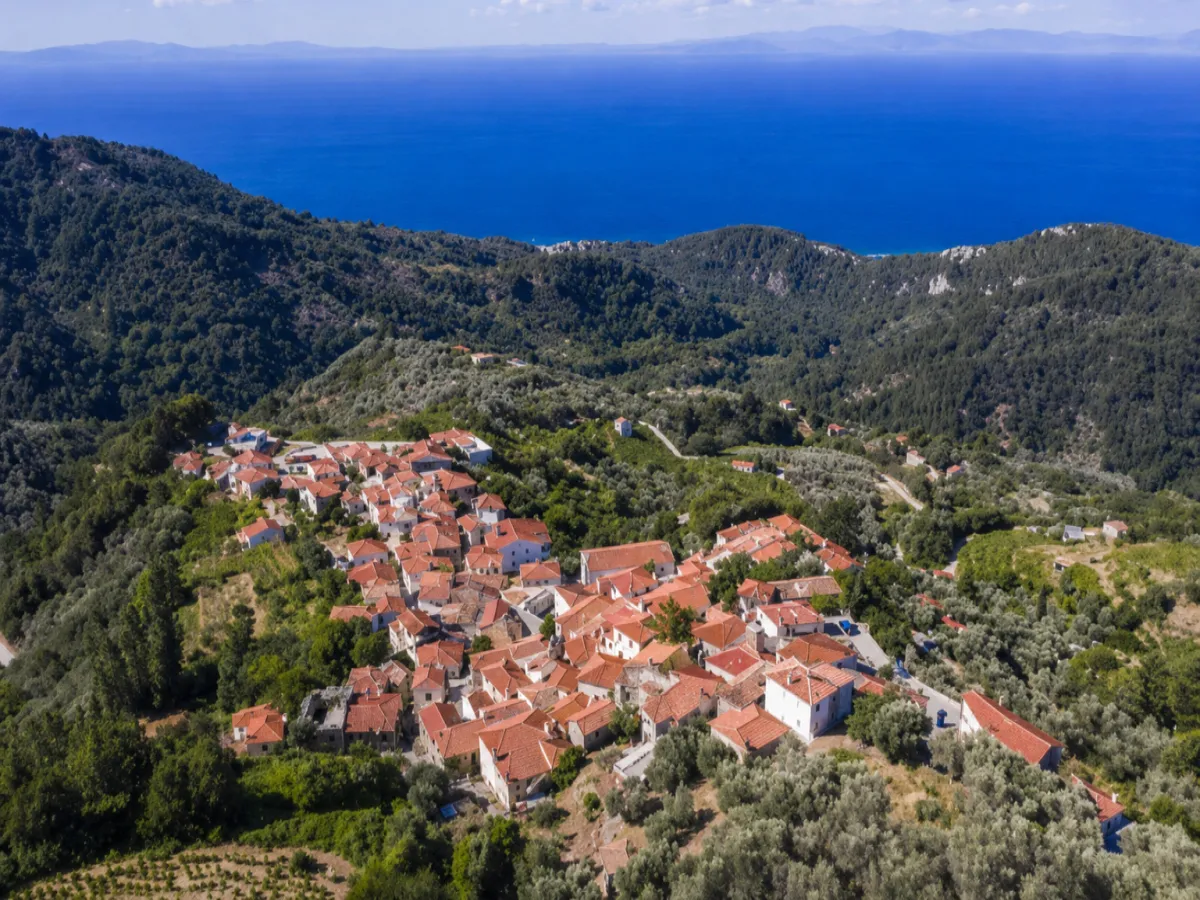
Manolates is one of the most picturesque and recognisable mountain villages of northern Samos. It is built on the green slopes of Mount Ampelos, also known as Karvounis, at an altitude of approximately 350–370 metres.
The village is surrounded by dense vegetation, mountain vineyards, olive groves, forests and small cultivated areas. From its higher points, the view opens towards the northern Aegean and the coast of Asia Minor, while its location combines the cool mountain climate with a relatively short distance from the northern coast of Samos.
📍 Location and natural environment
Manolates is located approximately four kilometres by road from the seaside village of Agios Konstantinos. The final section of the route is uphill, narrow and full of bends, passing through one of the greenest areas of the island.
The road follows the Kakorema ravine and passes through the Aidonia area, where plane trees, pine trees, cypress trees, running water and dense riverside vegetation dominate the landscape. The area takes its name from the nightingales that can be heard particularly during spring and early summer.
This natural route is an essential part of the experience of visiting Manolates. The road requires careful driving, but the forest, old farmhouses, vineyards and shaded ravines reward visitors before they even reach the village.
🏛️ Administrative status and population
Manolates belongs administratively to the Municipality of Eastern Samos and the Municipal Unit of Vathy. It is the seat of the local community of the same name.
According to the 2021 Census, the village has 78 permanent residents, compared with 131 residents recorded in 2011. The population increases during the summer months, when people with family roots in the village return and tourism activity becomes more intense.
Despite its population decline, Manolates remains a lively destination, with cafés, tavernas, craft workshops, small shops and cultural initiatives.
🕰️ History and origin of the village’s name
Unlike several older villages of Samos, Manolates appears to have developed as an organised settlement towards the end of the 18th century.
According to local tradition, the village took its name from the Manola or Manolas family, believed to have been among the first families to settle in the area. The same naming practice can also be found in other small settlements of Samos, which were named after the families of their earliest residents.
The first inhabitants selected the area because of its water resources, dense vegetation, the natural protection offered by the mountainous terrain and the suitable land for vine cultivation and olive growing.
🏘️ The historic “Six Neighbourhoods”
During the period of the Principality of Samos, and particularly in the middle of the 19th century, Manolates formed part of the administrative community known as the “Six Neighbourhoods”.
The six settlements were:
🏘️ Manolates
🏘️ Agios Konstantinos
🏘️ Ampelos
🏘️ Stavrinides
🏘️ Valeontades
🏘️ Margarites
After the union of Samos with Greece in 1912, Manolates became an independent community. Valeontades and Margarites gradually lost a large part of their population, while the settlement of Margarites was later officially abolished.
🍇 Viticulture and Samian wine
The history of Manolates is inseparably linked with viticulture. The terraces on the slopes of Karvounis have been cultivated for generations with the white Muscat grape of Samos, from which the island’s renowned sweet and naturally sweet wines are produced.
In the past, a large part of the population worked in the vineyards, wine production, olive cultivation and other agricultural activities. The two-storey houses were adapted to this way of life: the upper floor was used as the main living area, while the ground floor served as a storeroom, workshop, stable or space for keeping agricultural produce.
Viticulture continues to form an important part of the local identity, even though tourism, food service and handicrafts now have greater economic importance.
🏡 Traditional architecture and colourful neighbourhoods
Manolates has preserved a significant part of the traditional architecture of the Samian interior. The single-storey and two-storey houses have tiled roofs, wooden frames, small balconies, courtyards and stone details.
Unlike the uniform white appearance of other island settlements, several houses in Manolates are painted in bright or pastel colours. Flowerpots, climbing plants, basil, geraniums and jasmine fill the narrow streets, creating a village that resembles a living painting rather than a standardised tourist setting.
Vehicle traffic inside the village is limited. Visitors usually leave their cars in the parking area at the entrance and continue on foot through the paved and uphill streets.
🌳 The square of Manolates
At the heart of the village lies the small central square, surrounded by traditional houses, cafés, tavernas and flower-filled courtyards.
An important feature of the square is the old covered marble fountain, which recalls the time when public fountains were essential points for water supply and daily social interaction.
The square is the social centre of the village. During summer, it fills with visitors stopping for coffee, dessert, wine or food, without entirely losing the atmosphere of an old Samian neighbourhood.
⛪ The Church of Zoodochos Pigi
The main parish church of Manolates is dedicated to Zoodochos Pigi, the Life-Giving Spring, and not to Agios Ioannis, as stated in the previous text.
The church is one of the main religious and architectural landmarks of the village. It is built in the basilica style, without a dome, and has two aisles.
The feast of Zoodochos Pigi is celebrated on Bright Friday, the first Friday after Easter. The celebration is traditionally accompanied by religious events and a village festival in the surrounding streets and the central square.
🏛️ Manolates Folklore Collection – The Velonis House
One of the newer but most important cultural attractions of the village is the Manolates Folklore Collection – The Velonis House.
The collection is housed in a restored late-19th-century residence and presents the everyday life of an agricultural family of Samos. Its rooms display furniture, woven fabrics, household utensils, clothing, photographs, books and family archives, some of which date from the 18th and 19th centuries.
The building consists of two old houses that were joined together. It retains elements of both neoclassical and Asia Minor or Ottoman architecture, including the characteristic projecting upper-floor structure known as a sahnisi.
The collection does not merely display old objects. It highlights the way of life of the village’s winegrowers, craftsmen and families before the major social and economic changes of the 20th century.
🎨 Pottery, art and handmade creations
Over the years, Manolates has developed into a small centre of artistic creation. Greek and foreign artists, potters and craftspeople settled in the village and established workshops and small shops.
Visitors may find:
🏺 Handmade pottery and clay objects
🖼️ Paintings and visual artworks
💍 Handmade jewellery
🧵 Woven and decorative items
🧼 Soaps and herbal products
🎁 Small creations inspired by Samos
Handicrafts now form an essential part of the village’s contemporary identity, while remaining closely connected to its agricultural and folklore traditions.
🥾 Hiking and the Valley of the Nightingales
Manolates is an important point on the hiking network of northern and central Samos. The paths pass through vineyards, forests, old farmhouses, ravines and abandoned cultivated areas.
One of the officially recorded circular routes is Valeontades – Manolates – Valeontades, with a total length of approximately 8.2 kilometres. The route takes around four hours and passes through the Kakorema ravine, forests, mountain vineyards and orchards.
There are also longer hiking routes connecting Manolates with Vourliotes, Stavrinides, Ampelos and the wider area of the Monastery of Vronta. However, the Monastery of Vronta should not simply be presented as being “2.5 km from the village”, because the actual distance depends on the path, the starting point and the route followed.
Longer hikes require suitable footwear, water, a map or GPX file and a careful assessment of the weather conditions.
🍽️ Cafés, tavernas and local flavours
Despite its small size, the village has cafés and traditional tavernas, particularly around the square and along the central streets.
Visitors can taste Samian wine, home-style cooked meals, meat dishes, pies, local cheeses, salads and desserts. The experience is based more on simplicity, local hospitality and the view than on standardised tourist dining.
Opening hours vary depending on the season. During winter, several businesses operate on a limited schedule, while in summer the square and streets become considerably busier.
🚗 Access and parking
The main road access is from the northern coastal road and Agios Konstantinos. From the junction, the final uphill section extends for approximately four kilometres.
The road is paved, but narrow and includes several continuous bends. Careful driving is required, particularly when two larger vehicles or buses meet.
There is an organised parking area at the entrance to the village. From there, exploration continues mainly on foot, as the inner streets are narrow, uphill and in several places unsuitable for visitors’ vehicles.
📍 Approximate road distances
🚗 Approximately 4 km from Agios Konstantinos and the northern coast
🚗 Approximately 13 km from Karlovasi
🚗 Approximately 22–23 km from Samos Town
🚗 Approximately 32 km from Pythagoreio
🛫 Approximately 33–36 km from Samos International Airport, depending on the route
Distances may vary slightly depending on the exact starting point and the navigation application used.
🚶 What to see and do
📸 Walk through the paved streets and photograph the colourful houses and flower-filled courtyards.
🌳 Sit in the square and observe the marble fountain and everyday village life.
⛪ Visit the Church of Zoodochos Pigi.
🏛️ Discover the life of the old winegrowers at the Folklore Collection – The Velonis House.
🏺 Visit the pottery workshops and shops selling handmade creations.
🍷 Taste Samian wine and local dishes at a café or taverna.
🥾 Follow one of the hiking routes towards Valeontades, Aidonia, Stavrinides or Vourliotes.
🌅 Climb to the higher streets for views of the Aegean and the coast of Asia Minor.
💡 Useful information for visitors
🚗 Leave your car in the parking area at the entrance and continue on foot.
👟 Wear comfortable shoes, as the streets are steep and can be slippery in certain places.
☀️ During summer, prefer the morning or afternoon hours, when the temperature is milder.
🌧️ After rainfall, extra care is needed both on the uphill road and along the forest paths.
📞 Outside the main tourist season, check in advance whether the museum, workshops and food businesses are open.
🌿 Respect private courtyards, vineyards and the homes of permanent residents. Manolates is a tourist destination, but it remains first and foremost an inhabited village.
🏷️ Characteristics of the settlement
🏔️ Traditional mountain village at an altitude of approximately 350–370 metres
👥 78 permanent residents according to the 2021 Census
🍇 Strong historical connection with viticulture and Samian wine
🏡 Colourful tiled-roof houses and traditional architecture
🎨 Pottery, art and handmade craft workshops
🏛️ Visitor-accessible folklore collection housed in a restored residence
⛪ Historic parish church of Zoodochos Pigi
🌳 Access through the lush green Valley of the Nightingales
🥾 Connection with organised and natural hiking routes
🌊 Views towards the northern Aegean and the coast of Asia Minor
🍽️ Traditional cafés and tavernas
🧘 Ideal destination for nature-based, cultural and slow tourism


Add new comment