
Pyrgos of Samos
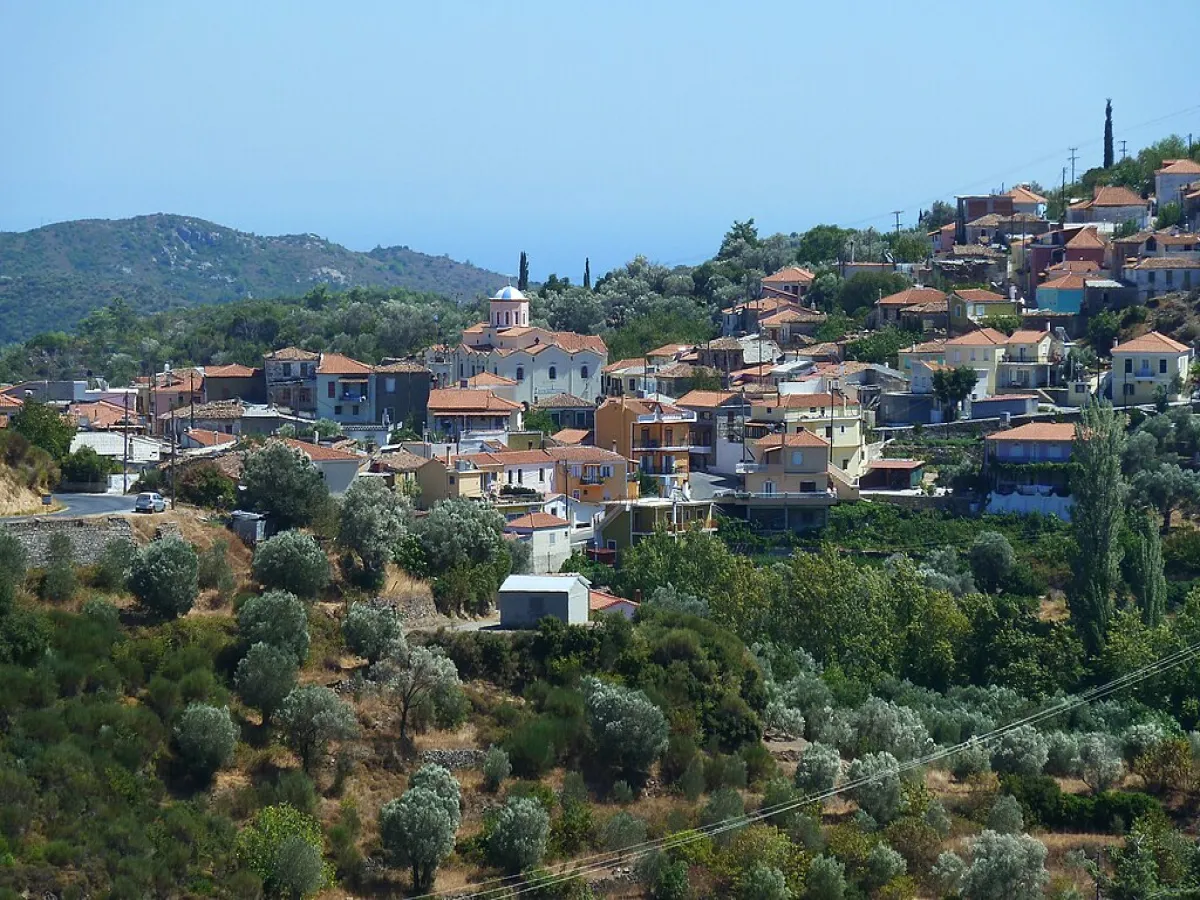
🏞️ Pyrgos, Samos – The Mountain Village of Honey and Flowing Waters
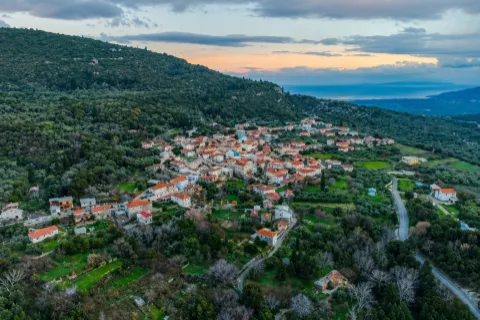
Pyrgos is one of the largest mountain villages in central and southern Samos. It is built on the southwestern foothills of the Ampelos mountain massif, also known as Karvounis, at an altitude of approximately 400 metres and close to the course of the Amphilyssos River.
Its green surroundings, abundant water, olive groves, vineyards and old stone houses shape the character of a traditional mountain village that served for decades as an important agricultural and commercial centre for the interior of Samos.
Administratively, Pyrgos is the seat of the Municipal Community of Pyrgos. It belongs to the Municipal Unit of Pythagoreio, the Municipality of Eastern Samos, the Regional Unit of Samos and the North Aegean Region. According to the 2021 census, the village has 340 permanent residents.
📍 Location and Character
Pyrgos lies near the centre of southern Samos, at an important point in the road network connecting Pythagoreio and the villages of the eastern side with Karlovasi, Marathokampos and the settlements of the southwestern interior.
It is approximately 16 kilometres from Pythagoreio, 20 kilometres from Karlovasi, 17 kilometres from Marathokampos and 30 kilometres from Samos Town. The routes leading to the village pass through olive groves, cultivated slopes, ravines and areas of dense vegetation.
Its location at the foothills of Mount Karvounis provides cooler conditions than the coastal areas, particularly during summer afternoons and evenings.
📜 History and the Origin of the Village Name
The foundation of the present settlement dates to around 1715, during the period when new villages developed following the repopulation of Samos.
According to Epameinondas Kritikidis in his work Topography of Samos, the first settlers came from the Peloponnese. The most widely accepted traditions connect their origins either with Pyrgos in Ilia or with Pyrgos Dirou in the Mani region of Laconia. The new village is believed to have taken its name from the settlers’ place of origin.
The first residents settled in a fertile area with water, forests and cultivable land. These conditions supported the development of agriculture, livestock farming, beekeeping and viticulture, while Pyrgos gradually became an important service and commercial centre for the surrounding villages.
🏛️ Administrative Development
The Community of Pyrgos was officially established in 1918, with the village as its administrative seat.
In 1997, under the Kapodistrias administrative reform, the community was abolished and Pyrgos became part of the Municipality of Pythagoreio. In 2010, it was incorporated into the unified Municipality of Samos and, following the division of the island into two municipalities in 2019, it became part of the Municipality of Eastern Samos.
👥 Population Development
Pyrgos had a significantly larger population in the past and was one of the most populated major villages of Samos.
In 1940, the village had 1,750 residents. The population fell to 1,253 in 1961 and 724 in 1981. It later recorded 653 residents in 1991, 562 in 2001 and 424 in 2011. According to the 2021 census, the permanent population was 340.
Despite the population decline, Pyrgos remains a lively, permanently inhabited village with ongoing agricultural activity and strong connections with former residents who return mainly during the summer months.
⛪ The Church of the Dormition of the Virgin Mary
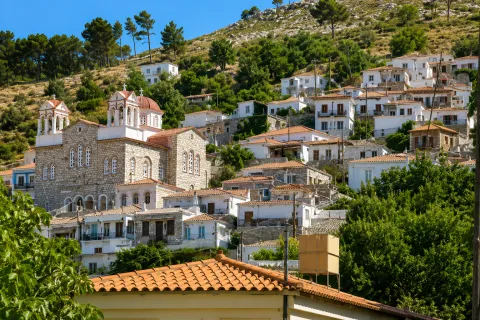
The parish church of Pyrgos is dedicated to the Dormition of the Virgin Mary. It is a three-aisled basilica with a dome, founded in 1877 and completed in August 1888.
The church is the village’s most important active religious landmark and stands out because of its size, architecture and position within the traditional settlement.
The Dormition of the Virgin Mary is celebrated with particular devotion on 14 and 15 August. Religious services, the procession of the icon and local events attract residents, former villagers and visitors from different parts of Samos.
🪨 The Unfinished Church of Agios Georgios
The imposing stone structure of the old Church of Agios Georgios dominates the square bearing the saint’s name. Its construction dates to the early 20th century.
The large stone shell remained unfinished and was later affected by fire. In 1971, a smaller church was created inside the structure, preserving the religious use and sacred character of the site.
A war memorial also stands in the same area, while an underground shelter was used there to protect residents during the Second World War.
🚰 The Amphilyssos River and Flowing Water
Water is a defining feature of Pyrgos. The village lies close to the Amphilyssos River and is surrounded by springs, ravines and places with flowing water that supported agriculture and the irrigation of cultivated land.
The abundance of water once enabled several watermills to operate in the area. An old watermill survives within the village, preserving the memory of a period when water power was used to grind grain and serve local households.
The historic water-management system also included irrigation channels, fountains and small technical structures that carried water towards gardens and cultivated fields.
🏡 Traditional Architecture and Neighbourhoods
Pyrgos preserves notable examples of traditional Samian architecture. The historic centre includes stone-built and plastered two-storey houses, tiled roofs, wooden window frames, external staircases and small courtyards filled with flowers and grapevines.
A characteristic feature of several older homes is the “sachnisi”, an enclosed wooden bay window projecting from the upper floor. Narrow stone-paved streets follow the natural contours of the terrain and connect the village’s different neighbourhoods.
Since 2002, Pyrgos has been officially recognised as a settlement of exceptional natural beauty, a designation connected with its traditional form, architecture and surrounding landscape.
🏫 The Old School and Community Buildings
The former primary school is one of the village’s characteristic public buildings and recalls a period when Pyrgos had a large number of children and greater educational needs.
Together with the churches, watermill, stone houses and old agricultural buildings, the school forms part of the historic appearance of the settlement.
🍯 The Village of Honey
Beekeeping is one of the activities most closely associated with Pyrgos. The area’s thyme honey is known for its intense aroma and flavour, while the diversity of local vegetation provides bees with thyme, heather, pine and many wild aromatic plants.
Pollen, royal jelly and other bee products are also produced in Pyrgos, while the collection and sale of aromatic herbs form part of the village’s productive identity.
🫒 Agricultural Production and Local Products
The economic development of Pyrgos was traditionally based on agriculture. Olive cultivation, viticulture and beekeeping were its principal productive activities, while fruit trees, vegetables and cereals were also grown.
Olive oil and wine covered household needs and were sold throughout the wider market of Samos. The timber of black pine trees from the forests of Karvounis was also exploited in the past.
Agricultural work continues to follow the cycle of the seasons, with the grape harvest at the end of summer and the olive harvest during the autumn and winter months.
🌲 The Natural Environment
The countryside around Pyrgos combines olive groves, vineyards, ravines, plane trees, pine-covered areas and low Mediterranean vegetation.
The major wildfire of 2000 affected a significant part of the forests surrounding the village. The presence of water and the natural conditions of Mount Karvounis gradually supported the regeneration of vegetation in several areas.
Provincial and agricultural roads around the settlement offer routes through cultivated land, small forests and places with flowing water.
🥾 Routes towards Mount Karvounis
Pyrgos is a suitable starting point for exploring the mountainous interior of Samos. Roads from the area lead towards Mesogeio, Pandrosos and the higher parts of Mount Karvounis, as well as towards Spatharaioi and Pagondas.
The routes pass through forests, olive groves, vineyards and ravines. Some rural roads require a suitable vehicle and careful driving, particularly after heavy rainfall.
🍲 The Festival of the Virgin Mary and Traditional Keskeki
The village’s most important religious and social celebration takes place on 15 August in honour of the Dormition of the Virgin Mary.
On the eve of the feast, residents prepare traditional keskeki with wheat, meat, onions and olive oil. The dish is cooked for many hours in large cauldrons and is offered to residents and visitors after the Divine Liturgy.
The custom expresses collective work, hospitality and community unity, bringing residents and former villagers together each year.
🌿 What to See
During your visit to Pyrgos, take time to discover:
✅ The Church of the Dormition of the Virgin Mary, completed in 1888
✅ The imposing stone structure of the Church of Agios Georgios
✅ The square and the war memorial
✅ The old watermill within the village
✅ The former primary school
✅ The two-storey stone houses with enclosed wooden bay windows
✅ The narrow stone-paved streets and traditional courtyards
✅ The places with flowing water and historic irrigation structures
✅ The olive groves, vineyards and beekeeping landscapes
✅ The mountain routes towards Mesogeio, Pandrosos and Mount Karvounis
🚶 The Visitor Experience
A visit to Pyrgos combines traditional architecture, rural landscapes, historic religious buildings and the daily life of a lively mountain village.
The walk can begin at the Church of the Dormition of the Virgin Mary, continue to Agios Georgios Square and pass through the old houses, watermill and peaceful neighbourhoods.
Approximately 60 to 90 minutes are recommended for a relaxed exploration of the main village landmarks. More time is needed when the visit is combined with routes towards Mount Karvounis and the surrounding villages.
📆 When to Visit
Spring: The countryside is lush and green, flowing water is more visible and temperatures are ideal for exploring and hiking.
Summer: The altitude provides cooler conditions than the coast. Morning and late afternoon are the most comfortable times for walking.
14 and 15 August: The major festival of the Dormition of the Virgin Mary takes place and traditional keskeki is prepared.
Autumn: The grape harvest and the beginning of the olive-harvesting season highlight the village’s agricultural identity.
Winter: Pyrgos retains its peaceful daily rhythm, with lower temperatures and an increased possibility of rain and fog.
🧭 How to Get There
Pyrgos is accessible by paved provincial roads from Pythagoreio, Karlovasi, Marathokampos and the surrounding villages.
From Pythagoreio, the route passes through Chora and the interior of southern Samos. From Karlovasi, the road climbs towards the central part of the island, while access from Marathokampos is provided through the villages of the southwestern side.
The roads are paved but include several bends. Streets in the historic centre are narrower, so parking at a suitable location and continuing on foot is the most practical option.
ℹ️ Useful Information
✅ Administrative community: Municipal Community of Pyrgos
✅ Municipal unit: Pythagoreio
✅ Municipality: Eastern Samos
✅ Population in 2021: 340 residents
✅ Altitude: Approximately 400 metres
✅ Distance from Pythagoreio: Approximately 16 kilometres
✅ Distance from Karlovasi: Approximately 20 kilometres
✅ Distance from Marathokampos: Approximately 17 kilometres
✅ Distance from Samos Town: Approximately 30 kilometres
✅ Postal code: 83104
✅ GPS coordinates: 37.711969, 26.804882
✅ Parish church: Dormition of the Virgin Mary
✅ Main local products: Honey, olive oil, wine and aromatic herbs
✅ Road access: Paved mountain road with bends
✅ Suggested visiting time: Approximately 60–90 minutes
✅ Ideal for: Traditional architecture, local history, religious monuments, nature, photography and rural exploration


Add new comment