
Ambelos Village of Samos
🏞️ Municipal Community of Ampelos, Samos – The Mountain Wine Village and the Northern Coast
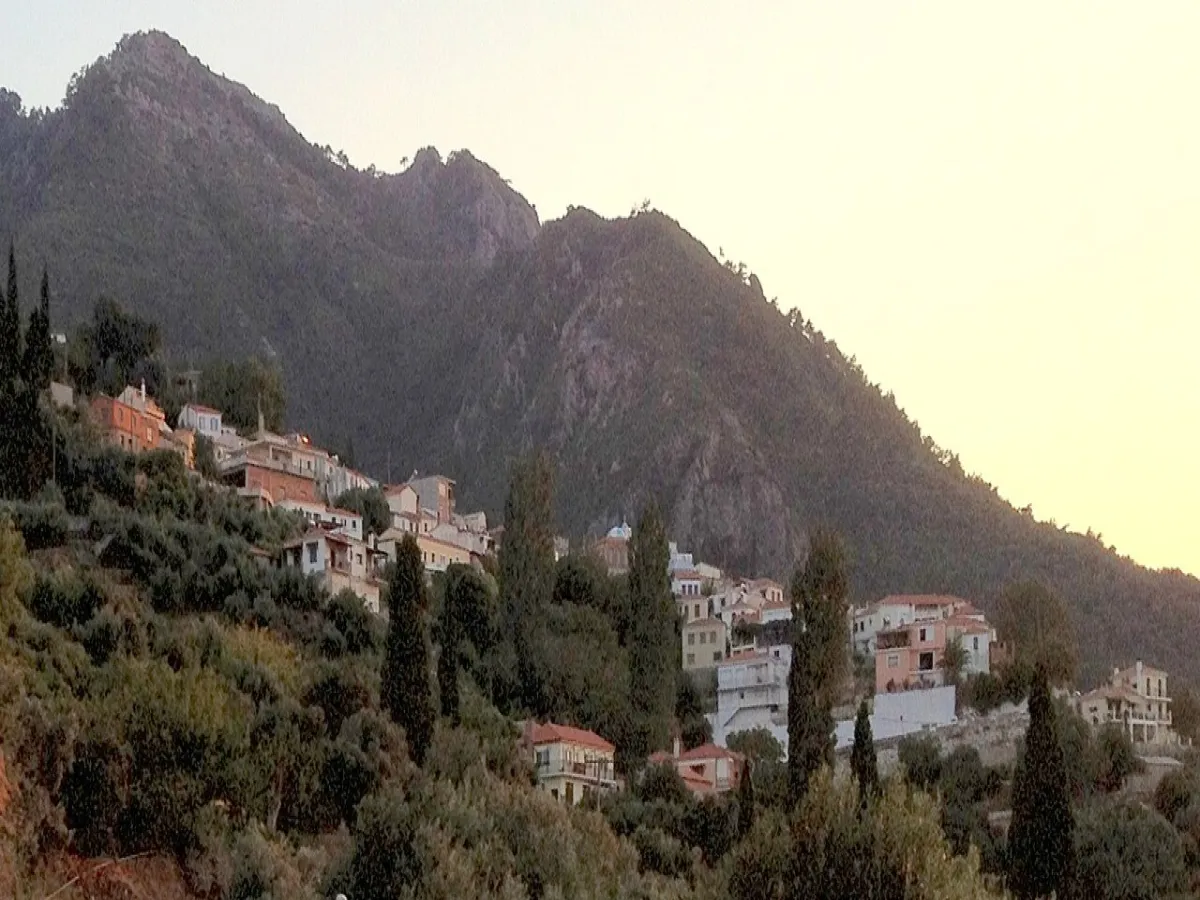
The Municipal Community of Ampelos is located in northern Samos, on the verdant slopes of Mount Ampelos, also known as Karvounis. Its central settlement is Ampelos, a historic village built amphitheatrically above the Aegean Sea, within a landscape of vineyards, olive groves, chestnut trees, pine forests, springs and flowing water.
The community also includes the coastal settlements of Livadaki and Petalides, combining the mountain character of the village with small residential areas along the northern coast. From the steep alleys and central square to the waterfalls, forest paths and peaceful beaches, the area displays considerable natural and geographical diversity.
Viticulture, the white Muscat grape, wine production and the use of the area’s abundant water resources shaped the economic and social development of Ampelos. Despite the significant population decline of recent decades, the village continues to maintain a permanent community, traditional architecture and a close relationship with the natural environment of Karvounis.
📍 Location and geographical character
Ampelos is located in the northern part of Samos, on the northern slopes of Mount Ampelos–Karvounis, at an elevation of approximately 290 metres.
The settlement is built on steeply sloping terrain and extends amphitheatrically towards the northern Aegean Sea. Its position provides open views over the northern coastline of Samos and, when visibility is clear, towards Chios and the opposite coast of Asia Minor.
The wider community extends from the mountainous and semi-mountainous zones surrounding the village to the coastal settlements of Livadaki and Petalides.
The landscape includes:
✅ Terraced vineyards
✅ Olive groves and orchards
✅ Pine forests and chestnut trees
✅ Springs and small streams
✅ Steep forested slopes
✅ Rocky formations and small ravines
✅ Coastal zones with natural vegetation
🏛️ Administrative identity of the community
The Municipal Community of Ampelos belongs to:
✅ The Municipal Unit of Vathy
✅ The Municipality of Eastern Samos
✅ The Regional Unit of Samos
✅ The North Aegean Region
The community includes three officially recognised settlements:
✅ Ampelos
✅ Livadaki
✅ Petalides
Ampelos is the central settlement and administrative centre of the community.
The area is classified among the rural and mountainous communities of the Municipal Unit of Vathy, as a large part of its territory is characterised by steep terrain, cultivated slopes and natural landscapes.
🗺️ The settlements of the Municipal Community of Ampelos
The community combines one historic mountain village with two small coastal settlements.
✅ Ampelos: The central and most populated settlement, built on the slopes of Karvounis, with traditional architecture, vineyards, a village square, a church and access to the waterfalls.
✅ Livadaki: A small coastal settlement approximately 3.5 kilometres north of the village, close to the main coastal road of northern Samos.
✅ Petalides: A coastal settlement approximately 6.5 kilometres north and northwest of Ampelos, in an area with scattered development, a natural coastline and a peaceful character.
The different locations of the three settlements allow the community to combine mountain living, agricultural production, a forest environment and direct access to the sea.
👥 Population and residential distribution
According to the 2021 Population Census, the Municipal Community of Ampelos has a total of 220 permanent residents.
The population is distributed among the three settlements as follows:
✅ Ampelos: 170 permanent residents
✅ Livadaki: 16 permanent residents
✅ Petalides: 34 permanent residents
In the 2011 Census, the community had 327 residents:
✅ Ampelos: 260 residents
✅ Livadaki: 27 residents
✅ Petalides: 40 residents
The population decline is connected with the long-term movement of residents towards the urban centres of Samos, mainland Greece and other countries.
During the summer months, the village and the coastal settlements become livelier as people originally from the area return, holiday homes are occupied and more visitors arrive to explore the paths and coastline.
📜 Establishment and historical development
Ampelos was known for centuries by the name Nenedes. The earliest known written reference to this place name dates from 1774 and appears in a donation document concerning property in the area.
The name “Nenedes” is associated with the Nene family, which is believed to have been among the first families to settle in the region.
During the period of the Principality of Samos, Nenedes was administratively associated with the neighbouring settlements of Agios Konstantinos, Manolates, Stavrinides, Valeontades and Margarites. These settlements formed the historic administrative unit known as the Municipality of the Six Neighbourhoods.
The village’s location on the fertile northern slopes of Karvounis contributed to the development of viticulture, olive cultivation and small-scale family farming.
During the 19th and early 20th centuries, Ampelos developed into an important agricultural village with a large population and considerable productive activity.
📝 From Nenedes to Ampelos
The Community of Nenedes was officially established on 21 September 1918, with the settlement of the same name as its administrative centre.
On 24 January 1957, the settlement of Nenedai was officially renamed Ampelos and the community became known as the Community of Ampelos.
The new name was directly associated with the village’s strong viticultural identity and with Mount Ampelos, on whose slopes it is built.
Livadaki was officially recognised in 1981 and incorporated into the Community of Ampelos. Petalides was recognised as a separate settlement in 2001 and incorporated into the Local District of Ampelos.
Following the administrative reform of 1997, the community became part of the Municipality of Vathy, in 2010 of the unified Municipality of Samos and, since 2019, of the Municipality of Eastern Samos.
🏘️ The form and architecture of Ampelos
Ampelos is built amphitheatrically on a steep slope, with its residential layout following the natural gradients of the terrain.
The older centre includes:
✅ Two-storey houses with tiled roofs
✅ Stone-built ground floors and rendered façades
✅ Wooden window frames and small balconies
✅ External staircases
✅ Courtyards with flowers, vines and basil plants
✅ Narrow uphill alleys
✅ Stone-paved passages
✅ Small gardens and stone boundary walls
The dense development of the centre is combined with more scattered houses on the outskirts, where the residential area meets vineyards, olive groves and natural vegetation.
The roads and alleys have steep gradients, while several parts of the historic centre are more suitable for exploration on foot.
🌳 The square and the centre of the village
The central square is the principal meeting point for residents and visitors.
The parish church, traditional cafés and dining establishments are located around the square. Natural shade, old buildings and views towards the surrounding slopes create a peaceful space that retains its social importance for the village.
Narrow streets lead from the square towards the older neighbourhoods, springs, viewpoints and the path to the waterfalls.
The centre is best explored on foot, as the short distances are combined with several slopes and stairways.
⛪ The Church of the Conception of Saint John the Baptist
The central parish church of Ampelos is dedicated to the Conception of Saint John the Baptist and dominates the village square.
The present church was constructed in 1966 on the site of earlier churches. The oldest known church at the same location dates from 1672, highlighting the village’s long religious tradition.
The Feast of the Conception of Saint John the Baptist is celebrated on 23 September and is an important date for the local community.
The church is also connected with cultural and charitable activities organised throughout the year.
💧 Springs and flowing water
Ampelos is known for its springs and abundant water, which contributed to the development of the settlement and its cultivated land.
Water from the slopes feeds small streams, irrigates gardens and vineyards and creates an exceptionally green landscape around the village.
Traditional fountains and small springs can be found in different locations. They once served as important places for everyday water supply and social interaction.
The presence of water encourages the growth of plane trees, chestnut trees, ferns, mosses and other plants that are not found with the same density in the drier areas of Samos.
🏞️ The waterfalls of Ampelos
The waterfalls are the best-known natural attraction in the area and are located west of the settlement, within dense vegetation.
Access is provided by a path that begins in the village area and passes among trees, rocks, streams and points with open views.
The route takes approximately thirty minutes, depending on the starting point, walking pace and condition of the trail.
The water descends over rocky formations, forming small waterfalls and natural pools. The volume of water is greatest after the winter rains and during spring.
The forest around the waterfalls is characterised by mosses, ferns, chestnut trees, plane trees and dense low vegetation, creating a cool environment even during the warmer months.
🥾 The path to the waterfalls
The path is one of the most popular short hiking routes in northern Samos.
The route includes:
✅ Shaded forest sections
✅ Narrower passages
✅ Rocky or wet ground
✅ Short ascents and descents
✅ Crossings close to streams
✅ Viewpoints towards the sea and the surrounding slopes
During winter and spring, the ground may be muddy or slippery. Suitable hiking shoes, drinking water and careful movement are essential.
The route is best suited to visitors with a basic level of physical fitness and is not easily accessible with a pushchair or wheelchair.
🌲 Mount Ampelos – Karvounis
Mount Ampelos, also known as Karvounis, is the principal mountain range of central and eastern Samos.
Its slopes are covered with pine forests, chestnut trees, cypress trees, olive groves and vineyards, while springs, streams and small valleys form in several areas.
Part of the mountain is protected under the Natura 2000 network because of its important habitats, flora and fauna.
Ampelos is a suitable starting point for discovering the northern slopes of the mountain and the network of traditional agricultural and forest routes.
🍇 Viticulture and the Muscat grape of Samos
Viticulture is a central element of the economic, social and cultural identity of the community.
The vineyards are arranged on stone terraces that retain the soil on the steep slopes. The northern exposure, elevation, humidity and soil conditions create distinctive conditions for cultivating the white Muscat grape.
Vineyard care includes seasonal activities such as:
✅ Pruning
✅ Tying the shoots
✅ Clearing the terraces
✅ Maintaining the stone walls
✅ Harvesting the grapes
✅ Transporting the produce from the slopes
The grape harvest was traditionally a collective activity involving families and workers from the village and the surrounding area.
Grapes grown in Ampelos contribute to the wider production of the sweet and dry wines of Samos.
🌿 Agriculture and local production
In addition to vines, the area is used for cultivating olive trees, fruit trees, vegetables and aromatic plants.
Local production includes:
✅ Wine made from white Muscat grapes
✅ Olive oil
✅ Honey
✅ Table olives
✅ Seasonal fruit and vegetables
✅ Herbs
✅ Souma
✅ Small-scale family products
Beekeeping benefits from the forest and aromatic vegetation of the slopes, while small family gardens continue to meet some of the residents’ everyday needs.
Cultivation is an important part of the landscape and keeps the village closely connected with its agricultural traditions.
🌊 Livadaki
Livadaki is a small coastal settlement of the community, approximately 3.5 kilometres north of Ampelos.
It is located close to the coastal road connecting the town of Samos, Agios Konstantinos and Karlovasi.
The area has low-density development, houses, small accommodation facilities, olive groves and access to the northern coastline.
Its location allows visitors to combine a stay close to the sea with easy access to the mountain village of Ampelos.
The northern orientation of the coast makes it more exposed to the meltemi wind and waves on days with strong northerly winds.
🌊 Petalides
Petalides is the second coastal settlement of the community and lies north and northwest of Ampelos.
The area is characterised by scattered houses, a natural coastline, olive groves, low vegetation and a quieter atmosphere.
Access is provided from the coastal road and through smaller local routes leading towards the houses and the shore.
Petalides is suitable for visitors seeking peaceful coastal accommodation and direct contact with the natural landscape of northern Samos.
Sea conditions are affected by northerly winds and may change considerably during the same day.
🍽️ Gastronomy and local flavours
Local cuisine is closely associated with the products of the mountain landscape, viticulture and small-scale family production.
In Ampelos, visitors may find:
✅ Homemade cooked dishes
✅ Goat and meat prepared according to local recipes
✅ Chickpea fritters
✅ Stuffed vine leaves
✅ Seasonal vegetables
✅ Olives and olive oil
✅ Local cheeses
✅ Honey and traditional sweets
✅ Pancakes
✅ Souma
✅ Sweet and dry wines made from Muscat grapes
The main options for coffee and dining are concentrated around the square and in the more easily accessible parts of the village.
🎭 Festivals and cultural events
The Feast of the Conception of Saint John the Baptist on 23 September is the most important religious celebration in the village.
The Pancake Festival is also organised during the summer, featuring traditional pancakes, music, dancing and the participation of residents and visitors.
Other events held in the village include:
✅ Religious services and traditional festivals
✅ Music evenings
✅ Traditional celebrations
✅ Events organised by local associations
✅ Gastronomic and community activities
These events contribute to the preservation of local traditions and reconnect permanent residents with people from the village who live elsewhere.
🛏️ Facilities and everyday services
Ampelos has traditional cafés, dining establishments and limited options for basic shopping and accommodation.
Most services are concentrated close to the square and along the main village road. Some businesses operate more actively during the summer months.
For a wider range of shops, a pharmacy, banks, services and accommodation, the nearest organised settlements are:
✅ Agios Konstantinos
✅ Kokkari
✅ Karlovasi
✅ The town of Samos
Parking is limited within the traditional centre. Cars can be left in an open area near the entrance or square, with exploration continuing on foot.
🥾 Hiking routes and exploration
Ampelos is a starting point for short and longer routes across the northern slopes of Karvounis.
The main options include:
✅ The path to the waterfalls
✅ Forest routes above the village
✅ Agricultural roads among the vineyards
✅ Routes towards springs and streams
✅ Walks towards the higher slopes of Karvounis
✅ Connections with neighbouring mountain settlements
✅ Descents towards Livadaki and the northern coast
Trail conditions are affected by vegetation, rainfall and maintenance. Longer routes require suitable footwear, sufficient drinking water and reliable knowledge of the route.
📸 Photography and viewpoints
The amphitheatrical position of the village creates many locations with open views towards the northern Aegean Sea.
Places of particular photographic interest include:
✅ The view from the higher houses
✅ The square and the church
✅ The uphill alleys
✅ The tiled roofs and courtyards
✅ The terraced vineyards
✅ The springs and flowing water
✅ The forest around the waterfalls
✅ The coastal areas of Livadaki and Petalides
Morning light highlights the view towards the sea, while the afternoon creates softer colours across the slopes and houses.
🌿 What to see
During your exploration of the Municipal Community of Ampelos, look for:
✅ The traditional settlement of Ampelos
✅ The central square
✅ The Church of the Conception of Saint John the Baptist
✅ The narrow uphill alleys
✅ The houses with tiled roofs and traditional courtyards
✅ The stone terraces with vineyards
✅ The springs and fountains
✅ The path to the waterfalls
✅ The waterfalls and forest environment
✅ The viewpoints towards the Aegean Sea
✅ The coastal settlement of Livadaki
✅ The coastal settlement of Petalides
✅ The peaceful routes across the slopes of Karvounis
🚗 Suggested routes
The community can be explored through different combinations:
✅ Agios Konstantinos – Ampelos: An ascent from the northern coast towards the historic village.
✅ Ampelos – waterfalls: A hiking route through dense vegetation and flowing water.
✅ Ampelos – Livadaki: A combination of a mountain village and the northern coast.
✅ Ampelos – Petalides: A route from the vineyard-covered slopes towards a peaceful coastal settlement.
✅ Ampelos – Stavrinides – Manolates: An exploration of the historic mountain villages of northern Samos.
✅ Ampelos – Karvounis vineyards: An agricultural and nature route among terraces, springs and forested areas.
🚶 Visitor experience
Approximately one to two hours are needed for a basic exploration of Ampelos. The square, church, alleys and viewpoints can be visited on foot.
Including the hike to the waterfalls can extend the visit to three or four hours.
Combining the village with Livadaki or Petalides creates a complete day route that includes a mountain landscape, hiking and the sea.
The steep gradients, stairways and uneven trail sections require comfortable footwear. The historic centre and the waterfall route are not easily accessible to visitors with limited mobility.
📆 When to visit
Spring: The best season for the waterfalls, springs, flowering nature and hiking routes.
Summer: The liveliest season, with more dining options and the opportunity to combine the village with Livadaki and Petalides.
Late summer: A particularly interesting period because of the ripening grapes and grape-harvesting activities.
Autumn: A suitable season for photography, peaceful exploration and discovering local agricultural life.
Winter: The village retains an authentic character and the waterfalls contain more water, but rain and humidity make the paths more difficult.
Morning: The best time for hiking and photographing the views towards the sea.
Afternoon: The ideal time for walking through the alleys and enjoying coffee or a meal in the square.
🧭 How to get there
Ampelos is accessible from the main coastal road connecting the town of Samos with Agios Konstantinos and Karlovasi.
A paved provincial road approximately four kilometres long begins in the Agios Konstantinos area and climbs towards the village.
The route passes through dense vegetation and includes several bends and sections with steep gradients.
Ampelos is approximately:
✅ 4 kilometres from Agios Konstantinos
✅ 14 kilometres from Karlovasi
✅ 24 kilometres from the town of Samos
✅ 33 kilometres from Pythagoreio
✅ 3.5 kilometres from Livadaki
✅ 6.5 kilometres from Petalides
The road is suitable for a standard car, although care is required on bends, narrower sections and during rainy weather or periods of increased traffic.
ℹ️ Useful information
✅ Official name: Municipal Community of Ampelos
✅ Geographical category: Community
✅ Central settlement: Ampelos
✅ Former name: Nenedes
✅ Location: Northern Samos
✅ Mountain range: Mount Ampelos–Karvounis
✅ Municipal Unit: Vathy
✅ Municipality: Eastern Samos
✅ Regional Unit: Samos
✅ Region: North Aegean
✅ Community established: 21 September 1918
✅ Official renaming: 24 January 1957
✅ Number of official settlements: Three
✅ Settlements: Ampelos, Livadaki and Petalides
✅ Community population in 2011: 327 permanent residents
✅ Community population in 2021: 220 permanent residents
✅ Population of Ampelos in 2021: 170 permanent residents
✅ Elevation of the central settlement: Approximately 290 metres
✅ Main traditional activity: Viticulture
✅ Main grape variety: White Muscat of Samos
✅ Central church: Conception of Saint John the Baptist
✅ Feast day: 23 September
✅ Main natural attraction: Ampelos Waterfalls
✅ Main coastal settlements: Livadaki and Petalides
✅ GPS coordinates of Ampelos centre: 37.80177, 26.80078
✅ Road access: Paved winding mountain road
✅ Recommended visiting time: From 1–2 hours to a full day
✅ Suitable for: Traditional village exploration, viticulture, photography, gastronomy, hiking, waterfalls, nature exploration and coastal routes


Add new comment