
Platanos of Samos
🏞️ Platanos, Samos – The Mountain Village of Wine and Panoramic Views
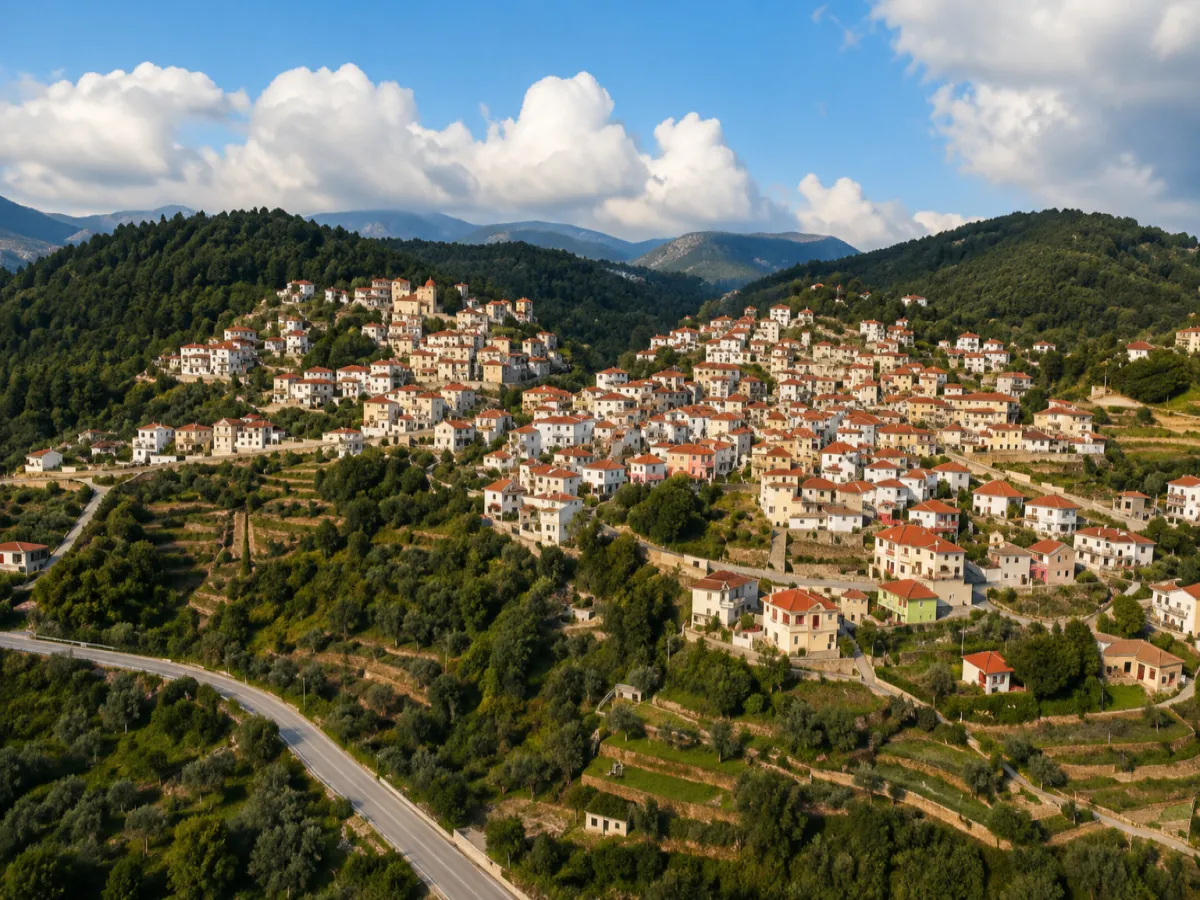
Platanos is one of the oldest and most distinctive mountain villages of Samos. It is built in the central part of the island, on the western slopes of the Ampelos mountain massif, also known as Karvounis, at an altitude of approximately 520 metres.
The square with its large plane trees and historic fountain, the traditional houses, narrow streets and vineyards extending across the surrounding slopes shape the village’s distinctive character. Its elevated position offers open views towards western Samos, Mount Kerkis, the Karlovasi area and the Aegean Sea.
Platanos is particularly known for its long viticultural tradition, Samian wines, beekeeping and the cool water of its springs. According to the 2021 census, the village has 340 permanent residents.
📍 Location and Character
Platanos lies on the western slopes of Mount Karvounis, in a mountainous area where vineyards, olive groves, pine-covered hillsides and small ravines continually alternate.
The settlement is built on sloping terrain, with its homes and neighbourhoods arranged at different levels. The narrow streets follow the natural contours of the hillside and lead towards the central square, which forms the heart of everyday village life.
Its high altitude provides cooler temperatures than the coastal areas, particularly during summer afternoons and evenings. From open viewpoints around the village, the landscape extends towards Mount Kerkis, the Karlovasi valley, the western coastline of Samos and the Aegean Sea.
📜 The History and Establishment of the Village
Platanos is considered one of the oldest settlements established during the repopulation of Samos.
Local tradition places the formation of the village at around 1590 and connects its first residents with settlers who arrived from Evia. Another historical account suggests that the settlers came from Platanos in Kynouria or from the Almyros area of Magnesia and gave the new settlement the name of their place of origin.
The local historian and folklorist Nikolaos Zafeiriou argued that native Samians continued to live in the area even during the period when most of the island had been abandoned. The first known written reference to Platanos was made after 1671 by Joseph Georgirinis, who had served as Bishop of Samos.
🌳 The Origin of the Name
One of the most widely accepted traditions connects the name “Platanos” with the plane trees and the abundance of water in the area where the settlement developed.
The large plane trees in today’s central square remain the natural symbol of the village. Its close relationship with water is also reflected in the old fountains, communal washhouses and small streams that served the residents and their cultivated land for centuries.
🏛️ Administrative Development
The Community of Platanos was officially established in 1918, with the settlement designated as its administrative seat.
In 1997, under the Kapodistrias administrative reform, the community was abolished and Platanos became part of the Municipality of Karlovasi. In 2010, it was incorporated into the unified Municipality of Samos and, since 2019, it has belonged to the Municipality of Western Samos.
Today, it is the seat of the Municipal Community of Platanos and belongs to the Municipal Unit of Karlovasi, the Regional Unit of Samos and the North Aegean Region.
👥 Population Development
Platanos had a significantly larger population in the past, when viticulture, agriculture and beekeeping provided employment for many local families.
In 1951, the village had 747 residents. The population stood at 704 in 1961 and fell to 502 in 1971. In 1981, 520 residents were recorded, followed by 440 in 1991, 577 in 2001 and 396 in 2011.
According to the 2021 census, Platanos has 340 permanent residents. Despite the gradual population decline, it remains a lively village with active agricultural production, a school and a strong presence of former residents returning during the summer months.
🌳 The Central Square and Its Large Plane Trees
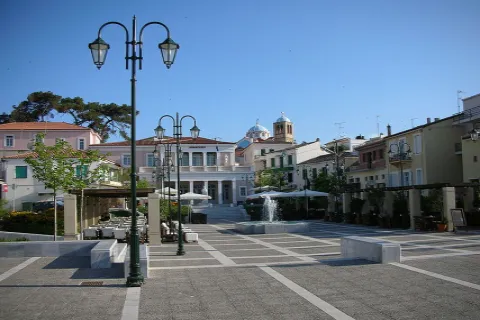
The central square is the most recognisable location in Platanos. Three large plane trees create dense shade and provide a naturally cool refuge during the summer months.
The square is the main social meeting point for residents. Much of the village’s everyday life is centred here, while during the summer it hosts cultural events, traditional customs and local celebrations.
The Lotza area also played an important role in the past. It was the village’s original square, where residents gathered to exchange news, discuss local matters and resolve issues concerning the community.
🚰 The Historic Public Fountain
At the far end of the square stands the historic public fountain of Platanos, one of the village’s most important landmarks.
Its original construction dates to the 17th century, while it was rebuilt in 1837. For many generations, it served as an essential source of water and a daily meeting place for the residents.
The cool water of Platanos became well known throughout Samos and remains closely connected with the identity and collective memories of the village.
⛪ The Church of Agios Georgios
The parish church of the village is dedicated to Agios Georgios and serves as the principal religious centre of the community.
The church stands along the main road running through the settlement and is an important reference point for religious services, feast days and the social life of the residents.
The festival of Agios Georgios attracts residents and visitors, preserving the close relationship between religious life and local tradition.
🕊️ The Church of the Dormition of the Virgin Mary
The Church of the Dormition of the Virgin Mary is among the most important historic religious monuments of Platanos.
It is a distinctive two-aisled church which, according to an inscription at its entrance, was built in 1787. Its age and unusual architecture make it one of the village’s most significant post-Byzantine monuments.
The church is connected with the older ecclesiastical history of Platanos and completes the image of a settlement that preserves important elements of its religious and cultural heritage.
🏫 The Historic Primary School
The Primary School of Platanos is one of the village’s most characteristic public buildings. It was constructed at the end of the 19th century and preserves the imposing appearance of school buildings erected during the period of the Principality of Samos.
The stone-built structure has a T-shaped ground plan, a small basement, an entrance portico with columns and strong three-layer masonry. Its appearance has been preserved with respect for the original architectural features.
The school suffered damage during the powerful earthquake of 2020 and was subsequently strengthened. Most interventions were carried out inside the building to protect its external façades. It remains an active public primary school.
🧺 The Old Washhouses and the Stream
Old communal washhouses survive near the stream and are closely connected with everyday village life before modern water-supply systems were installed.
These structures were used for washing clothes and served as places of work, conversation and social contact. Together with the public fountain and the old water channels, they reveal how the residents used the water from local springs.
Today, they form part of the folkloric and agricultural heritage of Platanos.
🏡 Traditional Architecture and Neighbourhoods
Platanos preserves notable examples of traditional Samian architecture. The historic centre includes stone-built and plastered houses, tiled roofs, wooden windows, external staircases and small courtyards filled with flowers and grapevines.
The narrow streets follow the gradient of the terrain and connect small neighbourhoods arranged at different levels. Stone retaining walls, steps and passages adapt the settlement to the natural form of the mountain slope.
Walking through the inner streets reveals a quieter side of the village, away from the main road and central square.
🍇 The Viticultural Tradition
Viticulture is one of the most important elements of the economic and cultural identity of Platanos.
The surrounding slopes are mainly cultivated with white small-berried Muscat, the grape variety behind the renowned PDO Samos wines. The vineyards grow on steep terrain, often on stone terraces that reduce erosion and make cultivation possible at higher altitudes.
The altitude, the temperature differences between day and night and the orientation of the slopes contribute to grapes with intense aromas and high sugar concentration.
🍷 Samian Wine
Wine is an inseparable part of life in Platanos. For generations, the grape harvest, pressing and winemaking were family and community activities.
The village’s grape growers deliver a significant part of their production to the local wine cooperative, while the tradition of small-scale family winemaking is also preserved.
Muscat grapes are used to produce sweet, naturally sweet and dry wines characterised by aromas of flowers, ripe fruit, honey and herbs. Platanos is one of the most characteristic stops in the wine-producing interior of Samos.
🍯 Beekeeping and Local Production
Beekeeping is the village’s second major traditional activity.
The variety of vegetation surrounding Platanos provides bees with thyme, heather, pine, strawberry tree and numerous aromatic plants. Local honey is distinguished by its fragrance and rich flavour.
Olive trees, fruit trees and family gardens are also cultivated, while agricultural life continues to follow the cycle of the seasons, from the grape harvest to the gathering of olives.
🌲 The Natural Environment
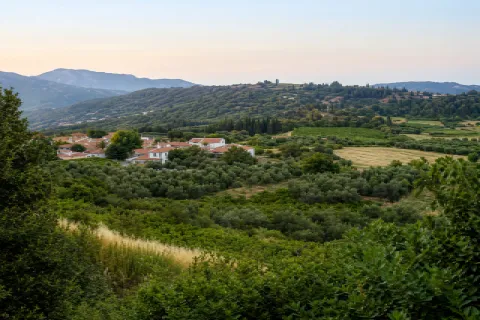
The countryside around Platanos combines vineyards, olive groves, pine-covered slopes, small ravines and low Mediterranean vegetation.
Old stone terraces are a characteristic feature of the landscape. They were created through demanding manual labour to retain the soil and allow cultivation on the steep slopes of Mount Karvounis.
Wildfires that affected Samos also damaged parts of the wider area. However, extensive zones of vegetation and cultivated land continue to surround the village.
🌅 The Panoramic Views
The location of Platanos offers some of the most open views in the mountainous interior of Samos.
From the road, the edges of the settlement and the higher viewpoints, visitors can see Mount Kerkis, western Samos, the Karlovasi area and the Aegean Sea.
The view is particularly impressive during the late afternoon, when the light highlights the stone terraces, vineyards and successive mountain slopes.
🎭 The Kleidonas Custom
The traditional custom of Kleidonas, one of the best-known summer folk traditions, is revived in Platanos.
The celebration is connected with Agios Ioannis and includes lighting bonfires, jumping over the flames and traditional rituals involving the so-called “silent water”.
The event takes place in the village square with the participation of residents and visitors and forms an important part of the cultural life of Platanos.
🎉 The Wine Festival
The Educational and Cultural Association of Platanos organises activities and events connected with the history and productive identity of the village.
Among them, the Wine Festival stands out, presenting Samian wines while the central square fills with music and dancing.
The celebration highlights the long-standing relationship between Platanos and viticulture and attracts residents, former villagers and visitors from different parts of Samos.
🥾 Hiking and Mountain Routes
Platanos is a suitable starting point for exploring the western side of Mount Karvounis.
Provincial and agricultural roads around the village pass through vineyards, olive groves, forests and small ravines. The routes offer different views towards Mount Kerkis, Karlovasi and the western coastline.
Some rural roads are unpaved and require a suitable vehicle, particularly after heavy rainfall. Comfortable footwear, water and sun protection are recommended for hiking.
🌿 What to See
During your visit to Platanos, take time to discover:
✅ The central square with its three large plane trees
✅ The historic public fountain dating from the 17th century
✅ The parish Church of Agios Georgios
✅ The historic Church of the Dormition of the Virgin Mary
✅ The old Primary School
✅ Lotza, the village’s original square
✅ The old communal washhouses near the stream
✅ The narrow streets and traditional houses
✅ The stone vineyard terraces
✅ The mountain vineyards of Muscat grapes
✅ The viewpoints overlooking Mount Kerkis, Karlovasi and the Aegean Sea
✅ The National Resistance memorial
🚶 The Visitor Experience
A visit to Platanos can begin in the central square, beneath the shade of the large plane trees and beside the historic fountain.
From there, you can continue towards Agios Georgios, the Church of the Dormition of the Virgin Mary, the school and the inner streets. The route reveals traditional homes, courtyards, stone walls and different aspects of everyday mountain life.
Approximately 60 to 90 minutes are recommended for a relaxed exploration of the village’s principal points of interest. More time is needed when the visit is combined with a route through the vineyards or the surrounding mountain landscape.
📆 When to Visit
Spring: The countryside is lush and green, temperatures are ideal for walking and the vineyards begin developing their new foliage.
Summer: The altitude offers cooler conditions than the coast. The square becomes particularly lively during the afternoon and evening.
Kleidonas period: The traditional custom is revived in the square with bonfires, music and the participation of the community.
Wine Festival period: Visitors can discover more about the village’s viticultural tradition and the wines of Samos.
Late summer and early autumn: The grape harvest highlights the agricultural character of the village.
Winter: Platanos retains its peaceful daily rhythm, with lower temperatures, rainfall and the possibility of fog.
🧭 How to Get There
Platanos is connected by paved provincial road with Karlovasi, Marathokampos and the other villages of western and central Samos.
The village lies approximately 12 kilometres from Karlovasi, 8 kilometres from Marathokampos, 25 kilometres from Pythagoreio and 38 kilometres from Samos Town.
The route includes numerous bends and uphill sections. Roads within the historic centre are narrow, so parking at a suitable location and continuing on foot is the most practical option.
ℹ️ Useful Information
✅ Administrative community: Municipal Community of Platanos
✅ Municipal unit: Karlovasi
✅ Municipality: Western Samos
✅ Population in 2021: 340 residents
✅ Altitude: Approximately 520 metres
✅ Distance from Karlovasi: Approximately 12 kilometres
✅ Distance from Marathokampos: Approximately 8 kilometres
✅ Distance from Pythagoreio: Approximately 25 kilometres
✅ Distance from Samos Town: Approximately 38 kilometres
✅ Postal code: 83200
✅ GPS coordinates: 37.7381, 26.7467
✅ Parish church: Agios Georgios
✅ Historic church: Dormition of the Virgin Mary
✅ Main local products: Wine, grapes, honey and olive oil
✅ Road access: Paved mountain road with bends
✅ Suggested visiting time: Approximately 60–90 minutes
✅ Ideal for: Traditional architecture, wine tourism, nature, photography, local history and peaceful exploration



Add new comment