
Perri of Samos

🏝️ Perri, Samos – The Small Coastal Settlement and Psili Ammos
Perri is a small coastal settlement in southern Samos, located near a peaceful and sparsely developed stretch of coastline belonging to the Municipal Community of Skoureika. It lies approximately 2.4 kilometres southwest of Skoureika and is surrounded by olive groves, low Mediterranean vegetation, agricultural land and rocky slopes.
The settlement consists of a small number of houses and agricultural buildings. Some are occupied throughout the year, while others are used as holiday homes. The absence of intensive tourism development has preserved the quiet character of the area.
According to the 2021 census, Perri has 27 permanent residents. Administratively, it belongs to the Municipal Community of Skoureika, the Municipal Unit of Marathokampos, the Municipality of Western Samos, the Regional Unit of Samos and the North Aegean Region.
📍 Location and Character
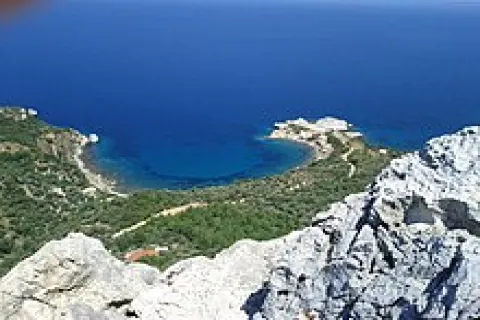
Perri is situated on the southern coast of Samos, between the coastal areas of Kampos of Skoureika, Psili Ammos and Pefkos. The settlement extends across low-lying terrain, in an area where olive groves reach close to the sea and small slopes form sheltered shores and natural coves.
The houses are sparsely distributed and do not form a dense traditional village centre. Perri has the appearance of a small agricultural and holiday community closely connected with Skoureika and the southern coastline.
From the open areas around the settlement, views extend towards the southern Aegean Sea, the neighbouring shores and the successive slopes of southern Samos.
🏛️ Administrative Development
Perri was officially recognised as a separate settlement on 5 April 1981 and was incorporated into the former Community of Skoureika.
In 1997, under the Kapodistrias administrative reform, it became part of the Municipality of Marathokampos. In 2010, it was incorporated into the unified Municipality of Samos and, since 2019, has belonged to the Municipality of Western Samos.
👥 Population Development
Perri has always had a small population, as it developed as a scattered coastal and agricultural settlement rather than as a compact village.
Earlier censuses recorded 8 residents in 1981, 2 in 1991, 28 in 2001 and 23 permanent residents in 2011. According to the 2021 census, the settlement has 27 permanent residents.
Activity increases during the summer months due to the holiday homes, visitors and people travelling towards the quiet beaches of the surrounding area.
🏘️ The Settlement Today
Modern Perri consists of a small number of houses, holiday homes and agricultural buildings located among olive groves and natural vegetation.
It does not have an organised commercial centre, a large square or extensive tourism services. Residents and visitors mainly rely on Skoureika and the larger settlements of the Municipal Unit of Marathokampos for shops, daily supplies and additional services.
Peacefulness, limited traffic and direct contact with the rural and marine environment are the main characteristics of the area.
🌊 Psili Ammos of Perri
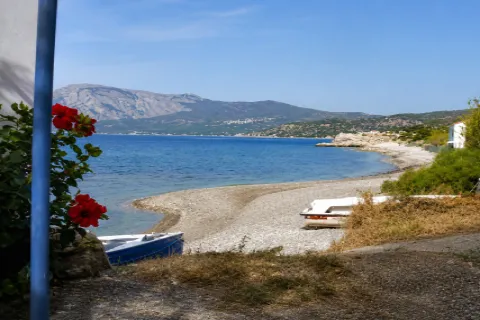
Psili Ammos of Perri lies within the coastal area of the settlement. It is a small and secluded beach with sand and pebbles.
The beach is unorganised and retains its natural character. It has no permanent umbrellas, sunbeds, changing facilities or other organised amenities, making it suitable for visitors seeking peace and limited human presence.
The name “Psili Ammos of Perri” is used to distinguish it from the better-known Psili Ammos Beach in southeastern Samos, near Palaiokastro and the Mykale Strait.
🏖️ The Shore and Its Natural Landscape
The shore combines sandy areas with fine and larger pebbles. Rocky formations appear at the ends of the beach, while shrubs, olive trees and low Mediterranean vegetation grow behind the coastline.
The small size of the beach and its more demanding access usually limit the number of visitors. Even during the busiest summer period, the area remains noticeably quieter than the organised beaches of Samos.
Some natural shade is available beneath trees or beside the rocks, depending on the time of day. As shade does not cover the entire beach, bringing an umbrella is recommended.
🌊 The Sea and Seabed
The water is generally clear, particularly when there is little or no wind. The seabed alternates between sand, pebbles and rocky areas, creating different underwater landscapes along the shore.
The rocks at the ends of the beach offer suitable conditions for observing the seabed with a mask and snorkel when the sea is calm and conditions are safe.
As there is no lifeguard supervision, visitors should exercise caution, especially during windy conditions or when swimming with children.
🌿 The Natural Environment
The landscape around Perri is characterised by olive groves, low shrubland, pine trees in certain areas and rocky slopes descending towards the sea.
Old stone terraces and dry-stone walls reflect the long agricultural use of the area. Small rural roads lead to olive groves, orchards and scattered houses.
During spring, the vegetation is more abundant and the countryside fills with wildflowers. In summer, the drier colours of the Mediterranean landscape become dominant.
🫒 Olive Groves and Agricultural Activity
Perri is directly connected with the agricultural tradition of Skoureika, where olive cultivation was a major economic activity for many generations.
Olive trees occupy a significant part of the land surrounding the settlement. Stone walls retain the soil on the slopes, while small rural roads provide access to the fields and houses.
The olive harvest remains an important seasonal activity. Fruit trees, vegetables and aromatic herbs are also cultivated in family gardens.
⛪ The Chapel of Agios Orestis
A chapel dedicated to Agios Orestis is located in the coastal area of Perri.
The church was built in 2007 in memory of Orestis Karadimitriou, while its official opening ceremony took place in August 2009. The small chapel is a modern religious landmark that blends harmoniously into the peaceful coastal landscape.
🥾 The Route to the Beach
Psili Ammos of Perri cannot be reached directly by car. From the nearest accessible point, a walk of approximately 180 metres is required.
The path or final part of the route can be uneven, particularly after rainfall or when vegetation has grown. Closed shoes or secure walking sandals are more suitable than ordinary flip-flops.
The short distance is not particularly demanding for an average walker. However, the route is unsuitable for visitors with serious mobility difficulties or for pushchairs.
🏝️ The Neighbouring Shores
The wider coastal area of Skoureika also includes Kampos, Pefkos and other small shores that retain a quieter character than the island’s better-known beaches.
Perri lies east of Pefkos and is connected with the neighbouring areas by narrow local and rural roads. A visit can be combined with a stop at Pefkos, Skoureika or Kampos of Skoureika.
The small neighbouring shores offer alternating landscapes of sand, pebbles, rocks, olive groves and places with natural shade.
🌿 What to See
During your visit to Perri, take time to discover:
✅ The small coastal settlement
✅ Psili Ammos of Perri
✅ The sandy and pebbled sections of the shore
✅ The rocky formations surrounding the beach
✅ The Chapel of Agios Orestis
✅ The olive groves and old dry-stone walls
✅ The viewpoints overlooking the southern Aegean Sea
✅ The small rural roads of the area
✅ The nearby shores of Pefkos and Kampos
✅ The village of Skoureika
🚶 The Visitor Experience
Perri is suitable for visitors seeking tranquillity, natural scenery and a beach without organised services.
A visit can begin in the small settlement and continue with the short walk towards Psili Ammos. At the beach, visitors can walk along the shore, swim or explore the rocky areas with a mask when the sea is calm.
Approximately 60–90 minutes are sufficient for a simple exploration of the settlement and a short stop at the coast. More time is required for swimming and a longer stay at the beach, together with complete personal supplies and equipment.
📆 When to Visit
Spring: The best period for walking, photography and observing the natural vegetation.
Summer: Suitable for swimming, although a hat, beach umbrella, drinking water and sun protection are necessary.
Morning: Temperatures are lower and the sea is often calmer.
Late afternoon: The heat decreases and the light highlights the rocks and slopes surrounding the shore.
Autumn: The area is exceptionally peaceful and the sea often remains suitable for swimming.
Winter: Access requires greater caution after rainfall, and seasonal services are unavailable.
🧭 How to Get There
Perri lies approximately 2.4 kilometres southwest of Skoureika. Access is provided through the local and rural road network descending from the village towards the southern coastline.
The route includes narrow sections and bends, while the condition of the rural roads can change depending on rainfall and maintenance work. Slow and careful driving is necessary, particularly with a low-clearance passenger vehicle.
For Psili Ammos, leave your vehicle at the nearest suitable point and continue on foot for approximately 180 metres. A four-wheel-drive vehicle is not always necessary, although it may be useful when the rural road network is in poor condition.
The recorded road distance is approximately 54 kilometres from Vathy and 29 kilometres from Karlovasi.
ℹ️ Useful Information
✅ Administrative community: Municipal Community of Skoureika
✅ Municipal unit: Marathokampos
✅ Municipality: Western Samos
✅ Population in 2021: 27 residents
✅ Settlement type: Small coastal and agricultural settlement
✅ Official recognition: 5 April 1981
✅ Distance from Skoureika: Approximately 2.4 kilometres
✅ Distance from Karlovasi: Approximately 29 kilometres
✅ Distance from Vathy: Approximately 54 kilometres
✅ Postal code: 83104
✅ Settlement GPS coordinates: 37.6817, 26.7649
✅ Nearby beach: Psili Ammos of Perri
✅ Shore type: Sand and pebbles
✅ Beach facilities: Unorganised
✅ Walk to the shore: Approximately 180 metres
✅ Natural shade: Limited and dependent on the time of day
✅ Tourism facilities: Very limited
✅ Essential equipment: Water, food, beach umbrella, sunscreen and suitable footwear
✅ Suggested visiting time: From 60 minutes to half a day
✅ Ideal for: Peaceful swimming, nature, photography, snorkelling and seclusion



Add new comment