
Lekka of Samos
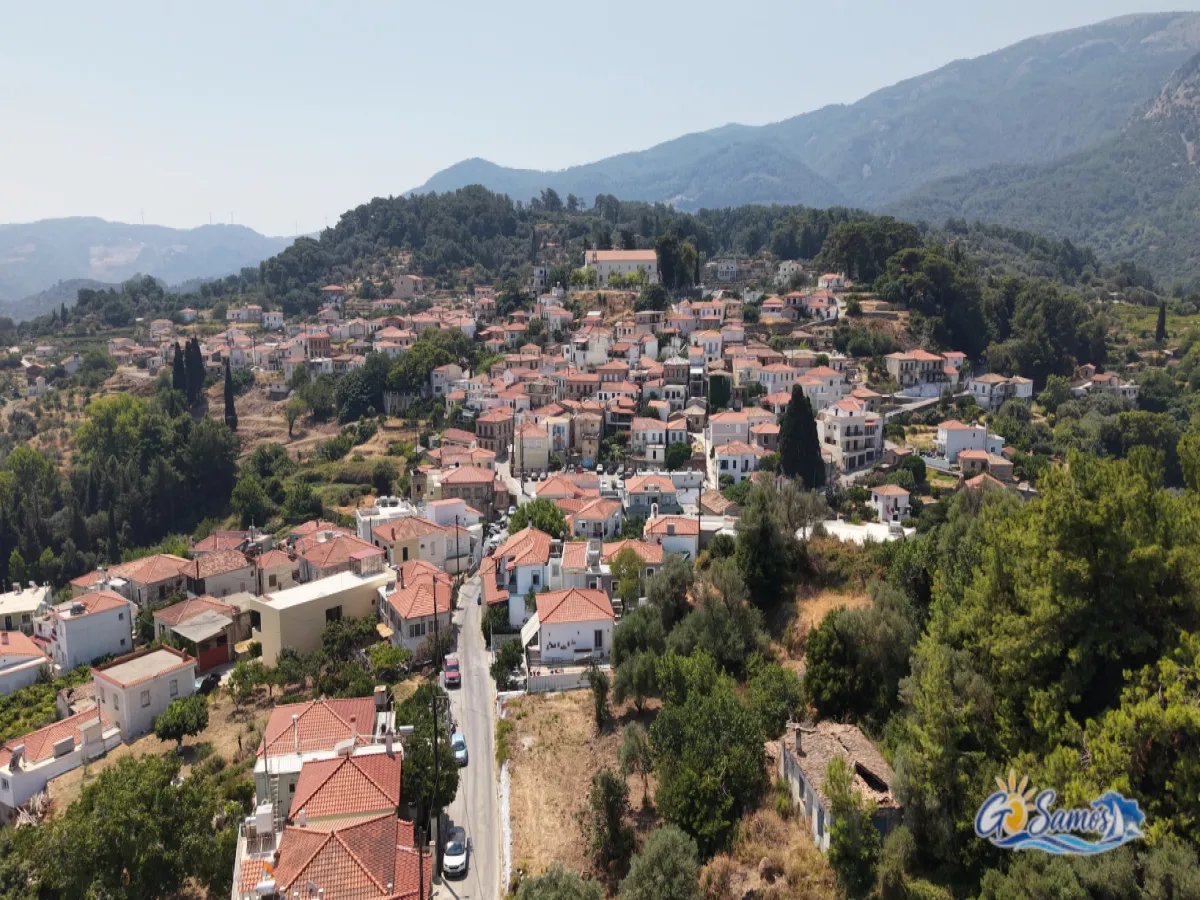
🏘️ Municipal Community of Lekka, Samos – The Amphitheatrical Village Above Karlovasi
Lekka is one of the oldest and most characteristic villages of western Samos, built amphitheatrically on the northeastern foothills of Kerkis, only a few kilometres above Karlovasi. At an elevation of approximately 200 metres, it is surrounded by olive groves, vineyards, fruit trees and dense Mediterranean vegetation, while many points in the village offer panoramic views towards Karlovasi and the northern Aegean Sea.
The village has largely preserved its traditional character. Tiled roofs, stone houses, old mansions, narrow lanes, small courtyards and the village square with its large plane tree create the image of a living Samian village that has not lost its connection with agricultural life and its history.
Lekka is closely connected with Karlovasi, yet retains a very different atmosphere and rhythm. Its history during the resettlement period of Samos, the impressive Church of Agios Ioannis Prodromos, the numerous rural chapels, the small settlement of Agios Panteleimon and the routes towards Potami add historical, religious and natural interest to a visit.
📍 Location and geographical character
Lekka is located in northwestern Samos, south and southwest of Karlovasi, on the northeastern foothills of the Kerkis mountain massif.
The village is built at an elevation of approximately 200 metres and develops along a slope descending towards the plain and coastal area of Karlovasi.
The landscape is characterised by:
✅ Olive groves
✅ Vineyards
✅ Fruit trees
✅ Gardens and vegetable plots
✅ Cypress trees
✅ Pine trees
✅ Mediterranean vegetation
✅ Small streams
✅ Stone terraces
✅ Cultivated slopes
Its position offers particularly open views towards Karlovasi, the northern coast of Samos and, when visibility is clear, towards the northern and northeastern Aegean Sea.
🏛️ Administrative identity
The Municipal Community of Lekka belongs to:
✅ The Municipal Unit of Karlovasia
✅ The Municipality of Western Samos
✅ The Regional Unit of Samos
✅ The North Aegean Region
The community today includes two officially recognised settlements:
✅ Lekka
✅ Agios Panteleimon
Lekka is the main settlement and the administrative centre of the community.
📜 The history and name of Lekka
The history of Lekka is connected with the period of the resettlement of Samos after the 16th century.
Local historical tradition links the name of the village with one of its first settlers, Lekas or Lekkas, who came from the Peloponnese.
For a long period, residents of other parts of Samos used the expression “stou Leka”, meaning “at Leka’s place” or “in Leka’s village”, and the name gradually became established as the local place name.
Organised settlement in the area dates back at least to the first centuries following the repopulation of the island, while later notarial documents from the 18th century mention inhabitants originating from Lekka.
🏚️ The old settlement of Moria or Mouria
Southeast of present-day Lekka, an older small settlement known as Moria or Mouria once developed.
The name was associated with settlers from the Peloponnese who established themselves in the area during the period of the resettlement of Samos.
The location offered:
✅ Fertile land
✅ Abundant water
✅ Natural protection
✅ Limited visibility from the sea
✅ Cultivable land
Geological instability and landslides gradually made habitation increasingly difficult.
The residents moved towards present-day Lekka, which was developing into a larger and safer residential centre.
Traces of older habitation and small religious monuments remain in the area of the former settlement.
📜 Administrative development
The Community of Lekka was officially established on 21 September 1918 with Lekka as its administrative seat.
At the time of its establishment, it included:
✅ Lekka
✅ Tsourlaioi
✅ Kapolides
✅ Plaka
Its administrative development includes:
✅ 1918: Establishment of the Community of Lekka
✅ 1920: The settlement of Kapolides ceases to be recorded as a separate settlement
✅ 1940: Tsourlaioi is officially renamed Agios Panteleimon
✅ 1940: Plaka ceases to be recorded as a separate official settlement
✅ 1997: Under the “Kapodistrias” reform, Lekka and Agios Panteleimon become part of the Municipality of Karlovasia
✅ 2010: Under the “Kallikratis” programme, they become part of the unified Municipality of Samos
✅ 2019: Following the division of the Municipality of Samos, the Municipal Community of Lekka becomes part of the Municipality of Western Samos
👥 Population and demographic development
Lekka was historically one of the more populated agricultural villages of western Samos.
During the 19th and early 20th centuries, the population increased considerably, as agricultural production and especially viticulture provided employment for a large number of families.
In more recent decades, migration towards Karlovasi, Athens and abroad reduced the population.
According to the 2021 census:
✅ Municipal Community of Lekka: 424 permanent residents
✅ Main settlement of Lekka: approximately 412 residents
✅ Agios Panteleimon: 12 residents
Compared with previous decades, the community today retains a relatively stable population base, an important feature for a small mountain village of Samos.
🏘️ Traditional architecture
Lekka preserves important examples of traditional Samian architecture.
The village develops amphitheatrically along the slope, with houses following the natural shape of the terrain.
Characteristic features include:
✅ Old two-storey houses
✅ Stone-built ground floors
✅ Tiled roofs
✅ Wooden windows and shutters
✅ Small balconies
✅ Courtyards
✅ Narrow lanes
✅ Paved sections
✅ Stone walls
✅ Mansion-style residences
Lekka has been included in a protection framework as an area of particular natural and residential interest, contributing to the preservation of its traditional appearance.
🌳 The square and the large plane tree
The village square is one of the most characteristic locations in Lekka.
The large plane tree provides natural shade and creates a traditional social meeting point.
Around the square, the everyday character of a Samian village is still visible:
✅ Traditional coffeehouses
✅ Benches and shaded areas
✅ Old houses
✅ Small lanes
✅ Views towards Karlovasi and the sea
The square is an ideal starting point for exploring the village.
⛪ The Church of Agios Ioannis Prodromos
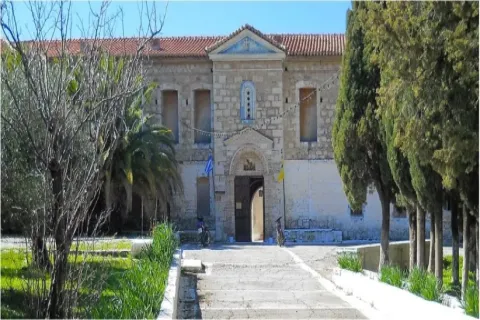
At the highest part of Lekka stands the impressive parish Church of Agios Ioannis Prodromos.
The church is dedicated to the Beheading of Saint John the Baptist and celebrates on 29 August.
Construction began around 1845, with significant participation and voluntary labour from local residents, and was completed in 1863.
It is a large three-aisled basilica without a dome, covered by a double-pitched tiled roof.
The three aisles are dedicated to:
✅ Agios Ioannis Prodromos
✅ Agios Dimitrios
✅ The Holy Archangels
The church is approximately 36 metres long, around 16 metres wide and has a total covered area of roughly 600 square metres.
🪨 The marble bell tower
One of the most impressive architectural elements of the church is its elaborate marble bell tower.
Its craftsmanship is associated with the great tradition of marble artisans from Tinos who worked in Smyrna.
Originally, the bell tower had eight bells of Russian origin, six of which survive today.
The powerful and distinctive sound of the bells became so strongly associated with the village that the residents of Lekka were once nicknamed “Kampanarides”, meaning “the bell people”.
🎨 The marble iconostasis and the interior
The interior of Agios Ioannis Prodromos is of considerable artistic interest.
The present marble iconostasis was created in 1914 in the marble workshop of the Tinian artist Nikolaos Perakis in Smyrna.
The previous wooden carved iconostasis had been made in 1871 and was later transferred to the chapel of Agios Nikolaos in Lekka.
The interior is also characterised by:
✅ Decorated wooden ceiling
✅ Plaster cornices
✅ Painted representations
✅ Rich collection of icons
✅ Carved wooden episcopal throne
✅ Marble architectural elements
✅ Old liturgical objects
The columns dividing the aisles have an inner core made from cypress trunks and an outer finish that gives them the appearance of marble columns.
🕯️ The sacred relic of Saint John
A relic preserved inside the church and associated with the Holy Head of Saint John the Baptist has particular religious significance.
According to local ecclesiastical tradition, the fragment was brought from the Holy Land and acquired by the residents of Lekka through a substantial offering of olive oil.
The relic remains one of the most important religious treasures of the village and is closely connected with the special devotion of the residents to Saint John.
📚 The historic church library
The church also preserves a small but particularly interesting collection of old ecclesiastical books.
A total of 47 printed books survive, mainly liturgical and musical works, dating from 1749 to 1900.
The collection is an important testimony to the religious and intellectual life of Lekka during the 18th and 19th centuries.
🎉 The festival of 29 August
The largest religious and social event in Lekka takes place on 29 August, the day of the Beheading of Saint John the Baptist.
The celebration attracts residents, people originally from the village and visitors from many areas of Samos.
Agios Ioannis is deeply connected with the identity of the village, and the church remains the main point of reference for the people of Lekka.
⛪ The rural chapels of Lekka
The wider area contains a large number of small churches and rural chapels.
Local tradition records approximately 21 chapels, scattered among olive groves, agricultural land and hillsides.
Their presence reflects the close connection between agricultural life and religious tradition.
Many of these chapels are destinations for short walks and local religious celebrations.
🌿 Agricultural landscape and cultivation
The economy of Lekka was based on agriculture for centuries.
The most important crops include:
✅ Vineyards
✅ Olive trees
✅ Fruit trees
✅ Vegetables
✅ Figs
✅ Pomegranates
✅ Small family gardens
In the past, carob trees were also cultivated, with their fruit used among other things as animal feed.
The old stone terraces on the slopes around the village are a characteristic feature of the traditional agricultural shaping of the landscape.
🍇 Viticulture and Samian wine
Viticulture held an important place in the economic history of Lekka.
The shape of the slopes, abundant sunshine and local microclimate allowed vineyards to develop on small terraces.
The cultivation of White Muscat connects the village with the wider wine tradition of Samos.
Traditional products associated with the grape harvest include:
✅ Grape must
✅ Petimezi grape syrup
✅ Moustalevria
✅ Grape-must pie
✅ Grape preserves
✅ Souma
✅ Local wine
🍽️ Local flavours
The traditional cuisine of Lekka reflects the agricultural character of the area.
Everyday meals historically relied mainly on products produced by local families themselves:
✅ Olive oil
✅ Olives
✅ Wild greens
✅ Vegetables
✅ Pulses
✅ Grapes
✅ Seasonal fruit
✅ Honey
✅ Wine
✅ Souma
Sweets made from grapes and grape must are a characteristic part of the local culinary tradition.
🌿 The connection with Kerkis
Lekka lies on the eastern side of the Kerkis mountain system and forms a transition between the plain of Karlovasi and the steeper western mountain regions.
In the interior, visitors encounter:
✅ Forested slopes
✅ Old agricultural roads
✅ Streams
✅ Olive groves
✅ Vineyards
✅ Small valleys
✅ Areas with abundant water
Vegetation becomes noticeably denser in lower valleys and around streams.
🏘️ Agios Panteleimon
Approximately 1.5 kilometres northwest of Lekka lies the small settlement of Agios Panteleimon.
Its former name was Tsourlaioi, and it was officially renamed Agios Panteleimon in 1940.
The settlement developed close to the bed of the Kastania stream, in an area with:
✅ Abundant water
✅ Dense vegetation
✅ Fruit trees
✅ Steep slopes
✅ Agricultural cultivation
✅ A particularly peaceful natural environment
Historically, the area was also known for the production of large, high-quality pomegranates.
🌊 The connection with Potami of Karlovasi
From the area of Lekka and Agios Panteleimon there is a natural and historic connection with the valley descending towards Potami of Karlovasi.
Agricultural and dirt roads lead towards:
✅ Agios Panteleimon
✅ Kastania stream
✅ Potami area
✅ Potami Waterfalls
✅ Potami Beach
The route passes through dense vegetation and is particularly interesting for visitors who want to explore the interior of the area beyond the paved road network.
🚶 Walking and hiking
Lekka is better suited to relaxed walking and rural routes than to organised mountain tourism.
Visitors can explore:
✅ The village lanes
✅ The area around the square
✅ The route towards Agios Ioannis Prodromos
✅ Small agricultural roads
✅ Olive groves and vineyards
✅ The route towards Agios Panteleimon
✅ The wider Potami area
Dirt and agricultural roads require greater caution after rainfall.
🏙️ The connection with Karlovasi
Lekka lies only about 4 kilometres from Karlovasi and has historically maintained close economic and social ties with the town.
The short distance provides easy access to:
✅ Public services
✅ Banks
✅ Pharmacies
✅ Healthcare services
✅ Schools
✅ University facilities
✅ Shops
✅ Supermarkets
✅ Restaurants and cafés
✅ Karlovasi Port
This proximity allows Lekka to retain the character of a traditional village without being isolated from essential services.
🛏️ Infrastructure and everyday services
The village provides basic everyday services and traditional social meeting places.
Lekka is not an organised tourist resort, and accommodation within the village itself is limited.
For a wider selection of accommodation, dining and shopping, Karlovasi is only a short distance away.
The absence of intense tourist development is an important part of the village’s quiet character.
📸 Photography and views
The amphitheatrical position of Lekka offers several particularly interesting photographic viewpoints.
Highlights include:
✅ The tiled roofs of the village
✅ Old houses
✅ Narrow lanes
✅ The square and plane tree
✅ Agios Ioannis Prodromos
✅ The marble bell tower
✅ Olive groves and vineyards
✅ Views towards Karlovasi
✅ The northern coast
✅ The Aegean Sea
From the higher parts of the village, the view is particularly open and offers one of the best panoramic perspectives over the wider Karlovasi area.
🌿 What to see
During a visit to the Municipal Community of Lekka, it is worth seeing:
✅ The traditional settlement
✅ The central square
✅ The large plane tree
✅ Old houses and mansions
✅ Traditional lanes
✅ The Church of Agios Ioannis Prodromos
✅ The marble bell tower
✅ The marble iconostasis
✅ The rural chapels of the area
✅ Vineyards and olive groves
✅ Viewpoints towards Karlovasi
✅ Agios Panteleimon
✅ The rural route towards Potami
🚗 Suggested routes
The location of Lekka allows several interesting combinations:
✅ Karlovasi – Lekka: A short ascent from the town to a traditional village with panoramic views.
✅ Lekka – Agios Panteleimon: A short route towards the second settlement of the community.
✅ Lekka – Agios Panteleimon – Potami: A route from the village towards the lush valley and northern coast.
✅ Lekka – Kastania: Exploration of two mountain villages of western Samos.
✅ Karlovasi – Lekka – Potami: A combination of town, traditional village and natural landscape.
🚶 Visitor experience
For a basic exploration of Lekka, approximately one to two hours are sufficient.
A visit can include:
✅ Walking through the lanes
✅ A stop in the square
✅ A visit to Agios Ioannis
✅ Photography of the views
✅ A short exploration of the surrounding agricultural area
By adding Agios Panteleimon or continuing towards Potami, a half-day itinerary can easily be created.
Lekka is suitable for visitors interested in traditional architecture, history, religious heritage, local life and a peaceful natural environment.
📆 When to visit
Spring: An excellent period for green landscapes, flowering courtyards, walks and photography.
Summer: Ideal for an afternoon visit, when temperatures drop and the square becomes more lively.
29 August: The most important feast day of the village, dedicated to Agios Ioannis Prodromos.
Late summer: Grape and harvest season, particularly interesting for the agricultural character of the area.
Autumn: Suitable for peaceful exploration and routes through olive groves and vineyards.
Winter: A very quiet period, with greener landscapes and increased water flow in the streams.
Morning: Suitable for walks and agricultural routes.
Afternoon: Ideal for the square and the views towards Karlovasi and the Aegean Sea.
🧭 How to get there
Lekka is easily accessible from Karlovasi via a paved road.
The route gradually climbs from the lowland area towards the foothills of Kerkis and has several bends in the final kilometres.
Indicative distances:
✅ Approximately 4 kilometres from the centre of Karlovasi
✅ Approximately 4.8 kilometres from Karlovasi Port
✅ Approximately 9 kilometres from Marathokampos
✅ Approximately 33 kilometres from the airport
✅ Approximately 35 kilometres from the town of Samos
Access is straightforward with a standard car.
The roads in the central part of the village are narrower, so it is more practical to park in an available area before entering the narrow lanes and continue exploring on foot.
ℹ️ Useful information
✅ Village name: Lekka
✅ Administrative name: Municipal Community of Lekka
✅ Geographical category: Community
✅ Character: Traditional mountain and agricultural village
✅ Location: Northwestern Samos
✅ Mountain massif: Kerkis – Kerketeas
✅ Position: Northeastern foothills of Kerkis
✅ Elevation: Approximately 200 metres
✅ Municipal Unit: Karlovasia
✅ Municipality: Western Samos
✅ Regional Unit: Samos
✅ Region: North Aegean
✅ Establishment of the Community of Lekka: 21 September 1918
✅ Official settlements of the community: Lekka and Agios Panteleimon
✅ Population of the Municipal Community in 2021: 424 residents
✅ Main parish church: Agios Ioannis Prodromos
✅ Beginning of church construction: Around 1845
✅ Completion of church: 1863
✅ Architectural type: Three-aisled basilica without a dome
✅ Marble iconostasis: 1914
✅ Feast day: 29 August
✅ Number of rural chapels in the wider area: Approximately 21
✅ Main traditional crops: Vineyards, olives and vegetables
✅ Main agricultural products: Olive oil and grapes
✅ Nearest major urban centre: Karlovasi
✅ Nearby settlement of the community: Agios Panteleimon
✅ Nearby natural area: Potami of Karlovasi
✅ Road access: Paved
✅ Recommended time in the village: 1–2 hours
✅ Recommended time including Agios Panteleimon and Potami: Half a day
✅ Suitable for: Traditional village exploration, history, religious interest, photography, gastronomy, agricultural landscapes and peaceful walks



Add new comment