
Ormos Marathokampou of Samos
⚓ Ormos Marathokampos, Samos – The Historic Port with a Shipbuilding Tradition
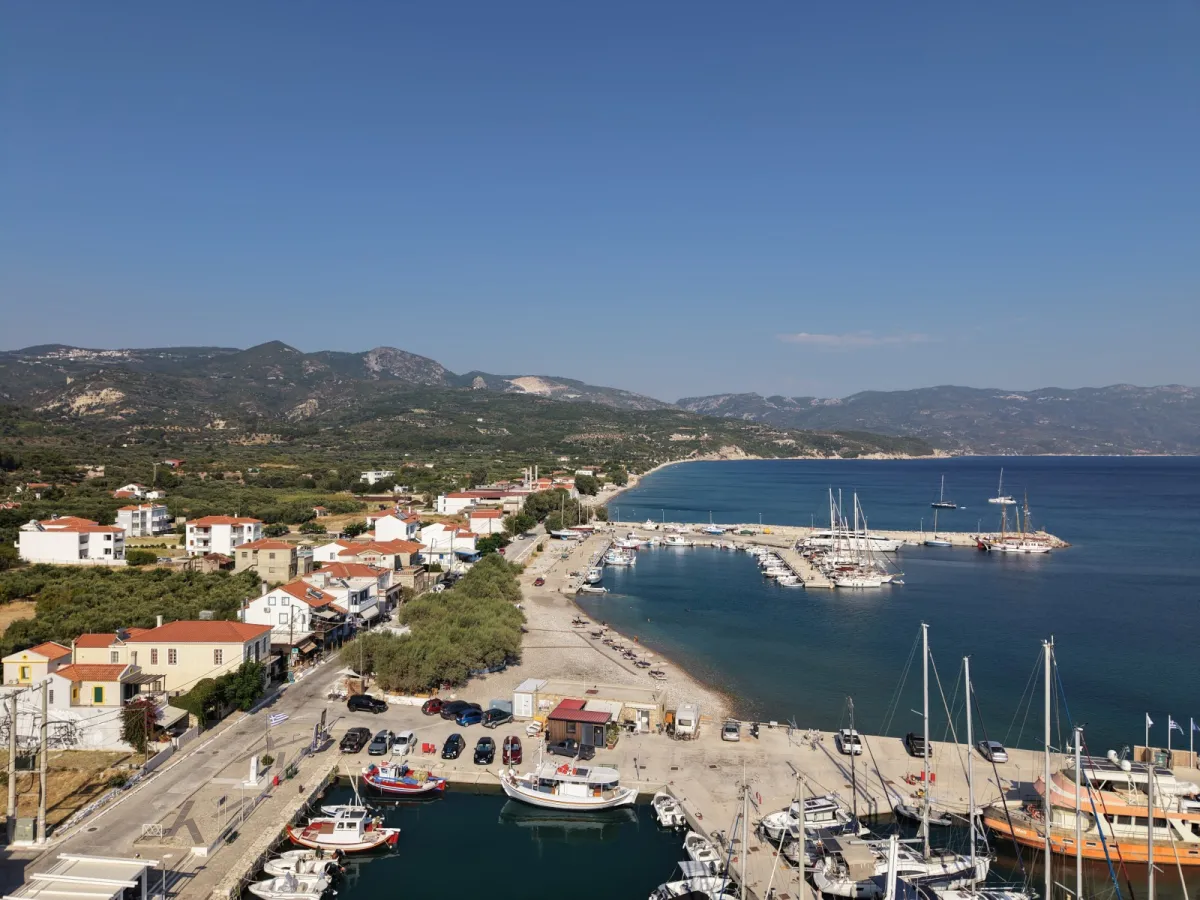
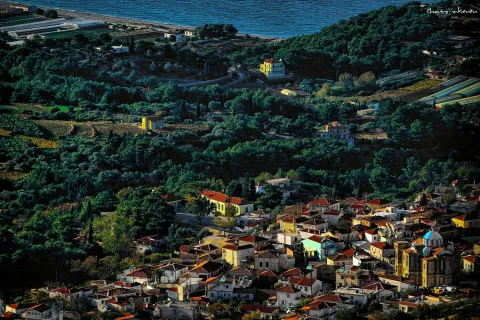
Ormos Marathokampos is a coastal settlement in southwestern Samos and the historic seaport of the village of Marathokampos. It extends along a small bay, with the imposing mountain mass of Kerkis rising in the background and the sea defining the settlement’s appearance, history and everyday life.
The harbour, fishing boats, low houses, waterfront road, Church of Agios Nikolaos and murals inspired by maritime life create a settlement with a strong seafaring identity. At the same time, accommodation, dining establishments and the proximity of the beaches of Kampos Marathokampos have strengthened its tourism character without erasing the atmosphere of the old fishing village.
According to the 2021 census, Ormos Marathokampos has 231 permanent residents. Administratively, it belongs to the Municipal Community of Marathokampos, the Municipal Unit of Marathokampos and the Municipality of Western Samos. The municipality forms part of the Regional Unit of Samos in the North Aegean Region.
📍 Location and Character
The settlement lies on the southern coast of western Samos, approximately 4.5 kilometres downhill from the village of Marathokampos. It is built almost at sea level along a coastal zone partly sheltered by the surrounding shoreline and low hills.
To the north, the slopes and foothills of Mount Kerkis dominate the landscape. To the east and west lie small beaches, olive groves, cultivated land and the coastal areas of Kampos, Velanidia and Limnionas. The island of Samiopoula can be seen to the south, while the open view across the southern Aegean is one of the area’s defining features.
📝 The Former Names “Spilia” and “Gialos”
The area was formerly known as “Spilia”. As the harbour developed and a permanent settlement gradually formed, the name Ormos Marathokampos—or simply Ormos—became established.
The name “Gialos” was also used in everyday local speech, referring to the coastal area and the old harbour. The name remains part of the settlement’s contemporary cultural identity through the Gialos Festival.
📜 The Commercial Port of Southwestern Samos
From the 18th century until the end of the 19th century, the harbour of Ormos was one of the most important transport and commercial centres in southwestern Samos. Passengers and goods travelled through the port towards the islands of the southeastern Aegean and the coast of Asia Minor.
Olive oil, wine, soap, charcoal, onions, fruit and other agricultural or craft products were shipped from the harbour. A port authority, quarantine station, customs office, approximately fifty warehouses and workshops connected with shipping and boat maintenance operated there to support this activity.
🏘️ From a Working Harbour to a Permanent Settlement
Despite the harbour’s intense commercial activity, Ormos did not have a substantial permanent population for a long period. Workers travelled down from Marathokampos and the surrounding villages in the morning and returned before nightfall because the coastal location remained exposed to the danger of pirate raids.
Permanent settlement increased mainly towards the end of the 19th century, after the threat of piracy had declined. Houses, workshops, warehouses and shops gradually appeared around the harbour, forming the coastal settlement visible today.
🧭 The Account of Karl Krumbacher
The German Byzantinist and traveller Karl Krumbacher passed through Ormos in February 1885 during a journey towards Patmos.
In his travel account, he referred to the stone-paved road connecting Marathokampos with the harbour, the port works then under construction and a soap-making workshop. His observations record the appearance of an active commercial harbour undergoing further development.
⚓ The Construction and Development of the Harbour
The first organised harbour works probably date from the middle of the 19th century. The original harbour included a quay and two piers used for loading and unloading traditional boats, although it did not always provide sufficient protection from strong southerly winds.
During severe weather, vessels sought safer anchorage in the natural bay of Makria Punta, southwest of the settlement. In September 1944, during the withdrawal of German forces from Samos, a large section of the western pier was destroyed by explosives.
During the 1960s, large concrete blocks were placed over the foundations of the old breakwater. More recent improvement works began in 2010 and were completed in 2017, forming the present harbour with mooring spaces and a fishing shelter.
🛶 The Tradition of Wooden Shipbuilding
Ormos was an important centre of traditional wooden shipbuilding. Traditional boats and merchant vessels were built and repaired in its shipyards, using timber from the forests of Samos, particularly the wider area around Mount Kerkis.
Organised wooden boat construction is believed to have begun around 1720, when craftsmen from Patmos brought their knowledge and techniques to the area. The activity continued until approximately the 1970s, leaving a lasting mark on the maritime history and identity of the settlement.
Shipwrights, sailors, fishermen and merchants were among the principal professions of the local community. Even after wooden shipbuilding declined, the memory of the traditional shipyards remained alive through personal accounts, photographs, tools and artistic representations.
🏘️ The Settlement Today
Ormos extends in a linear pattern along the sea and around the harbour. In the older part of the settlement, visitors can see low houses, narrow passages, small courtyards and buildings connected with its former commercial and maritime activity.
The waterfront road serves as the main axis of the settlement. Homes, small shops, accommodation and places to eat are located close to the water, creating a compact destination that is easy to explore on foot.
The appearance of Ormos is not dominated by large hotel complexes or dense urban development. It retains the character of a small coastal village, with increased activity during summer and a quieter daily rhythm in winter.
🛥️ The Present Harbour and Fishing Shelter
The harbour remains the central landmark of the settlement. It accommodates fishing vessels, small commercial boats, sailing boats and recreational craft, while the breakwater provides a pleasant place for walking and viewing the bay.
Fishing continues to form part of local life, although the economy now depends more heavily on tourism and services. During the early morning, visitors may see fishermen returning, arranging their nets and carrying out maintenance work on their boats.
⛪ The Church of Agios Nikolaos
Agios Nikolaos is the parish church of Ormos and is closely connected with the settlement’s maritime tradition. The older church was formerly a dependency of the Monastery of Koutloumousiou on Mount Athos.
A marble inscription states that the church was completed in 1772 at the expense of the people of Marathokampos and the shipowner Manolis Panakis. To the east of the church, remains can be seen of the building in which the monks lived, together with elements of an old aqueduct and fountain.
In 1962, the church underwent complete reconstruction and acquired its present form. The feast of Agios Nikolaos on 6 December has particular importance for the sailors, fishermen and residents of Ormos.
🏖️ Ormos Beach
At the eastern end of the settlement, beside the harbour’s small pier, lies Ormos Beach. It is approximately 85 metres long and consists mainly of pebbles, with several sandy sections.
The water is usually calm because of the beach’s sheltered position. Access is easy, and dining establishments and basic services are available within a short walking distance. It is primarily a beach used by residents and visitors staying in the settlement rather than a large organised coastal resort.
Farther east, the coastal zone continues towards Favrikia and Velanidia. To the west begins the wider tourist area of Kampos Marathokampos and Votsalakia.
🎨 The Maritime Murals
One of the most recognisable contemporary features of Ormos is its collection of large murals and street-art works depicting scenes from the lives of sailors, fishermen and traditional shipwrights.
A large image of a fisherman repairing his nets stands out on the breakwater. Other works on walls throughout the settlement portray old boats, craftsmen and scenes from the period of intense maritime activity.
The murals are more than decorative works. They form an open-air route of memory, connecting the present appearance of the village with the history of its harbour and traditional shipyards.
🫒 Trade, Agriculture and Soap Production
The economic history of Ormos was closely connected with the agricultural production of Marathokampos and southwestern Samos. Olive oil, wine, soap, charcoal, farm products and timber were transported from the inland area to the harbour for storage and shipment.
Soap production was an important local industry and was directly connected with olive-oil production. The former workshops and small industrial facilities show that Ormos was not only a fishing village but also an active production and commercial centre.
🎭 Cultural and Social Life
The Ormos Marathokampos Cultural and Improvement Association “Agios Nikolaos” organises events combining music, maritime tradition and local customs.
The Gialos Festival has developed into a multi-day event featuring music seminars, concerts and cultural activities, attracting artists and participants from Greece and other countries.
Other established local events include the Wine Festival in August, the revival of the Klidonas custom in June and the Koulouma celebrations on Clean Monday. Dates and programmes may change each year.
🌿 The Surrounding Area
Ormos is a suitable starting point for exploring southwestern Samos. The historic village of Marathokampos lies a short distance away on the slopes of Mount Kerkis, together with the coastal zone of Kampos and Votsalakia.
To the west are Limnionas, Agia Kyriaki and the more remote beaches beneath Mount Kerkis. To the east are Velanidia, Makria Punta, Kaladakia and the coastline towards Koumeika.
The landscape combines the sea, olive groves, low hills and the imposing mountain mass of Kerkis. The contrast between the mountain and the southern coast is one of the most characteristic features of the wider area.
🌿 What to See
During your visit to Ormos Marathokampos, take time to discover:
✅ The historic harbour and fishing shelter
✅ The waterfront road and the old residential centre
✅ The Church of Agios Nikolaos
✅ The remains of the former monastic dependency and fountain
✅ The maritime murals along the streets
✅ The large fisherman mural on the breakwater
✅ The locations associated with the traditional shipyards
✅ The beach beside the harbour
✅ The view towards Samiopoula and the southern Aegean
✅ The fishing boats and sailing vessels in the harbour
✅ The coastal routes towards Velanidia and Kampos
✅ The nearby village of Marathokampos
🚶 The Visitor Experience
A visit can begin at the Church of Agios Nikolaos and continue along the waterfront towards the harbour. From there, visitors can walk along the breakwater, observe the boats and look for the maritime murals.
The settlement is compact, and its principal points of interest are within a short distance of one another. Approximately 60–90 minutes are sufficient for a relaxed walk around the harbour, church, murals and beach.
A visit can last longer when combined with a meal, swimming or a drive towards Kampos Marathokampos and the neighbouring beaches.
📆 When to Visit
Spring: A suitable season for walking, mild temperatures and exploring the surrounding area.
Summer: The settlement becomes livelier, seasonal businesses are open and most cultural events take place.
Morning: The best time to observe fishing activity and everyday life around the harbour.
Late afternoon: An ideal time for walking along the breakwater and taking photographs.
Autumn: The area becomes quieter and remains suitable for exploring and swimming when weather conditions allow.
Winter: Ormos retains a permanent community, although many tourist services operate on a limited basis.
🧭 How to Get There
Ormos Marathokampos is accessible by paved road from Karlovasi, Marathokampos and the other areas of southwestern Samos.
The settlement lies approximately 4.5 kilometres from Marathokampos, 16.5 kilometres from Karlovasi, 33 kilometres from Pythagoreio and 46 kilometres from Samos Town.
The roads are suitable for a conventional car, although journeys from eastern Samos require time because of the distance and numerous bends. Parking spaces inside the settlement are limited, particularly during the summer months and on event days.
ℹ️ Useful Information
✅ Official name: Ormos Marathokampos
✅ Short local name: Ormos
✅ Former names: Spilia and Gialos
✅ Character: Coastal, historic and fishing settlement
✅ Historic role: Seaport and commercial harbour of Marathokampos
✅ Administrative community: Municipal Community of Marathokampos
✅ Municipal unit: Marathokampos
✅ Municipality: Western Samos
✅ Regional unit: Samos
✅ Region: North Aegean
✅ Population in 2021: 231 residents
✅ Population in 2011: 210 residents
✅ Altitude: Approximately 10 metres
✅ Period of harbour development: 18th–19th century
✅ Beginning of traditional shipbuilding: Approximately 1720
✅ Decline of wooden shipbuilding: Around the 1970s
✅ Parish church: Agios Nikolaos
✅ Completion of the older church: 1772
✅ Complete reconstruction of the church: 1962
✅ Completion of the latest harbour works: 2017
✅ Settlement beach: Pebbles with several sandy sections
✅ Beach length: Approximately 85 metres
✅ Main activities: Tourism, fishing, dining and services
✅ Main events: Gialos Festival, Wine Festival, Klidonas and Koulouma
✅ Distance from Marathokampos: Approximately 4.5 kilometres
✅ Distance from Karlovasi: Approximately 16.5 kilometres
✅ Distance from Pythagoreio: Approximately 33 kilometres
✅ Distance from Samos Town: Approximately 46 kilometres
✅ Postal code: 83200
✅ GPS coordinates: 37.7099, 26.6994
✅ Road access: Paved road
✅ Exploration: Easy and mainly on foot
✅ Suggested visiting time: Approximately 60 minutes–3 hours
✅ Ideal for: Maritime history, traditional wooden shipbuilding, photography, walking, dining and swimming


Add new comment