
Mavratzaioi of Samos
🏺 Mavratzaioi, Samos – The Historic Pottery Community and the Monastery of the Holy Cross
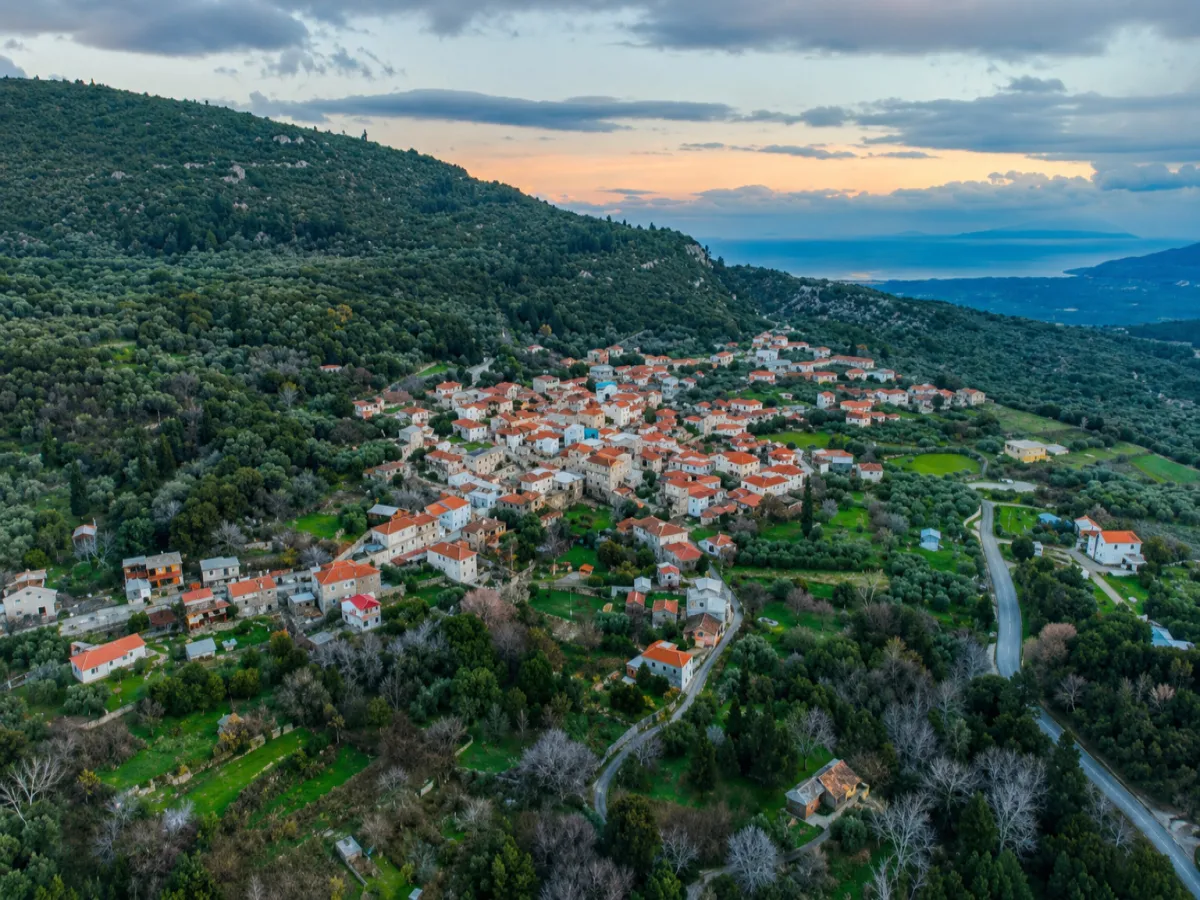
The Municipal Community of Mavratzaioi is a historic semi-mountainous community in the central part of Samos. Its administrative seat, the village of Mavratzaioi, is built on the southeastern slopes of Mount Ampelos, also known as Karvounis. The village stands out for its traditional architecture, stone-paved lanes, agricultural character and important pottery tradition, which developed particularly from the late 19th century onwards.
A visit combines exploration of a peaceful Samian village, an introduction to the history of local ceramics and a visit to the historic Monastery of the Holy Cross. The village also preserves religious monuments, old neighbourhoods and a small museum displaying objects connected with the daily and productive life of its residents.
According to the 2021 census, the village of Mavratzaioi has 230 permanent residents. It is the administrative seat of the Municipal Community of Mavratzaioi, which also includes the settlements of Gionides and the Monastery of the Holy Cross. The community belongs to the Municipal Unit of Pythagoreio within the Municipality of Eastern Samos.
📍 Location and Natural Environment
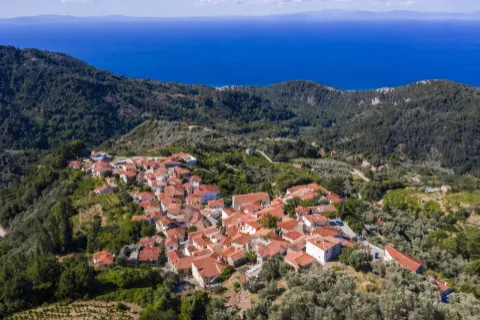
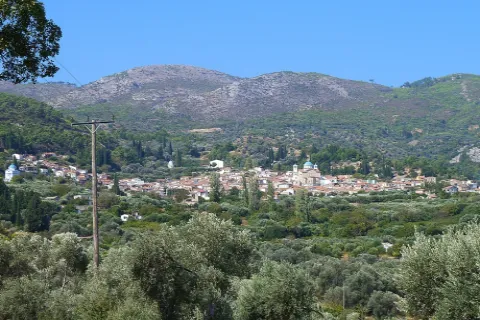
The village of Mavratzaioi lies on the southeastern foothills of Mount Karvounis, at an altitude of approximately 260 metres. It is surrounded by olive groves, cultivated land, low hills and forest vegetation.
Its location offers views towards the mountainous interior and the plain of southern Samos, without the pronounced coastal character of other communities on the island. The peaceful atmosphere, vegetation and gently sloping terrain create suitable conditions for exploration, photography and contact with the agricultural life of Samos.
📝 The Former Name of the Village
The village was already mentioned at the beginning of the 18th century under the name Gaitani. Local tradition connects the earlier names “Gaitanides” or “Gaitankioi” with a resident of the area who bore the first name or surname Gaitanos.
The present name is attributed to the arrival of the family of Georgios Mavratza, whose surname eventually developed into the place name Mavratzaioi. The new name had already become established when the village was officially recognised as the seat of a community in 1918.
📜 The Development of the Village
During the 19th century, Mavratzaioi developed into an organised agricultural village with churches, a school and productive activities. Agriculture formed the basis of the local economy, while the abundance of suitable clay allowed an important pottery industry to develop.
Ceramic production strengthened the village economy and made Mavratzaioi known throughout Samos. For several decades, the village’s earthenware vessels were used in homes, farms and the everyday activities of residents across the island.
🏛️ Administrative Development
The Community of Mavratzaioi was officially established on 21 September 1918, with the village of Mavratzaioi as its administrative seat. In 1920, the settlement of the Monastery of the Holy Cross was incorporated into the community, while Gionides was officially recognised and added in 1971.
Under the Kapodistrias administrative reform of 1997, the community became part of the Municipality of Pythagoreio. In 2010, it was incorporated into the unified Municipality of Samos and, since 2019, has belonged to the Municipality of Eastern Samos.
👥 Population and Settlements of the Community
In the 2011 census, the village of Mavratzaioi had 190 residents, Gionides had 51 and the Monastery of the Holy Cross had 3, giving the community a total population of 244.
In 2021, 230 permanent residents were recorded in Mavratzaioi and 37 in Gionides, while no permanent population was recorded at the Monastery of the Holy Cross for census purposes. The total population of the Municipal Community of Mavratzaioi was 267 permanent residents.
🏘️ The Form of the Village
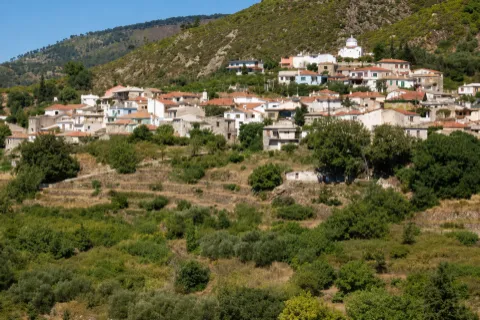
Mavratzaioi has a compact layout, with houses built around the square, the main roads and the older neighbourhoods. Traditional residences with stone foundations, tiled roofs, wooden doors and windows, external staircases and flower-filled courtyards have been preserved.
The narrow streets and stone-paved lanes display the simple architecture of the Samian countryside. The traditional core of the village is protected by special building regulations intended to preserve its form and architectural character.
🏺 The Pottery Tradition
The systematic development of pottery in Mavratzaioi dates to the late 19th century. The area known as Kokkinopouria, close to the village, contained considerable deposits of suitable clay that were used as the primary raw material.
The potters prepared the clay and shaped it on their wheels to create practical everyday objects. Production in Mavratzaioi, together with the pottery workshops of Karlovasi, met a large proportion of the ceramic needs of the entire island.
🫗 Traditional Ceramic Products
The workshops produced water jugs and pitchers for transporting and storing water, basins for kneading dough, cooking pots, plates, cups, storage vessels and large earthenware jars.
The craftsmen also produced vases, decorative objects and clay toys for children. Their shapes and sizes were adapted to the needs of Samian households, agriculture and daily life.
🔥 Pottery Workshops and Kilns
During the period of greatest prosperity, approximately 23 pottery workshops operated in Mavratzaioi. Most were located around the outskirts of the village so that smoke from the kilns used to fire the clay would not affect the residential neighbourhoods.
Production involved preparing and cleaning the clay, shaping it on the potter’s wheel, allowing it to dry naturally and firing it at high temperatures. Technical knowledge was generally passed from one generation to the next within pottery families.
📉 The Decline of Ceramic Production
Traditional production began to decline during the middle of the 20th century. The expansion of water-supply networks reduced the need for large clay water jugs, while metal and especially plastic household items replaced many handmade ceramic vessels.
Most workshops closed and the large-scale production of practical earthenware came to an end. The pottery tradition is preserved today mainly through old objects, photographs, tools, residents’ accounts and the collections of the village’s small museum.
🏛️ The Folklore and Ceramics Museum
A small folklore and ceramics collection is housed in the former school of Mavratzaioi and is dedicated to the social and productive history of the village.
The exhibits include traditional earthenware vessels, potters’ tools, old photographs, household objects and items associated with local customs and traditions. The collection helps visitors understand how pottery became closely connected with the economy and daily life of the residents.
⛪ The Parish Church of Agios Georgios
The parish church of Mavratzaioi is dedicated to Agios Georgios. It was rebuilt from its foundations in 1901 under the architectural supervision of Theofanis, the abbot of the Monastery of the Holy Cross.
In 1903, the Parliament of the Principality of Samos approved the issue of a special lottery to financially support the completion of the church. Agios Georgios remains the principal centre of the village’s religious life.
⛪ The Church of Agios Spyridonas
Approximately one kilometre before reaching the village stands the Church of Agios Spyridonas, which was built around 1900 under the supervision of Abbot Theofanis Arelis.
Its marble iconostasis stands out in the interior, while the grounds include a landscaped courtyard with a fountain. Its roadside location makes it easy to visit while travelling towards Mavratzaioi.
🌿 The Agricultural Economy
Agriculture has always been one of the main activities of the community’s residents, particularly olive cultivation and olive-oil production. The surrounding area also contains vineyards, fruit trees, vegetable gardens and small livestock holdings.
The rural roads around the village pass through cultivated hillsides and regenerated forest vegetation, creating attractive routes for peaceful exploration.
🔥 The Wildfires of 2000
The major wildfires of 2000 seriously affected the Mavratzaioi area, destroying cultivated land, natural vegetation and several houses on the outskirts of the village.
The local economy and many families were significantly affected, although much of the natural landscape gradually regenerated. The traces of the fire form part of the modern history of the community and the wider Karvounis area.
📚 Folklorist Nikolaos Dimitriou
Mavratzaioi was the birthplace of the teacher, writer and folklorist Nikolaos Dimitriou, who lived from 1897 to 1996.
His work is an important source of information about traditional Samian society, agricultural activities, professions, customs and everyday life in the island’s villages.
🌿 The Settlement of Gionides
Gionides is a small settlement belonging to the Municipal Community of Mavratzaioi. It lies approximately two kilometres south of the village, close to the provincial road connecting Pythagoreio with Karlovasi.
Its location provides convenient access to Mavratzaioi and the Monastery of the Holy Cross. According to the 2021 census, Gionides had 37 permanent residents.
⛪ The Monastery of the Holy Cross
The Monastery of the Holy Cross lies south of and below Mavratzaioi, close to the Chora Plain, at an altitude of approximately 200 metres. It is one of the most important historic monasteries of Samos and belongs to the Holy Metropolis of Samos, Ikaria and Korseoi.
The monastery was founded in 1592 by the monk Neilos, one of the founders of the Monastery of Megali Panagia. According to ecclesiastical tradition, Neilos discovered an icon of the Exaltation of the Holy Cross in the area and built a small church at the site.
📜 The Development of the Monastery
The original chapel was enlarged in 1604, and an organised monastic complex gradually developed around it. The monastery acquired considerable importance and attracted pilgrims from Samos and the Greek communities along the opposite coast of Asia Minor.
The older church gradually developed serious structural problems and damage, leading to the decision to construct a new katholikon during the 19th century.
🏛️ The 19th-Century Katholikon
Construction of the new katholikon began in 1838 on the initiative of Abbot Grigorios and with financial support from the residents of Samos.
The church was completed within a short period and designed as an imposing three-aisled domed basilica with a two-storey narthex. The right aisle was dedicated to Saint John the Forerunner and the left aisle to the Life-Giving Spring.
🎨 The Iconostasis and Interior Decoration
The katholikon contains an elaborate 19th-century carved wooden iconostasis decorated with plant motifs and scenes from the Old and New Testaments. It was created by craftsmen from Chios in 1854.
Other important features include the carved wooden pulpit of 1843, the episcopal throne of 1844, the marble floor with the double-headed eagle and two historic chandeliers. Parts of the church were decorated with folk-style wall paintings in 1848.
✨ The Monastery’s Sacred Relics
The sacristy contains ecclesiastical vessels, icons and historic offerings. Among the monastery’s most important sacred objects is a liturgical asterisk containing a fragment of the True Cross.
Some of the monastery’s historic objects have been transferred to the Ecclesiastical and Byzantine Museum of Samos for protection and exhibition.
🙏 The Monastery’s Feast Days
The principal feast is held on 14 September, during the celebration of the Exaltation of the Holy Cross. It is one of the most important island-wide pilgrimages on Samos and attracts worshippers from throughout the island.
The monastery is also known among the people of Samos as the “Great Cross”, a name that reflects its prominent place in the island’s religious tradition.
🌿 What to See
During your visit to the Municipal Community of Mavratzaioi, take time to discover:
✅ The village square and old neighbourhoods
✅ The stone-paved lanes and traditional houses
✅ The Folklore and Ceramics Museum
✅ The earthenware vessels and potters’ tools
✅ The parish Church of Agios Georgios
✅ The Church of Agios Spyridonas
✅ The area where the old pottery workshops once operated
✅ The olive groves and rural routes around the village
✅ The settlement of Gionides
✅ The Monastery of the Holy Cross
✅ The carved wooden iconostasis and sacred objects of the monastery
✅ The major feast held on 14 September
🚶 The Visitor Experience
A visit can begin in the village square and continue through the old lanes, to the Church of Agios Georgios and the Folklore and Ceramics Museum.
Visitors can then continue towards Agios Spyridonas, Gionides and the Monastery of the Holy Cross. Approximately 45–60 minutes are sufficient for a basic walk through the village, while a visit including the museum and monastery can take two to three hours.
📆 When to Visit
Spring: An ideal season for green landscapes, flowering courtyards, mild temperatures and walks along the rural roads.
Feast of Agios Georgios: A suitable time to experience the religious and social life of the village.
Summer: Morning and late-afternoon visits are preferable, particularly for walking through the village lanes.
14 September: The most important date for visiting the Monastery of the Holy Cross because of its major annual celebration.
Autumn: Suitable for photography, rural scenery and peaceful exploration among the olive groves.
🧭 How to Get There
Mavratzaioi is accessible by a paved road that climbs gently from the Pythagoreio–Karlovasi provincial road. The route is suitable for a conventional car.
The village lies approximately 11 kilometres from Pythagoreio, 24 kilometres from Samos Town, 29 kilometres from Karlovasi and 26 kilometres from Marathokampos. The Monastery of the Holy Cross is approximately two kilometres south of the village.
ℹ️ Useful Information
✅ Official name: Municipal Community of Mavratzaioi
✅ Character: Historic semi-mountainous agricultural community
✅ Location: Southeastern slopes of Mount Karvounis
✅ Altitude of the main village: Approximately 260 metres
✅ Seat of the community: Mavratzaioi
✅ Settlements within the community: Mavratzaioi, Gionides and the Monastery of the Holy Cross
✅ Municipal unit: Pythagoreio
✅ Municipality: Eastern Samos
✅ Regional unit: Samos
✅ Region: North Aegean
✅ Establishment of the community: 21 September 1918
✅ Population of Mavratzaioi in 2021: 230 permanent residents
✅ Total population of the community in 2021: 267 permanent residents
✅ Traditional craft: Pottery and ceramics
✅ Historic pottery workshops: Approximately 23
✅ Main agricultural activity: Olive cultivation
✅ Parish church: Agios Georgios
✅ Museum: Folklore and Ceramics Museum
✅ Nearby monastery: Monastery of the Holy Cross
✅ Year the monastery was founded: 1592
✅ Principal monastery feast: 14 September
✅ Distance from Pythagoreio: Approximately 11 kilometres
✅ Distance from Samos Town: Approximately 24 kilometres
✅ Distance from Karlovasi: Approximately 29 kilometres
✅ Distance from Marathokampos: Approximately 26 kilometres
✅ Postal code: 83103
✅ GPS coordinates: 37.7179, 26.8648
✅ Road access: Paved road
✅ Suggested visiting time: Approximately 1–3 hours
✅ Ideal for: Pottery, history, religious tourism, photography and peaceful exploration


Add new comment