
🐖 Paspalas of Samos – Traditional Preserved Pork with Savory
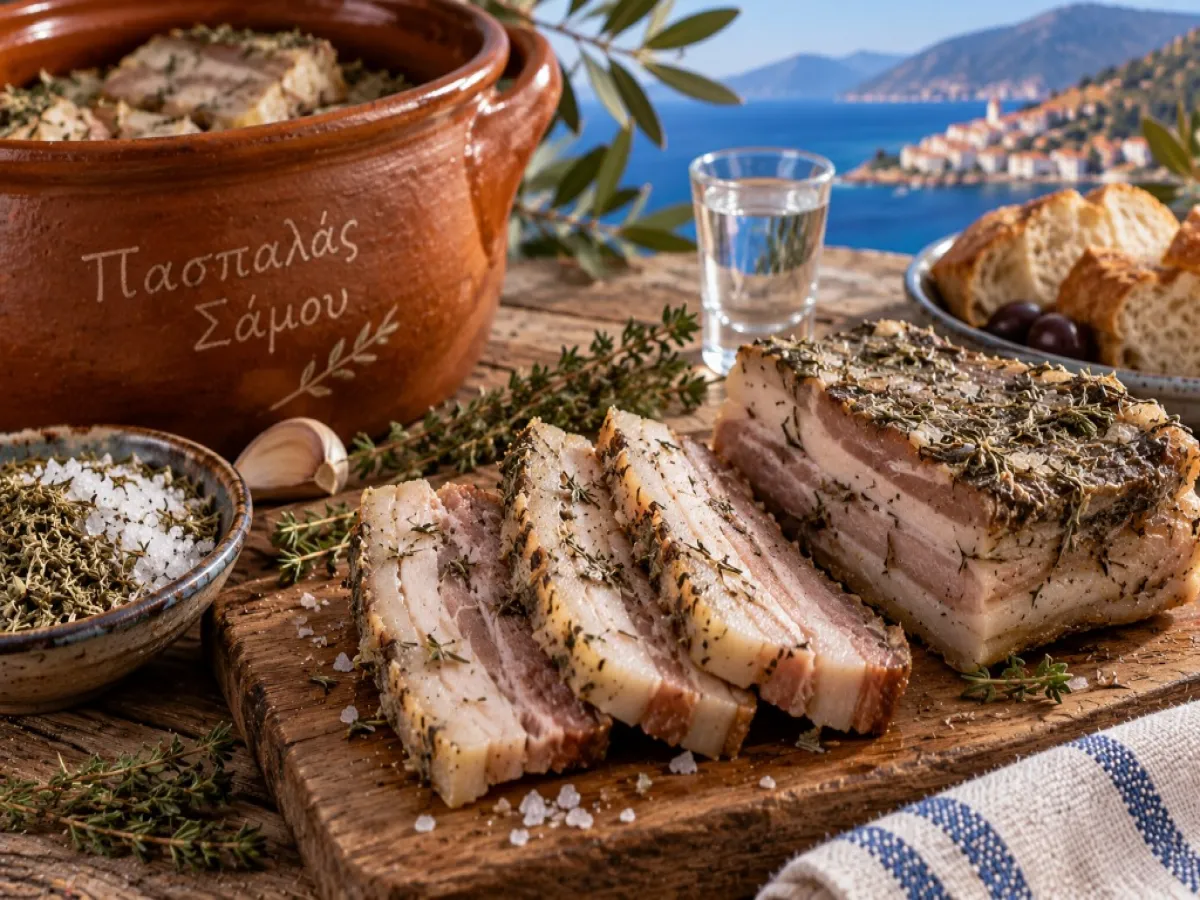
🥣 Ingredients
For a small home preparation
- 1.5 kg pork belly with plenty of natural fat
- Coarse sea salt, as needed
- 2–3 tbsp dried savory, or more to taste
- Rendered pork fat from the cooking, enough to cover
- A little water for the initial cooking
🌿 An old Samian flavour born from necessity
Paspalas is one of those traditional preparations that takes us back to a time when cooking was also a method of preserving food.
On Samos, it was traditionally made from the fatty part of the pig’s belly — what we would now call pork belly. The meat was slowly cooked, thoroughly drained and stored in layers with coarse salt and aromatic savory.
The idea was simple: after the traditional winter pig slaughter, the meat had to be preserved for as long as possible in an era without refrigerators or freezers.
For that reason, Paspalas was not originally just a meze. It was a practical way of keeping pork available in the household long after the festive season had passed.
🐷 Choosing the right cut of pork
Paspalas requires pork with a good amount of natural fat.
Pork belly is ideal because it contains alternating layers of meat and fat. During the slow cooking process, part of the fat renders out, leaving the meat tender and full of flavour.
In the past, there was no reason to look for a particularly lean cut. The fat was an essential part of both the flavour and the traditional preservation method.
👨🍳 Method
1. Cut the pork
Cut the pork belly into medium-sized pieces or thick strips.
Do not cut it too small, as the meat will lose some of its volume while cooking and rendering its fat.
2. Cook slowly
Place the pork in a heavy pot.
Add only a little water, just enough to start the cooking process, and cook over low heat.
As it cooks, the pork gradually softens and begins to release its own fat.
The traditional Samian method describes the pork belly being cooked for a considerable time until much of its fat is rendered, after which it is drained very thoroughly.
3. Drain very well
Once the meat is tender but still holds its shape, remove it from the pot.
Transfer it to a colander and allow it to drain thoroughly.
This is important: Paspalas should not retain unnecessary moisture.
Keep the clean rendered pork fat separately.
4. Mix the salt and savory
In a bowl, combine coarse sea salt with plenty of dried savory.
Savory is an essential part of the traditional Samian preparation, not merely an optional herb. Its strong Mediterranean aroma gives Paspalas much of its distinctive character.
5. Layer the Paspalas
Traditionally, the meat was stored in an earthenware pot.
Sprinkle a little of the salt and savory mixture over the bottom.
Add a layer of pork and sprinkle again with salt and savory.
Continue:
pork → salt and savory → pork → salt and savory
until all the meat has been used.
6. Cover with pork fat
In some traditional household versions, the meat was covered with rendered pork fat, creating an additional protective layer.
Gently warm the fat kept from the cooking process and strain it through a fine sieve.
Allow it to cool slightly, then pour it over the pork until the meat is covered.
As it cools, the fat solidifies.
🧂 Traditional preservation and the modern kitchen
There is an important distinction between the historical preservation technique and how the dish should be handled today.
In older Samian households, the earthenware pot was stored in a cool place and Paspalas served as a form of long-term meat preservation.
Today, however, there is no reason to reproduce room-temperature preservation methods.
Paspalas can still be prepared for its flavour and cultural value, but it should be kept refrigerated and treated as cooked pork.
This allows us to preserve the recipe — without preserving the food-safety risks of an era before refrigeration.
🔥 How Paspalas is eaten
Paspalas can be cut into smaller pieces and reheated in a frying pan.
Because it already contains a considerable amount of fat, additional oil is usually unnecessary.
The pork browns, the fat begins to melt again and the savory releases its aroma as soon as it warms.
It can be served:
- on its own as a meze,
- with eggs,
- with potatoes,
- alongside rustic bread,
- or in small quantities in other dishes to add flavour.
🥃 A meze for souma or wine
Paspalas needs no elaborate presentation.
A few pieces of warm pork, good bread and a glass of Samian souma or wine are perhaps the most natural way to enjoy it.
That is part of what makes it so interesting. It was not invented in a restaurant or designed as a “traditional gourmet dish”.
It was born in the household from the need to waste nothing from the pig and to preserve meat for the months that followed.


Add new comment