
Holy Monastery of Zoodochos Pigi – Ailiotissa, Samos
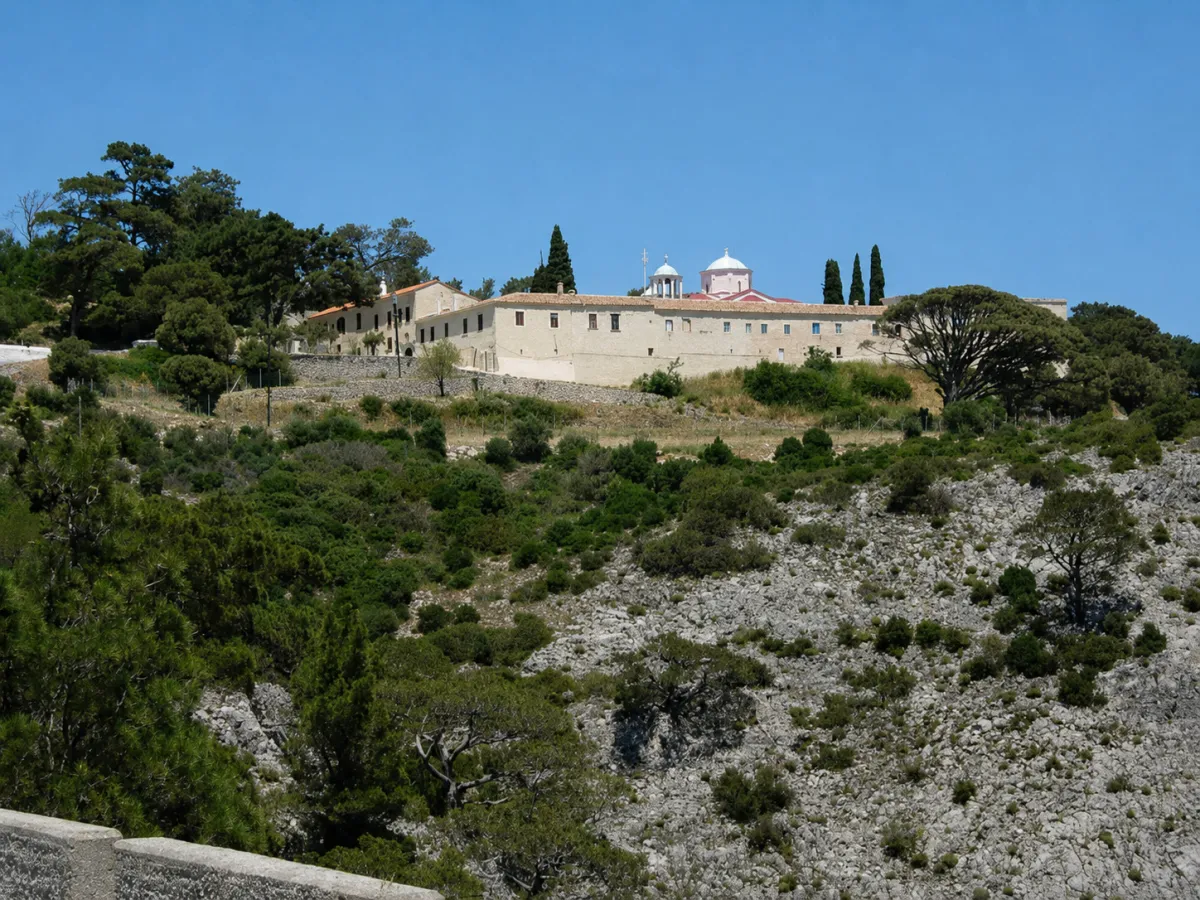
⛪ Holy Monastery of Zoodochos Pigi – Ailiotissa, Samos
The Holy Monastery of Zoodochos Pigi, also known as Ailiotissa, is located in eastern Samos, above the Vlamari area, in a green mountainous setting with panoramic views towards the Mycale Strait and the coast of Asia Minor.
Founded in 1756, it is one of the most important historic monasteries of Samos. It is a Patriarchal and Stavropegic Monastery, with a remarkable katholikon, an elaborate carved wooden iconostasis, old icons and important ecclesiastical treasures.
📍 Location
The monastery stands in a mountainous area east of Vlamari, on the slopes above the town of Samos, surrounded by pine-covered scenery.
Its elevation of approximately 320–400 metres provides open views across eastern Samos, the Mycale Strait and the opposite coast of Asia Minor.
The setting offers a strong sense of seclusion despite being relatively close to the town.
📜 The Foundation in 1756
The organised history of the monastery begins in October 1756.
A small church dedicated to Zoodochos Pigi, the Life-Giving Spring, already existed in the area, where the hieromonk Dorotheos settled.
With ecclesiastical permission, a cell, auxiliary buildings and the first organised monastic nucleus were gradually established.
The community expanded and the original small complex developed into an important monastery of eastern Samos.
⛰️ The Name Ailiotissa
The name Ailiotissa is associated with the area and with the presence of an old church or shrine dedicated to Prophet Elijah at a nearby higher location.
Over time, the name became established both for the monastery and the wider area, alongside its official dedication to Zoodochos Pigi.
🏛️ The Monastic Complex
The monastery has the characteristic form of an organised Aegean monastic complex.
Its two-storey wings are arranged around an inner courtyard and contain cells, hospitality areas and auxiliary facilities.
At the centre stands the katholikon, around which the liturgical and daily life of the monastery is organised.
⛪ The Katholikon of 1782
The present katholikon was completed on 18 May 1782 and is dedicated to Zoodochos Pigi.
It is an impressive domed church incorporating architectural elements associated with the Athonite monastic tradition.
The interior is organised around four columns, while the apses, narthex and central dome create a particularly imposing place of worship.
🏺 The Four Columns
The four marble columns of the katholikon are of particular interest.
An old tradition states that they were transported from the area of ancient Miletus, across the sea from Samos.
This tradition is accompanied by stories concerning their transportation by sea, which form part of the historical memory of the monastery.
🎨 The Old Frescoes
The katholikon once possessed extensive painted decoration.
Over the centuries, much of the original fresco work was lost or altered, although sections of old frescoes survive, particularly in the narthex and parts of the sanctuary.
The surviving paintings testify to the artistic care devoted to the church from the early period of its history.
🪵 The Carved Iconostasis of 1802
One of the monastery’s most important works of art is the impressive carved and gilded wooden iconostasis, dating from 1802.
Its construction is associated with the woodcarver Georgios Tantoglou and it is an outstanding example of ecclesiastical woodcarving from the beginning of the 19th century.
Its dense decorative work, plant motifs and icons make it one of the most striking features of the katholikon interior.
🖼️ The Icon of Zoodochos Pigi
The icon of Zoodochos Pigi occupies a central place in the devotional life of the monastery.
Its silver revetment dates from 1793 and is connected with a collective offering by residents of Mytilinioi.
The silverwork is associated with the craftsman Efstathios from Patmos.
The icon is one of the monastery’s most important objects of veneration and plays a central role in its annual feast.
🪵 The Icon Stand of 1810
The icon was placed in an elaborate carved wooden icon stand dating from 1810.
This work complements the important woodcarved decoration of the katholikon and is another example of the high quality of ecclesiastical craftsmanship associated with the monastery.
🖼️ The Great Deesis of 1819
Among the notable works connected with the monastery is the Great Deesis, dating from 1819.
The composition forms part of the monastery’s rich iconographic tradition and is an important element of its artistic heritage.
🚪 The Old Wooden Doors
The old wooden doors of the katholikon are also of particular interest.
According to monastic tradition, their intricate construction consists of a large number of small wooden pieces symbolically associated with the 365 days of the year.
Regardless of this symbolism, the doors remain a characteristic example of the detailed woodworking of their period.
🪨 Marble Floor and Architectural Details
The interior of the katholikon is complemented by a marble floor and various carved architectural elements.
At the outer entrance of the complex there is also a marble plaque dated 1833, depicting a church building and adding another notable feature to the monastery’s historic decoration.
📚 Ecclesiastical Treasures and Historic Property
During its long history, the monastery acquired ecclesiastical books, icons, liturgical objects, documents and other valuable treasures.
At the height of its prosperity, it also possessed significant property and was connected with chapels, country churches and monastic dependencies in eastern Samos as well as on the opposite coast of Asia Minor.
The extent of these connections reflects the important position the monastery once held in the religious and economic life of the region.
🏛️ Protected Historic Monument
The architectural and historical importance of the monastery has been recognised, and the complex is protected as a historic monument.
The katholikon, monastic buildings and surviving artistic elements form an important part of the post-Byzantine ecclesiastical heritage of Samos.
👩🦱 From a Male to a Female Monastery
For much of its history, Zoodochos Pigi functioned as a male monastery.
In the modern period, the character of the monastic community changed, and since 2002 it has officially operated as a female monastery.
Today it has an organised community of nuns and is one of the island’s most important active monastic communities.
🎨 Contemporary Monastic Activity
The present-day life of the monastery is not limited to daily services and the reception of pilgrims.
Traditional monastic activities are also practised by the community, including icon painting.
In this way, the monastery continues its long association with ecclesiastical art.
🙏 The Feast of Zoodochos Pigi
The monastery celebrates its main feast on Bright Friday, the first Friday after Orthodox Easter.
The date changes every year because it depends on the date of Easter.
The feast is the monastery’s most important annual religious celebration and attracts a large number of worshippers.
🕯️ Active Monastic Life
Ailiotissa remains an active female monastery with an organised community of nuns.
Daily services, feast days, the reception of pilgrims and monastic work keep the monastery active throughout the year.
Visitors therefore encounter a living place of monastic life rather than simply a historic monument.
🚗 Access
The monastery can be reached by road from the Vlamari area and the wider area of the town of Samos.
The road climbs through mountainous, pine-covered scenery and includes several bends.
No hiking is required to reach the monastery, although careful driving is advisable on the mountain road.
🕰️ Visiting
The monastery welcomes visitors during specific hours, which may vary depending on the season, religious services and the needs of the monastic community.
Visitors are expected to observe appropriate dress, quiet behaviour and respect for monastic life.
⭐ Why Visit the Monastery of Zoodochos Pigi – Ailiotissa?
Ailiotissa is one of the most important monastic sites in eastern Samos.
Its foundation in 1756, the katholikon of 1782, the carved iconostasis of 1802, the icon of Zoodochos Pigi with its silver revetment from 1793, the historic ecclesiastical treasures and the present-day community of nuns connect more than two and a half centuries of religious history.
Its impressive mountain setting and views towards the Aegean and the coast of Asia Minor add another dimension to the visit, creating a place where monastic tradition, ecclesiastical art, history and the natural landscape of Samos exist in harmony.


Add new comment