
Holy Monastery of Prophet Elijah – Karlovasi, Samos
⛪ Holy Monastery of Prophet Elijah – Karlovasi
The Holy Monastery of Prophet Elijah is located in the Megali Lakka area, southeast of Karlovasi, within a peaceful rural landscape of olive groves and low vegetation.
With a history beginning in 1625, it is one of the important post-Byzantine monasteries of western Samos. The architecture of the complex, the 18th-century katholikon, the carved iconostasis, the old icons and the ecclesiastical treasures reflect different phases of a history spanning approximately four centuries.
📍 Location
The monastery lies approximately 3 kilometres southeast of Karlovasi, at an elevation of around 150 metres.
It can be reached from the wider Karlovasi and Kontakaiika area, through the quiet countryside of western Samos.
Its relatively low elevation and road access make it quite different from the more isolated mountain monasteries of the island.
📜 The Beginning of the Monastery in 1625
A small church dedicated to Prophet Elijah already existed in the area before 1625.
The church belonged to Nikolaos Iakomou and was later transferred to Nea Moni of Chios.
The hieromonks Neophytos and Gregorios settled at the site, established cells and laid the foundations for an organised monastic presence.
In 1632, the relationship with Nea Moni of Chios was formally consolidated, and the monastic complex gradually developed around the earlier church.
🏛️ The Monastic Complex
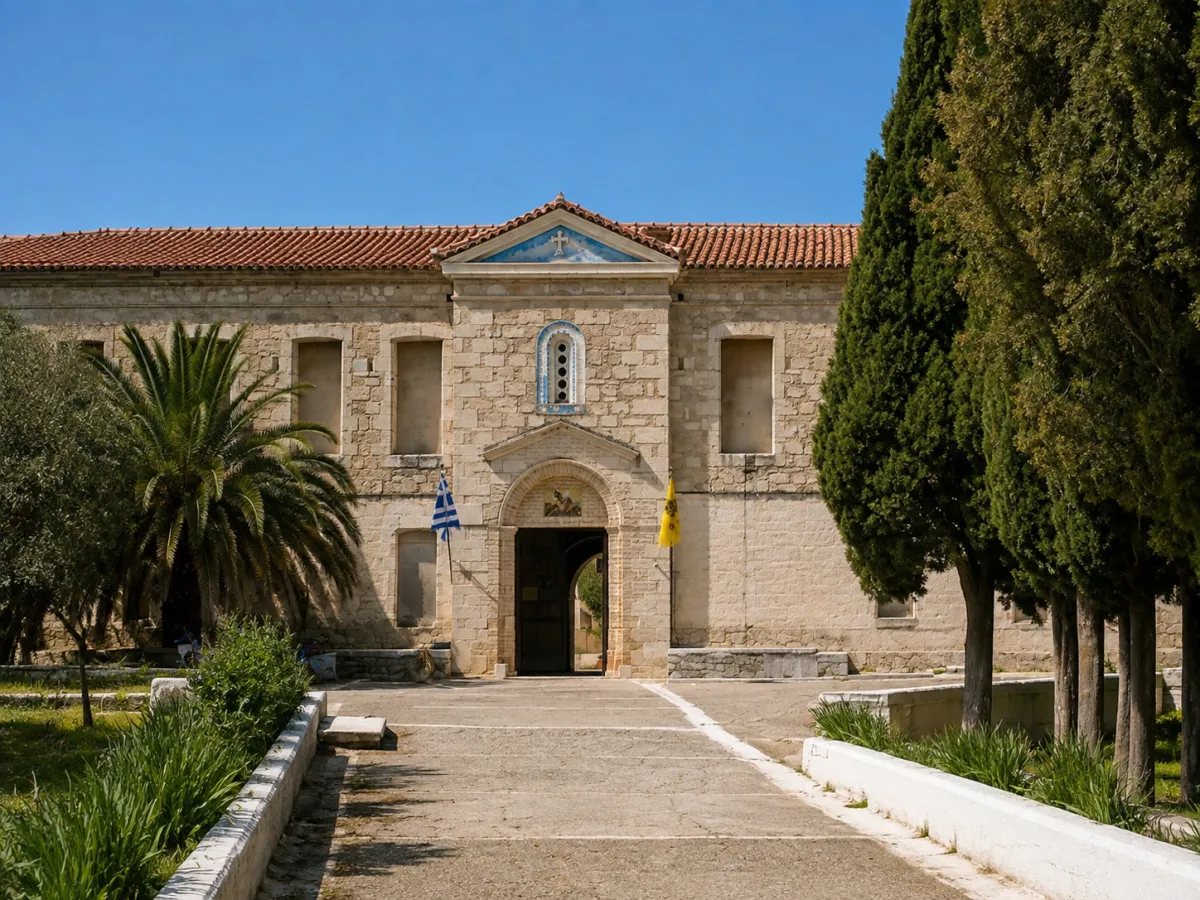
The monastery has an almost rectangular layout, with the monastic buildings arranged around an inner courtyard.
The wings are mainly two storeys high and contain cells and auxiliary spaces that served the needs of the monastic community.
The main entrance is located on the eastern side of the complex.
✝️ The Chapel above the Entrance
Above the main entrance is a small chapel dedicated to the Exaltation of the Holy Cross.
Its presence is a distinctive feature of the monastery’s architecture and provides a second place of worship in addition to the main katholikon.
⛪ The Katholikon of 1739
The present katholikon dates from 1739 and is dedicated to Prophet Elijah.
It is a vaulted church with a dome and forms the most important architectural element of the monastery.
The octagonal dome rises prominently above the main church and is one of the most distinctive exterior features of the complex.
🪵 The Carved Iconostasis of 1739
Of particular importance is the carved wooden iconostasis, also dating from 1739.
Its construction is associated with the craftsman Iakomis from Chios, together with Konstantinos and Manouil.
The iconostasis preserves the rich decorative tradition of post-Byzantine ecclesiastical woodcarving and is one of the most important artistic features of the katholikon.
🎨 The Frescoes of 1787
The interior of the katholikon once had extensive fresco decoration, much of which dates from 1787.
The complete original ensemble has not survived, but preserved inscriptions connect the decoration with the painter Ioannis from Samos.
The frescoes were created with the support of members and benefactors of the monastery, reflecting a period of economic and spiritual prosperity during the 18th century.
🖼️ The Icon of Prophet Elijah
A special place is held by the historic icon of Prophet Elijah.
Its silver revetment dates from 1804 and is one of the notable sacred objects associated with the liturgical history of the monastery.
The icon occupies a central place in the veneration of Prophet Elijah and is especially connected with the monastery’s annual feast.
🪨 The Marble Floor
The katholikon has a marble floor decorated with distinctive reliefs.
Among the motifs are the double-headed eagle, representations associated with Adam and Eve, and symbolic designs such as a skull and bones.
Old burials lie beneath parts of the floor and are probably connected with important figures in the history of the monastery.
📚 The Historic Library and Ecclesiastical Treasures
Over the centuries, the Monastery of Prophet Elijah acquired an important collection of old books, ecclesiastical documents, liturgical vessels and other sacred objects.
Among the oldest books associated with the monastery is a Bible edition dating from 1518.
The collection also included patriarchal documents, liturgical objects and reliquaries, reflecting the monastery’s long ecclesiastical history.
⛪ The Church of All Saints
Approximately 150 metres southwest of the monastery stands the Church of All Saints.
The church dates from 1632 and is directly connected with the early development of the monastery.
The surrounding area was also used as a cemetery, while traces of older monastic structures remain nearby.
🏺 Traces of Earlier Human Activity
Evidence of earlier human presence and the reuse of ancient building material has been identified in the area around the monastery.
Marble architectural fragments incorporated into later structures indicate that the site had a history predating the establishment of the present monastery.
Among the most unusual elements is a marble female head incorporated into part of the complex, although its original provenance cannot be determined with certainty.
🕯️ Four Centuries of Monastic Presence
From the 17th century onwards, the monastery passed through different periods of prosperity and difficulty.
Its connection with Nea Moni of Chios, the development of the monastic buildings, the construction of the katholikon and the accumulation of important sacred objects gradually shaped its distinctive identity.
Despite historical changes, Prophet Elijah retained its place as one of the significant monastic sites of western Samos.
🙏 Feast of Prophet Elijah
The monastery celebrates its main feast on 20 July, when the Orthodox Church honours Prophet Elijah.
The feast is the most important annual religious event of the monastery and attracts worshippers from the Karlovasi area and other parts of Samos.
🕯️ Active Monastic Life
The Monastery of Prophet Elijah remains an active male monastery and continues to maintain a religious and liturgical presence.
It is therefore not only a historic monastic monument, but also a living ecclesiastical site.
🚗 Access
The monastery can be reached by road from Karlovasi and the wider Kontakaiika area.
The route passes through rural countryside and does not require mountain hiking.
Access is relatively easy, although normal care is needed on the final sections of the local road.
🕰️ Visiting
The monastery can receive visitors, although access to all interior areas should not be assumed at every time of day.
For a more complete visit, prior arrangement is advisable, particularly for visitors who wish to see the interior of the katholikon.
Visitors are expected to wear appropriate clothing and respect the monastic environment.
⭐ Why Visit the Monastery of Prophet Elijah?
The Monastery of Prophet Elijah is one of the most important religious sites in the Karlovasi area.
Its history from 1625, the katholikon and iconostasis of 1739, the frescoes of 1787, the icon with its silver revetment from 1804, the marble floor and the historic ecclesiastical treasures create a monastic ensemble of particular interest.
A visit also offers the opportunity to discover a less widely known but highly significant part of the monastic and ecclesiastical history of western Samos.


Add new comment