
Holy Monastery of Agia Zoni – Vlamari, Samos
⛪ Holy Monastery of Agia Zoni – Vlamari, Samos
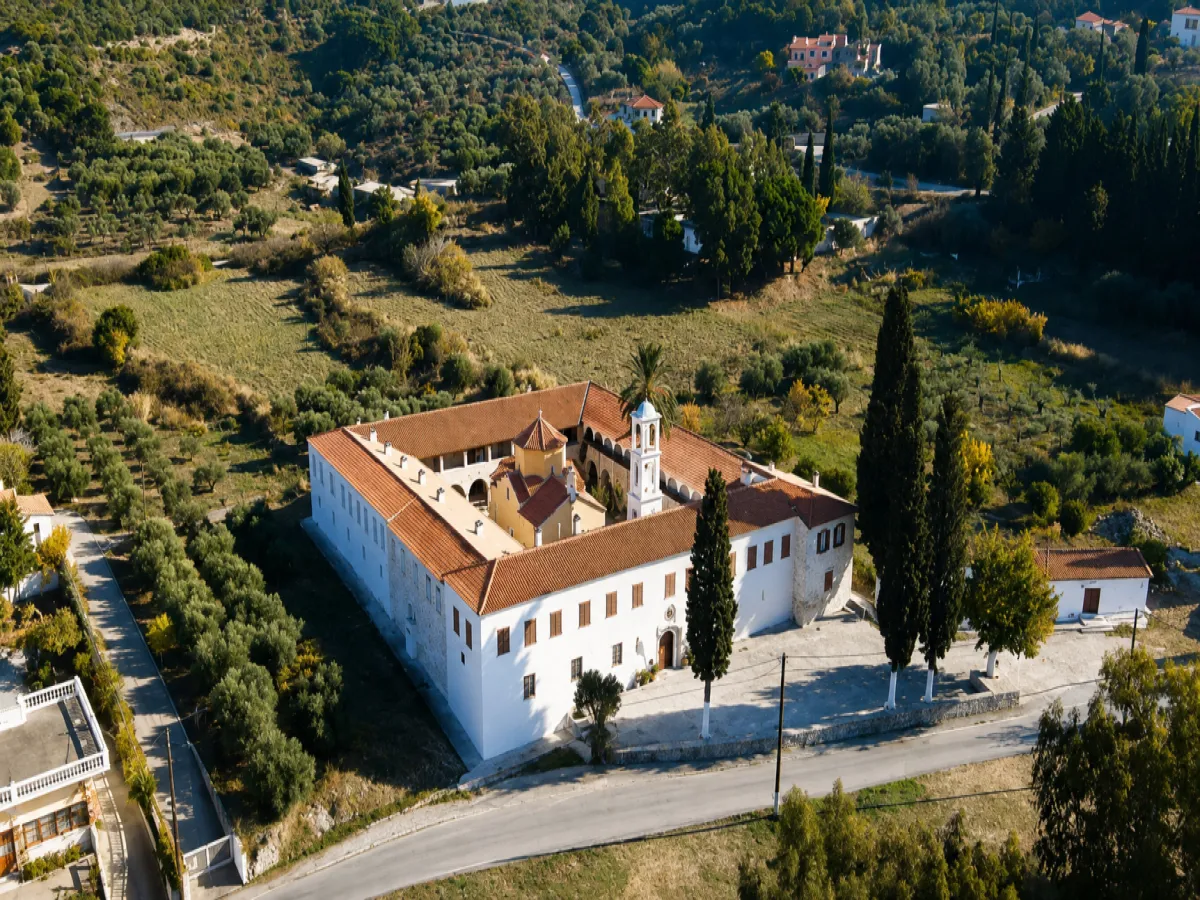
The Holy Monastery of Agia Zoni is located in the Vlamari valley, east of the town of Samos and near Palaiokastro, within a peaceful and lush landscape.
Founded in 1695, it is one of the most important post-Byzantine monasteries of eastern Samos. Its history, old frescoes, carved iconostasis, 18th-century bell tower and ecclesiastical treasures form a particularly significant monastic ensemble.
📍 Location
The monastery is situated in the fertile area of Vlamari, at a relatively low elevation of approximately 120 metres.
The surroundings are characterised by rich vegetation and cultivated land, while its short distance from the town of Samos makes it considerably easier to reach than many of the island’s mountain monasteries.
📜 The Foundation in 1695
The organised history of the monastery begins in 1695, when the hieromonk Meletios settled in the area and rebuilt an older ruined church.
Cells and the necessary buildings for an organised monastic community gradually developed around the church.
Soon afterwards, the monastery acquired particular ecclesiastical importance and became associated with the Patriarchal and Stavropegic tradition.
🏛️ The Monastic Complex
Agia Zoni has the characteristic enclosed form found in many historic monasteries of the Aegean.
The monastic buildings are arranged around an inner courtyard and include two-storey wings with cells and auxiliary spaces.
The layout creates a protected central area, with the katholikon forming the heart of the monastery’s religious and daily life.
⛪ The Katholikon
The katholikon is dedicated to the Deposition of the Holy Belt of the Virgin Mary.
It is a single-aisled vaulted church with a dome, characteristic of the post-Byzantine ecclesiastical architecture of Samos.
The octagonal dome is one of the most distinctive exterior features of the church, while the interior is complemented by a marble floor, old icons and rich carved wooden decoration.
🎨 The 17th-Century Frescoes
The interior of the katholikon preserves frescoes from the late 17th century, dating from the early period of the monastery.
Although time and later interventions have affected parts of the original painted decoration, the surviving elements remain an important example of the post-Byzantine painting tradition of the island.
🪵 The Carved Iconostasis of 1801
One of the most important artistic features of the katholikon is the carved and gilded wooden iconostasis, dating from 1801.
Its creation is associated with the period of Abbot Gavriil and it represents an important work of ecclesiastical woodcarving.
Its rich decoration and icons create one of the most characteristic features of the monastery’s interior.
🔔 The Bell Tower of 1751
Of particular interest is the marble bell tower, built in 1751.
Its construction took place during the abbacy of Merkourios and it is one of the oldest and most distinctive architectural elements of the complex.
Inscriptions at the western entrance of the monastery are also connected with later building works carried out during the 19th century.
🖼️ The Icon of Agia Zoni
A special place in the devotional life of the monastery is held by the icon associated with the Holy Belt of the Virgin Mary.
Its silver revetment dates from 1819 and is an important example of ecclesiastical silverwork.
The icon has a central role during the monastery’s annual feast and is an object of particular devotion.
✝️ Sacred Relic of the Holy Belt
The monastery preserves a sacred relic associated with the Holy Belt of the Virgin Mary.
The relic is one of the monastery’s most important pilgrimage elements and is closely connected with its dedication and annual feast.
On special religious occasions, it is carried in ceremonial procession.
📚 Ecclesiastical Treasures and Historical Archive
Over the centuries, the monastery accumulated old books, ecclesiastical documents, liturgical vessels, icons and other sacred objects.
These treasures provide important evidence of the religious, economic and social life of the monastery and of its place in the history of eastern Samos.
🇬🇷 The Monastery and the Modern History of Samos
Agia Zoni is connected not only with the religious history of the island.
During the turbulent periods of the 19th and early 20th centuries, the monastery became associated with important events in Samian history.
In particular, in 1912, during the events that led to the liberation of Samos and its subsequent union with Greece, the area around the monastery was connected with the activity of Samian fighters.
Agia Zoni therefore represents both a religious site and a place associated with the island’s modern historical development.
🏛️ Historic and Protected Monument
The architectural and historical importance of the monastery has been officially recognised, and the complex is protected as a historic monument.
The protection extends not only to the buildings but also to their immediate surroundings, helping preserve the historical and architectural character of the monastic site.
🙏 The Feast of Agia Zoni
The monastery celebrates its main feast on 31 August, when the Orthodox Church commemorates the Deposition of the Holy Belt of the Most Holy Virgin Mary.
The feast is the monastery’s most important annual religious event and attracts worshippers from different parts of Samos.
🕯️ Active Monastic Life
Agia Zoni remains an active male monastery and continues its monastic and liturgical presence.
Its continuing religious life gives the site particular importance, as visitors encounter not only a historic monument but also a living place of Orthodox monastic tradition.
🚗 Access
The monastery is accessible by road from the areas of Vlamari, Palaiokastro and the town of Samos.
The journey does not require mountain hiking, and the relatively short distance from the town makes it an easy destination to reach.
🕰️ Visiting
The monastery welcomes visitors during specific hours.
Visiting times may vary depending on the season, religious services and the needs of the monastic community, so it is advisable to confirm them before visiting.
Visitors are expected to observe appropriate dress, quiet behaviour and respect for monastic life.
⭐ Why Visit Agia Zoni Monastery?
Agia Zoni is one of the most important religious sites in eastern Samos.
Its foundation in 1695, the 17th-century frescoes, the marble bell tower of 1751, the carved iconostasis of 1801, the icon with its silver revetment from 1819 and the historic ecclesiastical treasures create a monastic ensemble of considerable artistic and historical value.
At the same time, its connection with important moments in modern Samian history and its continuing monastic life make the monastery a place where faith, art and the history of Samos come together as a single experience.


Add new comment