
Mytilinioi in Samos – Municipal Community and Agricultural Center

Mytilinioi is located in the center of the island of Samos, on the eastern foothills of Mount Karvounis (also known as Ambelos), at the western edge of the valley of the same name, while its altitude is 120 meters. The village is built in such a way that the sea is not visible. This indicates that it may have been built at this location due to fear of the pirates that existed in the past.
🌾 Agricultural Role & Landscape
Mytilinioi was the first agricultural center of Samos. It is one of the largest villages of Samos in terms of population and production of high-quality and selected products. The wider area of Mytilinioi begins outside Kokkari and reaches close to Pythagoreio. The village is built amphitheatrically on three hills and in the middle of the lush and very fertile valley of Chisio (a large stream), and it overlooks a small part of Eptastadio and the high ridge of Mykali.
🚜 Local Economy
The residents of the village are mainly farmers. The main products they produce are olive oil, wine, fruits and vegetables. They also produce livestock and poultry products mainly to cover their own needs. In the past, they cultivated tobacco and cereals.
🚗 Distances
The village is located 7 km from the town of Pythagoreio, 13 km from the town of Samos, 35 km from the town of Karlovasi and 33 km from Marathokampos.
History
The name of the village

History says that at some point the island of Samos had almost been deserted due to the continuous pirate attacks. Its inhabitants were forced to scatter to the surrounding islands such as Chios, Mytilene, etc. After an invitation by Kilic Pasha, people from Mytilene arrived in Samos, and thanks to the sympathy he had for them, he allowed them to choose the place where they would build their village.
They chose the area where the village of Mytilinioi is still located today, and as it turned out, they made a very good choice, since it is a beautiful place with fertile soil, abundant water and rich vegetation.
These characteristics, combined with the sense of honor, intelligence and hard work of its inhabitants, resulted in great development and prosperity. It is worth noting that Mytilinioi was once a small town.
In 1886 the village had 992 houses, six parishes and almost 3,500 inhabitants. There are many views regarding the origin of the village’s name.
According to Ep. Stamatiadis, as he mentions in “Samiaka”, the village was named Mytilinioi because the first inhabitants who settled there originated from Mytilene on the island of Lesvos. Father Apostolakis Andreas, in his book, states that the first settlers of the village possessed many virtues. They were intelligent, hardworking and honorable.
The entrances to the village
The village of Mytilinioi has two main entrances, both of which lead to the central road of the village. At one entrance ends the road coming from the area of Chora. Starting the route from Chora towards Mytilinioi, one passes over the impressive bridge of Chora.
It is a work from the period of the governorship of Pavlos Mousouros (1866) and although this governor does not belong to the category of the good rulers of the area, he has many important road projects to his credit, among which is this road. It is worth mentioning that the view along the entire route is very beautiful.
At the second entrance ends the road coming from Vathy of Samos, where just before entering the village we encounter the well-known bridge of Mytilinioi, which was built about 150 years ago. On the central road of the village, we find the famous Aegean Natural History Museum – Mytilinioi Paleontological Museum, as well as the Mytilinioi Primary School, where the renowned “Efthymiada School” once operated.
A few meters further down follows Karakostas Square with the large marble War Memorial, where a hoplite can be seen giving water from his canteen to an injured fellow soldier. There is also the main square of the village with the two large plane trees that offer shade during the summer months to both locals and visitors. In the main square of the village there are cafés, restaurants and grill houses, while on the central road there are many shops that serve both residents and visitors.
The Bridge of Mytilinioi

The bridge of Mytilinioi was built about 150 years ago and was a very large project for its time. Everything began in January 1870 with the general assembly of the representatives of the Principality, under the presidency of the then ruler Pavlos Mousouros, who for the first time presented his technical program concerning the construction of carriage roads and bridges, which until then did not exist.
The transportation of people and products was carried out with animals, through paths or even cobbled roads, from the villages to the ports of Vathy and Pythagoreio in the east and Karlovasi and Marathokampos in the west.
The technical program referred to the construction of the road Vathy – Mytilinioi – Chora and Pythagoreio, and of two bridges, one of which was over the torrent of Mytilinioi, called Yvetos in antiquity. However, the proposal of the ruler did not receive a warm reception. People could not imagine the development of technology and civilization, and there were also the muleteers who feared they would lose their jobs. The cost of the project was very high.
The money was not sufficient, so the Sultan gave an order that for this specific project 100,000 grosia from the tax revenues would be given each year for three years, that is a total of 300,000, as well as the entire road tax, which amounted to 160,000 grosia each year for the same period.
The bridge over the torrent of Mytilinioi began in March 1870 and was completed within the same year. The road was completed in 1872. The cost of the road of Mytilinioi was 50,000 grosia per kilometer and the bridge cost 230,000 grosia. It must be emphasized that the bridge of Mytilinioi is the first that was built, the largest, and also a masterpiece of architecture in the whole of Samos. Even the cast iron railings that were installed were brought from England.
The Polish architect Surtolefski also built the other bridges of Samos, but in this one he had the opportunity, also because of its size, to create a unique work that everyone admired at the time and that even today impresses with its imposing presence.
Unfortunately, for many years this bridge was a recipient of rubbish and rubble. However, in recent years, thanks to the efforts of the village president and the local community, it was decided that this important work should be highlighted and promoted as befits an important monument of architecture and of our cultural heritage.
The bridge was cleaned, stone steps were constructed that allow you to go down to the riverbanks, information signs were placed for visitors of the village, and it was fully illuminated, presenting a fantastic sight during the night hours.
Efthymiada School

On the central road of the village, the imposing building that houses the First Primary School of Mytilinioi stands out. In this building operated the famous “Efthymiada School”, a model for its time of the mutual teaching school system. The history of this school is impressive:
In 1828, by decision of the Extraordinary Commissioner of the Eastern Sporades, Mr. Ioannis Kolettis, a mutual teaching school was founded at this site, where important teachers taught, such as M. Tzesmelis, the very learned Germanos, Chatzidamaskinos and many others.
In 1837–38, in addition to the mutual teaching school, where Ioannis Andreadis was the teacher, a Greek school also operated with teacher Grigorios Konstantas.
From 1843, at the Greek school, apart from the common subjects, practical knowledge was also taught for the cultivation of vineyards, winemaking and olive growing.
From 1888, in order to enroll in the first class of the Greek school, one had to hold a certificate of completion of full Primary School.
In 1848 begins the history of the Efthymiada School. The hierodeacon of the village, Efthymios Kalymnios, who had emigrated to Moldavia, left in his will half of his fortune to the Greek school of Mytilinioi, with the purpose of building a modern for its time school building.
At the end of the 1880s, the wish of Efthymios Kalymnios was fulfilled and the construction of the present school building began. The cost of construction and equipment amounted to 148,768 grosia and was covered by the will of Hierodeacon Efthymios, by the Port Fund of Pythagoreio and by the Principality of that time.
On September 19, 1893, with the start of the lessons, the inauguration of the new school building also took place, and to honor their benefactor, the school was renamed “Efthymiada School”. In the following years, the “Efthymiada” was enriched with books and educational material from various donors and became, for its time, a model school.
Today, this building houses the First Primary School of Mytilinioi, which has seven classes and the capacity to host from 151 up to 175 children. The earthquake of October 30, 2020 also affected this imposing building. Its first floor has been secured by special crews and repairs were expected to begin in the summer of 2021 after the end of the school year.
The history of water in Mytilinioi
The village of Mytilinioi is built on an aquifer and the water is close to the surface. From time to time, water has been supplied to the village from three large springs of the area, “Kazania”, “Kontaxi” and “Roggia”. There is an artificial reservoir and a complete internal water supply network, and the water reaches the houses.
The great drought that affected the island of Samos from 1967 until 1972 brought severe water shortage to the village of Mytilinioi, with the result that some springs dried up completely. The residents were in despair. The solution to the problem of water shortage was given by an inexhaustible well located inside the village.
With very fast procedures, the Village Community bought the well from its owner and organized the pumping and transfer of the water to the aqueduct. In order to avoid reckless waste of water, it divided the village into three water supply sectors, to which it supplied water in turns.
Later, again through actions of the Community, a new borehole was found in the area of Mesokampos, which helped improve the situation. Today, there is no problem with the water supply of the village. After works that were completed recently, the old internal water supply network was replaced with a new one.
There is also regular inspection and cleaning of the reservoir so that the quality of the water remains at the desired levels.
The history of the economy of Mytilinioi
During the past centuries, there were two important crops that supported the economy of the village and contributed to its development: viticulture and tobacco cultivation. Viticulture, as an economic resource for the inhabitants of Mytilinioi, lasted until the end of the 19th century.
In 1870, the insect phylloxera appeared in France and destroyed millions of acres of French vineyards. This led to an increase in demand for Samian wines, which reached record sales and prices in 1880, as well as a record number of ferry connections to the island.
In 1888, however, phylloxera also appeared in Samos, leading to the destruction of the vineyards and driving thousands of Samians into despair.
Faced with this situation, the farmers of Mytilinioi also found themselves in a very difficult position. In order to meet the needs of their families, many began to go to the opposite mainland, to the coasts of Asia Minor and also inland, where many Greeks lived and worked for Turkish Beys or Aghas. Many also worked in tobacco, where tobacco cultivation was developed.
There the idea began that they could start cultivating tobacco in Samos as well. This idea gradually spread to Mytilinioi too, and one after another began cultivating tobacco in the village. Adapting to the new crop was difficult.
The residents of the village had to adjust to the new conditions. Although this new crop gradually began to cover the family needs of the villagers, it was very tiring and demanding and required work almost throughout the entire year. At the beginning of the new cultivation, when the fields were rested, the yield was very good, as was the purchase price of the tobacco.
The inhabitants made use of all the natural resources of the village in order to produce good quality tobacco. From animal manure to various plants, wood, stones, etc. During the sowing of the seeds, almost the entire family was mobilized in order for the work to be done quickly and properly. The selling price of tobacco was not always high.
Companies were lying in wait and gathering information in order to buy at the lowest possible price. On November 25, 1929, the market opened and the first tobacco was sold at quite a good price, but in the following years, with the economic crisis that broke out in America and spread to Europe, the results were disastrous for tobacco producers.
From 1934 onwards the situation began to improve, but the war and the occupation forced the villagers to stop tobacco cultivation. In order to survive, they began to sow wheat and other cereals in all their fields. After liberation, tobacco cultivation started again but not at the same pace. After the end of the civil war, internal migration began and many started to leave the village.
During the decade 1950–1960, many young people left abroad and the village began to empty. In the following years, very few Mytilinioi residents cultivated tobacco, until in 1985 tobacco cultivation in the village came to an end. It is worth noting that Mytilinioi were first in tobacco production in all of Samos, reaching 1,300 tons per year. This economic upgrading of the village led to its development and to the construction of new houses, churches, etc.
Aegean Natural History Museum – Paleontological Museum, K & M Zimalis Foundation
K & M Zimalis Foundation
In 1992, with a donation from the couple Konstantinos & Maria Zimalis, the foundation bearing their name was established. The main purpose of the foundation was the creation of a modern Natural History Museum which would house and take care of the paleontological findings of the wider area of Mytilinioi in Samos and would also continue excavations for the discovery of more fossils. The foundation also aims to research and promote internationally the remarkable natural wealth of Samos as well as of the wider Aegean region. Another goal of the foundation is to support young scientists who are involved in environmental protection.
Aegean Natural History Museum – Paleontological Museum

The Aegean Natural History Museum – Paleontological Museum is located on the central road of Mytilinioi. The buildings cover an indoor area of 1,600 sq.m. on three levels (laboratories, exhibition halls, library, offices). The surrounding area is about 20 acres. At its entrance there is a bronze statue of the ancient Samian astronomer Aristarchus, while within the Museum’s grounds there is a small chapel dedicated to Saints Constantine and Helen.
The Museum is a member of the International Council of Museums (I.C.O.M.). Its modern facilities were completed in 1994, when the official inauguration also took place.
The functions of the Museum are divided into three sectors:
Research and Environment
Exhibition
Education
The Museum cooperates with several Universities for the realization of its purposes, as well as with other institutions and museums in Greece and abroad.
The exhibition area of the Museum attracts the interest of its visitors due to its many and impressive exhibits and consists of five sections:
Paleontology
Minerals and Rocks
Marine Life
Herbs
Zoology
All the above sections are supported by the corresponding laboratories. The Museum’s collections are constantly enriched and include a large number of findings from excavations funded by the foundation, many kinds of minerals and rocks, shells, birds, mammals and reptiles, as well as a large number of herbs in the form of a Herbarium.
In the exhibition area of the Museum there is also the famous “Kaplani of the display case”. It is a wild animal that had greatly affected the agricultural population of Samos when it appeared on the island.
This wild animal, the kaplani or the “most savage leopard”, is believed to have fled from Asia Minor to Samos while being hunted. It appeared on the island in 1856 and was exterminated in 1862. Testimonies of the time report that it was a fierce and unstoppable animal with incredible speed.
Its extermination took place when a group of armed Samians managed to drive it and trap it in a cave. In 1870 another kaplani appeared again in Samos, without however affecting the agricultural population of the island as the previous one had. Since then, no similar animal has appeared in Samos.
Visitors can tour the Museum areas for a symbolic fee, while it is worth noting that for the residents of the village, entrance is free of charge.
Paleontological excavations
The area of Mytilinioi in Samos was known for its fossil-bearing sites to the international scientific community since the middle of the previous century. The ancient Greeks were also aware of the existence of fossilized bones, but they could not explain their true origin and therefore created various myths.
The animals whose fossils were found in the area came to the island at the time when it was connected with Asia Minor as well as with the rest of Greece.
The paleontological findings are impressive. Some scientists believe that many of these animals were carried away by major floods that formed torrents. The presence of fossilized bones inside volcanic tuff proves that there was intense volcanic activity on the island.
In 1963, the University of Thessaloniki professor Ioannis Melentis carried out excavations in the area of Adrianos, which is located near Mytilinioi, and discovered a large number of fossilized bones, which were initially exhibited in a hall of the Community Office of Mytilinioi.
In 1994 they were transferred to the Aegean Natural History Museum – Paleontological Museum of Mytilinioi, which undertook their preservation and enrichment with new findings.
The churches of the village
In Mytilinioi there are many churches and chapels which reveal the great development that the village had in the past as well as the strong religious feeling of its inhabitants. The first five churches are parish churches. Also, near the village of Mytilinioi is the Monastery of the Holy Trinity.
Panagia
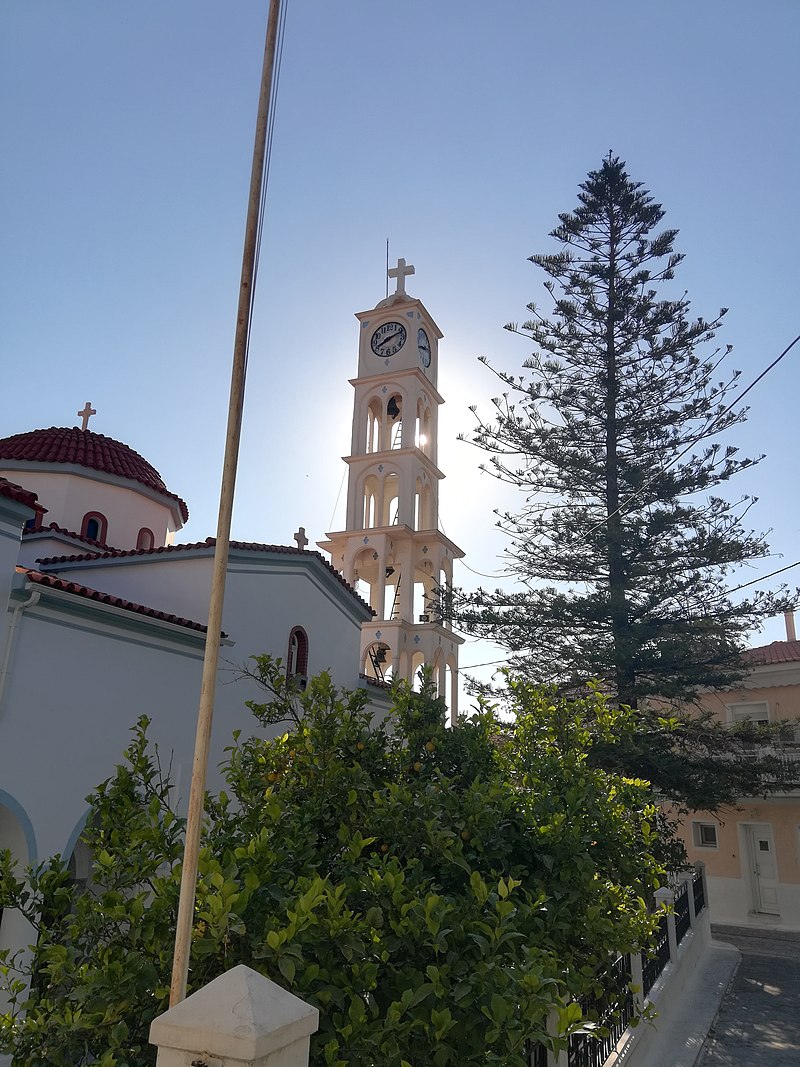
The Church of Panagia with the well-known clock
The Church of Panagia is located near the central square of the village and after works that took place in 1971 it became a three-aisled church. With these works, a new imposing bell tower was also added, which can be seen even from a great distance due to its great height.
The real jewel of this church, however, is the large clock that is located above the bell tower and strikes at specific hours of the day. The interior decoration of the church is rich, with a finely carved wooden iconostasis of excellent craftsmanship.
It has old and remarkable icons such as those of the Three Hierarchs (1674), Saint John the Theologian (1750) and Saint Charalambos (1750). The earthquake that struck the island of Samos on October 30, 2020 caused minor damage to the church, which was repaired immediately.
Agios Antonios
The Church of Saint Anthony is located at the highest point of the village, which is why it can be seen from a great distance. It is the largest church of Mytilinioi in terms of space. It is old but has been renovated recently. The icon of Saint Anthony is of classical style.
The decoration of the church is tasteful and modest, giving a sense of reverence. In the Church of Saint Anthony, sacred books of old editions (1689) are preserved. The recent earthquake caused serious damage to the church, which has not yet been repaired, and for this reason it is temporarily not accessible to the faithful.
Agios Dimitrios
The Church of Saint Dimitrios is two-aisled, with very beautiful decoration and many icons of post-Byzantine style. Among the many icons it has, the one of Zoodochos Pigi (Life-Giving Spring) dated 1720 stands out. This church also has a beautiful and large courtyard.
Agia Matrona

The Church of Saint Matrona is located near the central square of the village. It is also called “Christ of Glistra” because its second aisle is dedicated to the Nativity of Christ.
It has excellent icons, among which those of Saint Matrona and Saint Charalambos stand out. It is a small church but has impressive decoration, especially in its first aisle with its five impressive chandeliers. Also noteworthy is the mosaic located in the courtyard of the church.
The strong earthquake of October 30, 2020 destroyed the marble cross that was located on top of the church’s bell tower.
Agios Nikolaos
Saint Nicholas is the smallest but also the oldest church of Mytilinioi and has wall paintings of great value due to their age.
Church of the Nativity of Christ
This church is located in the central square of the village and is also called the Church of the Fountain. This church is a pilgrimage church, meaning that services are held only for vows, baptisms, weddings, etc. Unfortunately, it suffered major damage from the recent earthquake and the residents of the village are awaiting restoration works.
The Nativity of the Virgin Mary
It is a small church located on the northwestern side of the village and belongs to the large Cypriot Monastery of Kykkos.
Annunciation of the Virgin Mary
This church is administered by the Patriarchate of Jerusalem and is a dependency of it. The residents of the village know this church as “Vangelistra”.
Cultural and Sports Associations
The residents of Mytilinioi have an active presence in the community life of the village and have founded several associations with the aim of promoting and preserving the cultural and historical values of their place.
Cultural Association of Mytilinioi of Samos Worldwide
This cultural association was founded by residents of the Attica basin who originate from Mytilinioi, with the aim of strengthening and preserving customs and traditions, reviving festivals for entertainment purposes, as well as promoting mutual assistance among friends.
It publishes the newspaper “Our Roots”, where the news and events of the village are recorded. In 2008, the president and the members of the Association’s Board, in their effort to preserve the history of Mytilinioi, decided to publish a photographed collectible album which contains rare photographic material from the village.
Cultural and Educational Association of Mytilinioi of Samos
This is the association that strengthens the cultural tradition of the village and includes:
– Dance Sections
– Gymnastics Sections
– Choir Sections
The Cultural and Educational Association of Mytilinioi of Samos is housed in the building of the Youth and Friendship Center (KENEF).
The village Philharmonic Band also belongs to this association. In a specially designed area on the first floor of KENEF, the young people of the village learn and are taught music by older and more experienced musicians, thus ensuring the continuity of the Philharmonic. In all major celebrations and events of the village, the Philharmonic Band is present, beautifying the village with its beautiful melodies. During the Christmas period, the Philharmonic first tours the entire village and then the nearby villages, playing carols and other festive melodies.
Cultural Center of Mytilinioi of Samos
On the central road of the village is located the Cultural Center of Mytilinioi. In the past it housed the Second Primary School, while much earlier it functioned as a Girls’ School.
It operated as a school until the early 1980s. From 1983 to 1992 it hosted the Cultural and Educational Association of Mytilinioi with its philharmonic band, dance groups and many other activities (painting exhibitions, folklore material exhibition–museum, exhibitions of woven textiles, copper engraving, marble carving, various games, table tennis, etc.). It was renovated during the presidency of Polykratis Konstantinidis and was officially delivered as a legal entity – Cultural Center in 1998. Since then, various events have been organized in its premises by local organizations. Under the “pediment” of the main entrance, there is a built-in round marble plaque with a relief depiction.
AES Phoenix of Mytilinioi

AES Phoenix of Mytilinioi was founded in 1973 and has competed both in the First and in the Second Division of the Samos Prefecture Championship. It uses as its home ground the Mytilinioi Stadium “Vasileios Kalymnios”. The official colors of AES Phoenix are Bordeaux and Blue.
The Phoenix Mytilinioi team has its own Academy where children from the age of 4 can participate. In the 2017–2018 season, the Phoenix team was declared champion in the Second Division of the local championship.
Many professionals as well as ordinary citizens contribute and support the efforts of the local team, which also participates in and often organizes the famous “pancake festival”.
Volunteering
Volunteer Firefighting Unit of Mytilinioi of Samos

Due to the location of the village and the dense vegetation that surrounds it, the residents of Mytilinioi, realizing the need to protect their village, created many years ago a volunteer firefighting unit. Most of the young people of the village become active members of this volunteer unit and every summer they are on 24-hour alert in order to immediately protect the village when a fire breaks out.
During the winter, when there is no risk of fires, the volunteer firefighters of the village maintain the vehicles and all the equipment they have, in order to be ready for the next summer.
It is worth noting that the unit has its own premises, which have been granted to them free of charge, and include an office with all the necessary communication equipment, a closed storage area where all the firefighting equipment is kept, as well as a large parking area where the firefighting vehicles are parked.
The contribution of the volunteer firefighters to the village of Mytilinioi and to the whole island of Samos is very great. Apart from their enormous contribution to firefighting, they help with cleaning the roads and squares of the village, rescuing people and animals, cutting trees and branches, as well as opening paths.
It is also worth mentioning that the volunteer firefighters of the village, as well as all volunteer firefighters of the island, are often trained by the Fire Service and are preferred in the recruitment announcements of the Fire Brigade due to the specialization and great experience they have.
Mytilinioi today
The earthquake that struck the island of Samos in October 2020 did not cause major damage to the village of Mytilinioi. There were minor material damages to houses, shops and churches. The greatest damage was suffered by the Church of Saint Anthony, which remains closed to this day, as well as the first floor of the Primary School, which has been temporarily secured to prevent falling building materials.
Most of the damages have been repaired, while the demolition of some very old houses is still pending.
Mytilinioi is a lively village with active residents. Many are engaged in agricultural work, while there are all kinds of commercial businesses operating in the village, covering all the needs of the residents. The population has decreased significantly compared to previous years. There is also reduced involvement, especially among young people, in agricultural activities.
Most of the young people of the village study outside the island and some choose to live in large cities. Finally, there is evident concern among the residents of Mytilinioi about the migrant hosting facility under construction in the Zervou area, just outside the village.


Add new comment